Thursday, August 30, 2007

Fit One, Page Six, Panel One


The last of the crew needs especial remark,
Though he looked an incredible dunce:

He had just one idea — but, that one being "Snark,"

The good Bellman engaged him at once.


It's a fair cop, guv'nor! The Bellman, assisted by the Fellowship of the Snark, brandishes his clochetic truncheon at this wallah's stoney noggin. Note further, my dear Watson, that a close reading of the text with a fine-toothed comb and well-knitted brow elicits the following facts:

Given …
The duncedness of this otherwise un-named crewmember is literally not-to-be-believed, a statement which itself is not-to-be-believed since it has not been repeated the requisite three times.
Given …
The sole internal property of this non-nonbelievable dunce is Snark.
From which …
The total epistemology of a dunce is a snark.
And therefore …
To possess a dunce is to possess a ready-made Platonic Ideal of a Snark — and in a very handy demi-godlike package too!
And therefore…
This dunce is no dunce, eh? QED!

So, our dunce is an imposter disguising himself as an Easter Island moia with an uncanny penchant for resembling the notorious French confidence-picturist and double-crosser, Eugène Delacroix! After some rough handling and quick bell-work, the so-called Eugène made the following (internal, hence epistemologically dunciad) statement:

"… one should not be too difficult. An artist should not treat himself like an enemy. Experience ought to teach us two things: first, that we should do a great deal of correcting, secondly, that we must not correct too much."

Proof positive and bob's your uncle! This man's an absolute diabolical numbskull, cunningly fitted out with all the French Polynesian deviltry necessary to hold two simultaneously opposing thoughts at once — the very conditions necessary for a Snark to flourish inside the old brain pan! Pseudo-neoplatonic skullduggery with alarming whiffs of a faux-phrenological sub-gnostic epistemological thing-um-a-jiggery — some sort of game's afoot! I could have had a job with NASA but I'm sticking it out with this snark business, I'm a brainworker!

Thursday, August 23, 2007

Fit the First, Page Four and Five as a Spread (The Meaning of the Snark!)


Meaning, meaning, meaning, nor any drop to think! Bad punnery must be excused, for The Meaning Of It All is a weighty burden for any one to bear, much less an impecunious artist wrestling with the eternal question of Snarkology. 42 will still have to do for now.

In the meanwhile, feast your eyes on this page spread and despair! It's all turned out rather nicely, the textures, the page flow, the surreal imagery redolent of nothing in particular, just the idle reveries of the middle-aged snarquiste confronted with a dwindling bank account, a paltry client list and an unrequited obsession with late-Victorian, proto-surrealist nonsense poetry.

As part of my on-going program of conducting imaginary conversations with imaginary readers, I offer the following remarks concerning the pen-and-inkery jiggery-pokery that goes on behind the scenes: I use No. 1950 Gillot pen nibs, I always keep two by me, a stiffer new one for detail & an older, springier one for the heavier bits. Very fine details are done with a Hunt 104. My flavour of ink is FW Steig acrylic artists' ink, it's reasonably black and of medium viscosity. I once preferred Pelikan but it made my throat hurt. I draw a very tight pencil on tissue (samples to be scanned and posted later) and then ink atop either denril or drafting vellum. I dislike lightboxing and bristol board for one very important reason: I make mistakes. Fixing them on bristol board involves pro-white or even paste-ups & rubber cement, while denril or vellum allows me to use my prized Rotex electric eraser. I just zap the offending work and re-ink, often more than once. Nibs are cleaned with window cleaner spray, the ammonia smell gives me Diazo machine flashbacks from the 1980s. I do plan to post more detailed scans & explanations of the practical nature of pen & inkery whenever my legions of readers clamor for it.

This entry seems devoid of the usual jokes and tomfoolery for the simple reason that we live in a cold, cruel and harsh world, a world in which, to give examples, I've read somewhere (will post the URL eventually) that the Disney Corporation is contemplating some new, even "better" Lewis Carroll-themed audiovisual extravaganzas. This is in addition to the long-awaited Marilyn Manson version of the same. Huzzah! This way to the laughing gas, ladies and gentlemen!

Thursday, August 16, 2007

Fit One, Page Five, Panel Three


He came as a Baker: but owned, when too late —
And it drove the poor Bellman half-mad —

He could only bake Bridecake — for which, I may state,

No materials were to be had.


Overheard by our foreign correspondent whilst loitering in the Immigration and Customs queue boarding the HMS Snark :

Immigration and Customs Officer: Have you any personal articles of clothing which you are taking aboard?
A Baker resembling Lewis Carroll: I don't know.
Immigration and Customs Officer: Have you any luggage or packages which you are taking aboard?
A Baker resembling Lewis Carroll: I don't know.
Immigration and Customs Officer: Can you state your own name?
A Baker resembling Lewis Carroll: I don't know.
Immigration and Customs Officer: Can you make bridecake?
A Baker resembling Lewis Carroll: I don't know.
Immigration and Customs Officer: Do you not know whether you can make bridecake or are you simply unable to procure the materials to do so?
A Baker resembling Lewis Carroll: I don't know.
Immigration and Customs Officer: (in a heated manner while vigorously waving his arms at the HMS Snark) But dash it all, sir, what does all this mean?
A Baker resembling Lewis Carroll: I don't know.

Note that the Baker consistently eschews the binary either-or of conventional logic upon which his interlocutor is depending, resorting instead to the triunary-based logic of "I don't know". We have already seen how the principle of threes supersedes all other logical statements (what I tell you three times is true) aboard the HMS Snark. Thus, the Baker disposes of the boojum of binary Marxist dialectical materialism, its frumious one-two is slain by his manxome one-two-three! Huzzah! The vorpal blade of the trinitarian Snarkist trialectic immaterialism goes snicker-snack! Oh, there's a PhD dissertation somewhere in all of this, my beamish boys and girls — oh frabjous day! Callooh! Callay!

In the meantime our correspondent had fled the scene and was unable to record any more of what transpired. She had observed that this exasperated public official was being approached now by the pallidly neat, pitiably respectable, incurably forlorn figure of Bartleby the Scrivener — a signal for general bedlam to ensue, huzzah again!

Those who wish to hear an accurate audio recording of a general bedlam and in addition, verify the accuracy of their timepiece (at no extra expense), please refer to the third audio clip in the jukebox to the right.
Hip hip, hooray!

Thursday, August 9, 2007

Fit One, Page Five, Panel Two


"His form is ungainly--his intellect small —"
(So the Bellman would often remark)

"But his courage is perfect! And that, after all,

Is the thing that one needs with a Snark."

He would joke with hyenas, returning their stare

With an impudent wag of the head:

And he once went a walk, paw-in-paw, with a bear,

"Just to keep up its spirits," he said.


A nautical though nice bit of ink-stained gallimaufry in which we see the Baker's character (still anonymous though!) in a better light, perhaps even the light which shines down from above, the light to which the Baker refers with his finger, in fact, the light for which one does not lack when heaven guides the way. If one were to see the Baker in a philosophical light, one might say that he carries about him a certain Platonic air, a mystical faith in a universal flashlight which he carries about with himself wherever he goes and which enlightens his path in even the darkest caves of the human mind. It is this mental flashlight which provides him with the aplomb necessary to navigate through the thickets of hyenas and bears in which he finds himself today. Note also that he smiles at his tormentors, a Mona Lisa sort of smile which says to his would-be tormentors: I know that you are not real, that you are merely shadows of a Higher Hyena and Bigger Bear.

The ursine fellow to the Baker's left is a Gradgrindish sort of fellow, well-schooled in the Facts of Life, ma'am, a scholastic air about him, Aristotelian even, judging by his know-it-all headware. He has no need for invisible flashlights (or torches, as LC would say), he relies upon Facts, just the Facts & their Causes, perhaps even some Numbers, and that's That! He carries a book, not for idle speculation but for assaulting lesser-minded weaklings such as the Baker with.

At their feet we see a personage in the guise of a drawing of a hyena taken from a xerox of a photograph of Heraclitus copied from a painting of a second-hand redaction of the life of Michelangelo as told to Vasari. This reflective beast (first mentioned in Fit One, Page Three, Panel Three) is lounging pool-side, debating whether 'tis best to plunge entirely into the waters or better still to merely dabble the tips of one's toes in the waters. He is consumed with doubt lest he be unable to bathe in the same waters twice. Incidentally, it appears as if he is also consumed with a petty jealousy over the excellent design of the panel in which he finds himself depicted. Not only is it a cunning gloss upon the above Stanza, but it also illustrates the wisdom of obtaining one's artistic training at a qualified and accredited institute of higher learning, a precaution which this hyenaic gentleman's rival, the infamous Raphael (not shown here) attended to by graduating cum laude from the Roman campus of the School of Athens.

Thursday, August 2, 2007

Fit One, Page Five, Panel One


He would answer to "Hi!" or to any loud cry,
Such as "Fry me!" or "Fritter my wig!"

To "What-you-may-call-um!" or "What-was-his-name!"

But especially "Thing-um-a-jig!"

While, for those who preferred a more forcible word,

He had different names from these:

His intimate friends called him "Candle-ends,"

And his enemies "Toasted-cheese."


The penultimate crew member, the Baker, AKA Lewis Carroll, the man with the foolish grin keeping perfectly still with the eyes shut tight in his head to see the world spinning around.


Perhaps the Baker is a boojum of sorts! The authorial nature of the Snark is obvious now, and what makes it especially tasty (as tasty as toasted-cheese-wig-fritters) is the gentle (but very thorough) dissolution of the author into his internal, safely nonsensical world. This panel illustrates the central premise of the Snark. We see the Baker in the stylized pose of the-fool-at-thought, his eyes shut for he has no need to see the Snarkian landscape — he is the Snarkian landscape, and later tonight, when the topic of supper is broached, why, he's on the menu, on the table, he's the knife and he's the waiter!


Where will it all end? What does it all mean? Is Lewis Carroll an proto-existentialist grappling with a multiply-fractured Other generated from and concealed within himself, exhausted by a pseudo-Gnostic quest played out amidst a desolate wasteland littered with the semiotic debris of a long-toppled Victorian imperium? Or is he just this guy, you know?


Credits: Mr. Carroll appears courtesy of himself (and within himself). Mr. Carroll's wardrobe courtesy of Boutique Loplop, footwear courtesy of Chez Pied, hair styled and deep-fried in hot fat by Salon René, animals styled and trained by Bwana Dali.

Tuesday, July 24, 2007

Fit One, Page Four, Panel Two


He had forty-two boxes, all carefully packed,
With his name painted clearly on each:
But, since he omitted to mention the fact,
They were all left behind on the beach.
The loss of his clothes hardly mattered, because
He had seven coats on when he came,
With three pairs of boots — but the worst of it was,
He had wholly forgotten his name.


The subject for today's sermon is the number 42, personified by the late, great Douglas Adams (pictured above at his easel). The late Mr. Adams has been dragooned by this artist into performing what is essentially a Magrittian pratfall involving bits of canvas, packing crates and some pokey things. He is ably assisted by the charming Xie, AKA Alexandra Kitchin, a young Englishwoman clad in a Chinese costume delineated by the very best India ink, the entire ensemble having once furnished the subject of a photograph by Lewis Carroll.

This artist has not felt it necessary to depict the seven coats and six boots mentioned in the above stanzas, owing to the fact that since the clothes make the man, the commutative principle of haute couture allows the man to make the clothes. Therefore, the sartorial and ontological nudity of this man (still un-named, un-manned and un-drawn) is his own lookout. No doubt, if left alone, nature will have its way and his coats and boots would multiply and eventually replenish his wardrobe (the commutative spirit of Victorian men's fashion was biblically fecund) and he will find himself the proud possessor of 42 coots and boats.

With these newfound portmanteaux in hand, we see our anonymous semi-protagonist depicted evacuating this barren strand for the ontologically, sartorially and spatially broader comfort of the next stanza, wiser by a factor of 42.

Wednesday, July 18, 2007

Fit One, Page Four, Panel One (Happy Snark Day!)


There was one who was famed for the number of things
He forgot when he entered the ship:

His umbrella, his watch, all his jewels and rings,

And the clothes he had bought for the trip.


We are not famed for the number of things we forget, we are infamous for remembering to introduce the penultimate crew member of the HMS Snark (still anonymous for now but stay tuned) and we have timed it perfectly for today is Snark Day, the 133rd anniversary of the day when Lewis Carroll composed the last line of the Snark. Carroll proceeded to write the remainder of the poem over the next two years, ending at the beginning on April 1st, 1876 with the publication of the Snark. While you're "digging" Marie Osmond's letter-perfect phonetic performance of Hugo Ball's Karawane in the jazzy-looking jukebox over by the soda machine to the right (plus Max Ernst's advice for troubled youth and Man Ray's home improvement tips), amaze your Snark Day date with your ink-stained grasp of all things Snarkish:


Snark Day Trivia:
The Snark's last line was composed in the birthplace of P.G. Wodehouse and the final terrestrial abode of Ford Prefect — Guildford, Surrey!
Snark Day Trivia: A possible etymology for Snark is the German verb schnarren, to jar or buzz, itself cognate with the Low German snarren, to snarl. A friend of Lewis Carroll's, Beatrice Hatch, wrote in 1898 that the author had told her that Snark was a portmanteau of snail and shark. Pshaw!
Snark Day Trivia: Dante Gabriel Rossetti was convinced in his later, even less rational years, that Carroll intended the Snark to symbolize himself. Rossetti also identified himself with wombats to an unhealthy degree and eventually disinterred his wife to retrieve some poems which he had entrusted to her.
Snark Day Trivia: Today is also the feast day of Saint Arnulf of Metz, patron saint of beer brewers. So, if you don't object, my dear, we'll try a glass of bitter beer — I think it looks inviting!

Thursday, July 12, 2007

Fit the First, Page Two and Three as a Spread (The Meaning of the Snark)


Pages 2 and 3 in their final layout, type included. No hand lettering, for now I'm using ITC Garamond Condensed by the great Tony Stans, a classic ITC face (which also dates the artist for those who keep track of such things). I must also mention that the display fonts used on the opening Fit the First Page are Selfish and Downcome, designed by a very talented Brazilian, Eduardo Recife. His work is rather good and can be found here. Truthfully, the ITC font is a minute shade too light, too phototype. If I could find a compressed bodycopy, as tight and legible as ITC GC and a darker color to balance my linework, with the same Victorian, slightly faux-letterpress aroma of Recife's work, I will change the Garamond.


The initial conceit of the Snark is properly launched. The theatrical, self-contained staginess of the Snark, its insistent play-acting, makes a stageboard and footlights opening motif inescapable. Carroll loved messing about with boats and amateur theatricals both, I have chosen the most economical means to effect both modes of transportation. The play's the thing, damn the torpedoes!


And now, it's time to ask: what does it all mean? What's with this Snark, was Lewis Carroll embarking on some psycho-Freudian, hypo-ontological, extra-existential crypto-quixotic crusade? If a college freshman searching for inspiration for a theme paper on the Hunting of the Snark were to consult these pages, what would I tell him? Should I confide to him or her that the Snark's meaning can be approximated best by regenerating all 5,065 words of the original text into a matrix roughly congruent in morphology, syntax and grammar to the original, the generation process beginning on or about July 18, 1874? And will the resulting text file provide an optimized WYSIWYG explanation of the meaning of the Snark, assuming of course that one has not yet taken religious orders but that one does have minimal pedagogical experience in college-level mathematics (also assuming that one "reads" the resultant codex with a false recursive memory of having composed it oneself whilst seeing it for the first time)? Must I also hint that the physical location of this generation process is unimportant, that anywhere in the rain while wearing scratchy woolens and mudcaked wellingtons will do? Questions, questions, nary a hint of an answer! Take heart, all ye who yearn for answers , such questions — like laughter — are probably doomed to disappear.

Sunday, July 8, 2007

Fit the First, Page Three, Panel Three


There was also a Beaver, that paced on the deck,
Or would sit making lace in the bow:

And had often (the Bellman said) saved them from wreck,

Though none of the sailors knew how.


All aboard! At one and the same time, the Bellman delivers himself from an impending watery grave, snatches a coveted berth aboard the H.M.S. Snark, tingles his bell to signal our departure and introduces the Beaver, who is busily engaged upon her salubrious lace-making.


I am aware that readers assume the Beaver to be a He. Carroll's text is ambiguous on the point, only using the masculine (possessive) pronoun in the plural to refer to the Beaver and another (usually the Butcher). In his Annotated Snark, Martin Gardner concurs on this important grammatical point, which is reinforced in my mind by its aesthetic rightness.

Inasmuch as the Snark is an imaginary animal and thus its clochetic pursuer triply so, inasmuch as the creator of these drawings is rumored to be imaginary by the good people of the The Comics Journal message boards, and inasmuch as Castor canadensis, AKA the Beaver, is riparian, sedentary and unimaginably disinterested in travel and the needletrade, be it resolved: No man — for such is the Bellman's essence — can, strictly speaking, step into the same river twice, especially when there is no river (for any body of water delineated by an artist, however vaguely — touché! — unreal himself, is rendered null and void). Any riparian fauna must, ipso facto hey-nonny-nonny and a-hey-diddle-diddle, be contrary to any popular expectations held of them.

QED, the Beaver's a She and not a He and any other arguments I cordially defer as yet, for nothing will come of nothing. Speak again of this matter and I will invoke my Aristotelian rights: nature abhors a void, especially a kingly third portion (AKA the artists' Law of Thirds). Now stop learing at this nice drawing and get busy googling Heraclitus and Shakespeare, the bookends of occidental thinkery.

Monday, July 2, 2007

Fit the First, Page Three, Panel Two


A Billiard-marker, whose skill was immense,
Might perhaps have won more than his share —

But a Banker, engaged at enormous expense,

Had the whole of their cash in his care.


Immediately to the right of the Bellman is the Broker, AKA Karl Marx. To the latter's right is the Billiard-Marker, AKA Raymond Roussel. If — and the thing is wildly possible — the charge of drawing nonsense were ever brought against the illustrator of this brief but instructive poem, it would be based, I feel convinced, on this panel. Messers Marx and Roussel were both notable figments of each other's imagination, each believing the other an opiate of the masses or a mass of opiates.

In a related matter, it's come to my attention, thanks to the current Max Ernst thread on the message board at The Comics Journal, that there is some genuine doubt as to my existence. The treason of reality, so scandalous, so flattering! Or even better, to paraphrase Magritte (who knew a thing or two about snarks and boojums) —
CECI — IL N'EST PAS UN ARTIST.

Thursday, June 28, 2007

Fit the First, Page Three, Panel One


The crew was complete: it included a Boots —
A maker of Bonnets and Hoods —
A Barrister, brought to arrange their disputes —
And a Broker, to value their goods.

From right to left (semitic justification has been applied for at the appropriate government agencies):
The Boots, AKA Charles Darwin
The Bonnet, AKA Friedrich Nietzsche
The Barrister, AKA Martin Heidegger
The Broker, AKA Eric Satie
The Bellman, AKA The White Knight AKA Sir John Tenniel

The observant reader (I use the singular because so far that is the sum total of my reader) may detect a pattern here. Stella Snead's absence has been noted by the sole reader, to whom I had to soulfully admit that Snead did not meet my rigorous criteria for inclusion into the hunting party of the Snark (all members must have been alive during Carroll's lifetime). The sole reader is not only acutely observant, remarkably well-read and well-seeing, but even better, quite good looking.

If memory serves, Satie enjoyed creating miniscule models of houses shaped out of lead, which he kept in a cabinet in his home. He would periodically advertise these houses in the local newspaper — making no mention of their actual size — and would take great delight in ushering the prospective home-purchaser into his parlor, and there solemnly presenting him with the unexpected lilliputian house. One can imagine Nietzsche's reaction to this — the Gallic humor! the German silence!

Satie's aptly-named piano piece, Vexations, is an ideal soundtrack for la vie snarque, and so here are several recent performances of it, really worth a listen.

Friday, June 15, 2007

Fit the First, Page Two, Panel Two


"Just the place for a Snark! I have said it twice:
That alone should encourage the crew.
Just the place for a Snark! I have said it thrice:
What I tell you three times is true."

Self-explanatory, I should think. The Quebecois, tripartite motif is reinforced by the element of stealthy moisture. Both the fleur-de-lys and water (and what is the color of this water? It is the color of water) are attributes of monarchy, the former being an attribute of the ancien regime and the latter (l'eau) being referred to by the Sun King in his pronouncement: apres moi, le deluge. The Bellman is given to royal diktats of this sort which he clearly legitimizes with a Christian, trinitarian strategy. The hunting of snarks is not peasant's sport, it is the sport of kings. Pshaw to the separation of church and state that is so ballyhooed by our American cousins. What ho! saddle up, the last man afield is a prole!

Friday, June 8, 2007

Fit the First, Page Two, Panel One


"Just the place for a Snark!" the Bellman cried,
As he landed his crew with care;
Supporting each man on the top of the tide
By a finger entwined in his hair.

A theatrical start, and one that I hope Lewis Carroll would have appreciated. The unreality of the stage (compounded by, in this instance, the unreality of all things internet) is the best starting point for a Snark hunt. The mentally astute reader will note that the Boots is Charles Darwin (definitively responsible for the unreality of god) and that the Bellman is the White Knight from Through the Looking Glass. The more astute reader will know that the White Knight was a self-portrait (rather idealized and verging on the unreal) of the cyclopic Sir John Tenniel, illustrator of Through the Looking Glass. The most astute reader will remember that the Boot's pose is that of St. Anthony in Grunewald's Temptation of St. Anthony, a compelling depiction of the unreal visions created by the unreal nemesis of an unreal deity upon a real believer. What I tell you three times, eh?

Sunday, June 3, 2007

Fit the First, Page One

We artists have an obligation to provide employment to our equally impecunious academic brethren and I am determined to create my Hunting of the Snark in the spirit of fraternal thing-um-a-bob with the above-mentioned whats-is. Every page, every panel, every jot and tittle of my Snark will provide much-needed gainful employment for all graduate students and other itinerant savants (including but not limited to shut-ins, the congenitally idle, involuntary wards of the state, newspaper arts-page gad-abouts, etc).
Huzzah for the sacred groves of academe! The satyriac professors shepherding their flock of semiotic yet shapely grad students armed with finely-tuned stipends! You can rely upon my Snark for much gainful head scratching and a bounty of fruitful hair-splitting. Therefore, gentlemen! ladies! I present to you the first page of Fit the First. Your clue: ontology recapitulates phylogeny! Go forth and discuss amongst yourselves: the Snark is eye and we are treading in deep waters, the salty whiff of existentialism is in the seaside air. Smells like late-Victorian bathing-machine teen spirit to me.


Thursday, May 31, 2007

The Preface … Fiat Snark!

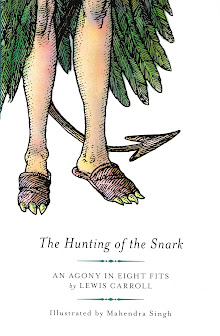
I've spent the last year working on a sequential version of Lewis Carroll's The Hunting of the Snark and I expect to spend at least another year on it. Hopefully, a publisher will be found for it (they all love the Snark but is Ms Carroll truly relevant to today's YAs? Why doesn't she answer her phone? Who's her agent anyway?)

In the meantime, maybe it's best to let my Snark venture out on its own with little baby steps, enough to whet the appetite of any lurking boojums. Plus, it's an exhibitionist and loves to be talked about.
I still have no cover idea but I've finished the author's preface. I decided to focus on Carroll's portmanteaux. His revolutionary concept of the role that luggage can play in verbal communication must have baffled train porters and pedants alike.

Here is Figure 1:


Fig. 1 – A visual explication of the portmanteau concept. Shown here is Mr. Lewis Carroll, a poet and the author of this preface and a portmanteau of Rev. Charles Lutwidge Dodgson, mathematics don at Christ Church College, Oxford.


And for the truly perplexed, Figure 2:


Fig. 2 – A visual explication of the portmanteau concept. Shown here is Charles Lutwidge Dodgson, a mathematics don at Christ Church College, Oxford and a portmanteau of Mr. Lewis Carroll, a poet and the author of this preface.

Hooray for the Victorian concept of what's suitable for children! More to come ...