Showing posts with label Martin Heidegger. Show all posts

Monday, September 19, 2011

Fit 6, pg. 67/3 … the snark of reason produces sleep


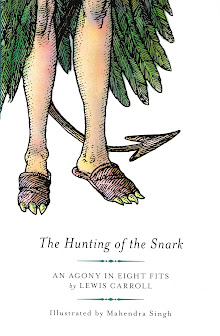
THE HUNTING OF THE SNARK by Lewis Carroll, a graphic novel by this artist and explained here, page by page, panel by panel, squiggle by squiggle … right now we're in Fit the Sixth, where the Barrister (played by Martin Heidegger) is dreaming of prosecuting a pig …

We've been wandering the Carrollian Dreamtime of Fit the Sixth for quite a while, exploring the fascinating connections between Victorian Nonsense and the legal profession. This illustrator has seen fit to expand the nightmarish implications of all of the above by ensuring that the Barrister, Snark, Judge, Jury, Witnesses and even Defendant all possess the features of Martin Heidegger, the eminent Continental brain-and-nitpicker.

But perhaps now is as good a time as any to awaken from this dream, to ignore the bellowing and wake up to face the ringing in one's ears. And there's the rub, it seems, for awakening from one dream does not automatically guarantee one a safe berth in whatever reality that is assumed to enfold both dream and dreamer.

In short, when we awake, do we awake into reality or merely another dream? Perhaps such questions do not trouble the sleep of most readers but for those of us who Hunt the Snark, such enigmas are pure catnip, knowing as we do that Nonsense is the dream of Logic.

Like so many of the broad, unverified statements with which this blog is littered, I'll not bother with the piddling details behind it. It's all a question of recursion, really, and the very mention of that word gives most Occidentals a bad case of ontological hives.

From whence comes this fear? Eastern philosophy is brimming with the mind-addling fumes of recursion, it's the cat's pyjamas of classical Hindu metaphysics and for good reason: once one accepts recursion as a valid foundation for one's world view, reality starts looking a lot, well … more fun. All of which is a rather giggle-inducing poke-in-the-eye of what good old stodgy Aristotelians once called the First Cause.

All of which confirms this Snarkista's growing suspicion that for the High Anglican-cum-logician Carroll, Nonsense was the inflammatory reaction of a logician's mind plagued by the chronic affliction of Belief …

Whether you call it the First Cause or the Author or even the Illustrator, it's clear as mud that something is going on here, something fiendishly similar to a funhouse hall of mirrors haunted by a genuinely tricksy Boojum.

Of such mind-mangling quiddities are the recursive arabesques of Snarkish ontology constructed, dear readers. Now discuss amongst yourselves, please. And keep it down, I'm going back to sleep.

NB. The train hovering in the background is actually a wretchedly clumsy drawing of a 1967 Ford Falcon, a sturdy vehicle whose chauffeur is puttin' the pedal to the medal in response to his passengers' request to "take us out of this picture." Poor sods, little do they know, eh?

Monday, August 15, 2011

Fit 6, pg. 67/1 … Aguirre, the Snark of God


THE HUNTING OF THE SNARK by Lewis Carroll, a graphic novel by this artist and explained here, page by page, panel by panel … right now we're in Fit the Sixth, where the Barrister (played by Martin Heidegger) is dreaming of prosecuting a pig …

Transportation for life … it's not a pretty sentence, not even a pretty sentence fragment. Has the Defendant Pig been deprived of his Lexus and condemned to using the subway for the rest of his life? Has he been reduced to riding a bicycle to and from his sty? A skateboard with obligatory tattooes and iPod prostheses?

Gosh, no, he's been deported to one of the British penal colonies, such as Australia, where he can endure the agony of fresh air, sunshine and limitless social and business opportunities instead of the customary Victorian British urban pollution, pouring rain and stifling class system. Although, to be honest, I don't think that by the time the Snark was composed (1874-1876) the British were deporting felons to Australia anymore but I think you get the picture … or even better, you don't get the picture!


Cue evil laughter here, and meanwhile, peruse carefully the above picture. Now compare it to the one at the very top of this posting, the version which appeared in print.

Would it surprise you to learn that this artist often draws that-which-is-not-to-be-seen by the reader, ie., he goes to the bother of drawing whatever it is that the word-panel will obscure when it is positioned later in the production process?

I didn't think you did, smarty pants. Frankly, how could you? How could you guess that I would go to such ridiculous, creepily epistemological lengths to subject various players in my Snark to the dreaded … transportation for life!

The more thoughtful reader will quickly grasp that this curious graphic practice is the visual equivalent of the literary "softly and suddenly vanishing away" which the poet has utilized as the First Cause of his Snarkish plot engine. Pictures aping words aping pictures aping words, and all that. Such complex and delicately crafted levels of conceptual meaning have proved to be a reliable turn-off for the general book-buying public, I can assure you.

Lazier (and faster breeding) readers will content themselves with observing that various members of the jury have themselves been transported for life and that it serves them right. They might even exclaim aloud: This is not a legal system, it's utter Nonsense, I mean, good lord, look at them! Everyone resembles Martin Heidegger. That's not justice and it's certainly not legally sound nor even a legal sound.

Say it slowly, to yourself … Heidegger … Heidegger … it's more of a sneezy ejaculation, a snorty, snirty, snarky clearing of the upper respiratory system with viscous, Flemish connotations … it won't hold up in any court of law, much less a dream court populated by somatic body doubles.

Next week: a cease and desist letter from the Heidegger estate and a hearty thanks from the North American Swine Producers Council.

NB. Attention comix fans!
The Hooded Utilitarian has published the results of its Best Comix Poll Ever, the collated opinions of various artists, writers, critics, vendors, etc. As always with the HU, the results are instructive and they're currently expanding upon the subject with explanatory essays, rebuttals, detailed break-downs, etc. This artist's response to the poll should appear there shortly and is guaranteed to please any fellow devotees of Mixtec and Mughal comix art …

The HU's poll is worth a look, especially for younger illustrators. To be honest, the results confirmed my worst, elitist suspicions about the circular ruination of North American illustrators/comix wallahs … you are what you look at and if this is what some of us are looking at, yikes.

Inking towards Gomorrah, with scarcely a penny in my pocket and the debt-collector at my heels, drawing well is the best revenge. Second best is seeing well.


Monday, August 1, 2011

Fit 6, pg. 66/3 … I ink, therefore I am


THE HUNTING OF THE SNARK by Lewis Carroll, a graphic novel by this artist and explained here, page by page, panel by panel … right now we're in Fit the Sixth, where the Barrister (played by Martin Heidegger) is dreaming of prosecuting a pig …

When drawing a dream in which the dreamer not only plays the part of every character in his dream, but is himself being played by the Eminent Continental Steamer, Martin Heidegger, the prudent illustrator pauses for thought.

From whence comes this illustrator's antipathy for Marty Heidegger? Is it the blathery philosophical drivel? The penchant for racist careerism? The beady, piggy eyes?

Perhaps the above stanzel can furnish some answers, for it is intimately concerned with "finding a verdict", ie., a quest for the truth, forensic and otherwise. The truth in this case is GUILTY, a blanket existential statement which Marty would have approved of, appealing as it does to the winsome young co-eds that Marty preferred to rummage through after classes.


But we Snark Hunters are made of sterner stuff. We take our philosophical marching orders from none other than Diogenes the Cynic (as shown here in Gerome's splendid painting), the bane of bloviating professors and politicians alike!

Diogenes was very much the Boojum of Western philosophy's Snark Hunt, preferring as he did to simplify things by cogitating in public while naked. He was a jolly rascal who often wandered through Athens with a lantern in daylight, claiming to be searching for an honest man. In case no one got the joke, he also preferred to live in a large barrel in which he would roll through the agora during moments of national crisis, a political tactic in need of revival in our troubled times.

His philosophy was simple, literally, and this simplification has earned him the eternal disdain of more practical-minded people, the kind of people who prefer the more comforting truths of money, religion, consumerism and groupthink.

In our Snark Hunt, we've replaced his barrel with the Bellman's Bell and we've clothed him in the garb of an English Barrister so as not to frighten the kiddies, but I think you get the general idea.

The truth, dear readers, is the very last thing one wishes to entrust to Barristers or Philosophers, unless, of course, they are furnished with a lantern, smelling of raw onions (oh yes, I've included them) and blessed with a dog-like sense of fidelity to the tenets of Cynicism.

Of course, we're all guilty of something or the other in this Snark Hunt, alas.

But you can buy a copy of this graphic novel and thus expunge some of your guilt in enjoying this free Carrollian exegesis whilst I shiver in my barrel-like garret. I shall expunge my own guilt by emulating Diogenes and doing some naked inking whilst my faithful King Charles Cavalier Spaniel lies at my feet, dreaming of chasing the squirrelly Boojums which plague her sleep.


Monday, June 20, 2011

Fit 6, Pg. 65/1 … Snark Upanishad, Yeah!


THE HUNTING OF THE SNARK by Lewis Carroll, a graphic novel by this artist and explained here, page by page, panel by panel … right now we're in Fit the Sixth, where the Barrister (played by Martin Heidegger) is dreaming of prosecuting a pig …

This particular panel is dedicated to the ubiquitious situation of everybody speaking at once so that nobody knows what’s being said.

The late, great Strother Martin (probably one of the Heiddeger Martins from Heidelberg, back in the old country) once noted, in a similar situation involving some other dunderheads messing about with the law, phenomenology and life’s problems in general, that what we have here is a failure to communicate. But how to illustrate such a situation without in turn failing to communicate one’s own self? How can we avoid the relentless, downward spiral of miscommunication, and distrust which so plagues modern youth?

Such logical intricacies were a sort of busman’s holiday for a certain class of Hindu (and Buddhist) philosophers and sages of yore whose otherwise innocuous turbans concealed brains possessed with a fiendish capacity for splitting hairs. The very antithesis of the plain-talking Strother Martin, these learned gentlemen delighted in concocting the metaphysical equivalent of the blazing hot curries on which they subsisted; arguments possessed of such piquancy that they were often disguised as bland, easy-to-swallow parables lest they frighten the kiddies or scare the livestock, so to speak.

The most famous of such parables describes the misguided attempt by a group of blind brahmins to describe what an elephant is like through touch alone. One brahmin, grasping the trunk, thinks the elephant is rope-like, the other hugs a leg and finds the elephant to be tree-like, and so on until you, the befuddled reader trapped in your occidental web of illusion, get the point and purchase another round of curry for the house.

Needless to say, this illusion business (better known as maya in the finer sort of new — and old — deli) is further compounded by this artist with the addition of a really top-knotch epistomelogical corker: the multivalent confusion generated by having everyone concerned being the same person.

In such a case, when observer and observed are one and the same, one can truly say that anything anyone might have to say about anything will be best classified as everyone speaking at once and hence no one knowing what is said (pauses to wipe forehead with a dampened dosa). Or as a certain neologizing German thinkwallah might have put it, what we have here is a failure to überselbstzeichnungangstgemachen.

Stay tuned, tolerant reader, for next week’s exciting, hijacked episode of Lewis Carroll’s Hunting of the Snark … or something like that …

Monday, June 6, 2011

Fit 6, Page 64, Panel 1 … my object all sublime, I shall achieve in time, to make this snark hunt fit the crime


THE HUNTING OF THE SNARK by Lewis Carroll, a graphic novel by this artist and explained here, page by page, panel by panel … right now we're in Fit the Sixth, where the Barrister (played by Martin Heidegger) is having a dream …

Melodramatic courtroom scenes are the crack cocaine of modern cinema and television; the average viewer must have a regular dose at certain intervals or they will soon lose interest in whatever televisual dog’s-breakfast is being served ‘em by the sweaty-palmed, hysterically gibbering minions of Hollywood or Bollywood or whatever-wood they happen to find themselves lost in quasi-Dantesque peril.

However, our watchword for today is — eschew the obvious, disdain the cheap thrills of courtroom antics leavened by lurid, torn-from-the-headlines social issues! You shall have none of that here and I do not care if you lapse into oddly compelling convulsions.

Instead, you shall have a wholesome bit of this week’s episode of Lewis Carroll’s Snark Hunt, in which we find the Barrister heaving onto his hind legs before an English judge and jury, all for the benefit of a porcine defendant of no fixed address. There are no lurid social issues being mooted about in this courtroom, just the sweaty business of Man vs. Swine with a pinch of Desertion to lend it all an air of forensic veracity,

Good lord, I hear you mutter, everyone looks like everyone else, what’s going on here? Fret not, dear reader, you are not hallucinating nor is this artist suffering from idiopathic monofacia, in fact this is a prime example of what legal experts call habeas corpus (or more correctly, habeo corpus, for the benefit of congenitally officious readers).

Yes indeed, we have here the body and the face of the Barrister, AKA Martin Heidegger, multiplied ten-fold so that he can simultaneously play all the necessary roles of this Carrollian nightmare of a courtroom drama. In doing so, not only do we cut down on unnecessary expenditures of our favorite brand of second-grade-fresh, reheated cafeteria-style india ink but we can also avoid the bothersome necessity of accurately drawing the many different faces of a full complement of judge, jury, defendant, spectators and string section.

Good lord, I hear you mutter, string section? Why yes, a string section and I think they are playing something rather jolly, a spritely tune which could even serve as an overture to the impending legal machinations of Messers Heidegger, Heidegger, Heidegger & Heidegger, LLC (gesundheit). It sounds rather like a bit of Gilbert and Sullivan and the hypernaturally eagle-eyed reader will have already noted the bit of foolscap in the Barrister’s hand upon which we can observe that hark, the hour of ten is sounding!

Cryptically sound advice indeed, for it might serve as both an indicator of the numerical quantity of Heideggers facially cluttering the landscape and more to the point, perhaps even the opening verses of Gilbert and Sullivan’s forensic benchwarmer, Trial By Jury.

The well-oiled Carrollian will sigh appreciatively at all this, knowing as they do that Carroll once harbored designs of collaborating with Sir Arthur Seymour Sullivan. These designs were crushed by something or the other, such was (and is) the topsy-turvy world of the crushing theater.

It is only now, over 130 years later, that the reader can judge for himself what such a collaboration might have looked like as he peruses our artistic reconstruction of a Carroll and Sullivan collaboration. I suggest that with glass in eye, you observe in a melodiously crosshatched manner that Heideggers with anxious fears are abounding, breathing hope and fear — for to-day in this arena, summoned by a stern subpoena, the Snark shortly will appear.

Monday, May 16, 2011

In Xanadu did Kublai Khan a stately pleasure-snark decree


I have to change the frequency of my blog postings, from now on I'll post once a week on Mondays, at least until I devise a system for earning more money by doing less work for less money.

THE HUNTING OF THE SNARK by Lewis Carroll, a graphic novel by this artist and here explained page by page, panel by panel. Today's posting is the frontispiece of Fit the Sixth, the so-called Dialectical-Materialism Fit …

With a nightmarish fanfare of snores and snorts, Fit the Sixth of Lewis Carroll’s cri-de-cœur, AKA The Hunting of the Snark, now heaves into view. This Fit is devoted to the Barrister's adventures and since he's depicted throughout my version of the Snark in the guise of Martin Heidegger, expect some snappy legal and ontological hijinks to ensue!

This page, a little number which I call The Barrister’s Dream, is an illustrative poke-in-the-snoot aimed squarely at the grand English tradition of Oneiric Verse, ie., such yawn-inducing showstoppers as the Dream of the Rood, Bill Blake’s Dream and Christina "Sister Wombat" Rossetti’s Dream Land.

The well-read reader, and perhaps even the ill-read reader, will note that in this Fit of his Snark, Carroll successfully introduced the nightmarish element of potential litigation into the English Dream Poem, thus bringing to light the adversarial relationship twixt Dreamer and Dream.

We all of us dream and yet none of us truly know why, nor, more to the point, what our dreams might mean. If this is not an apt metaphor for the relationship twixt the Average Citizen and the Law, I’m a frittered-cheese-wig! Hence, our need for barristers and all their jolly legal ilk cluttering the land, and hence we find that even whilst asleep, Carroll has seen fit to provide you, the d.r., with qualified legal assistance at affordable rates.

If you are so inclined, it might occur to you that the Entire Meaning of the Snark is a similar enigma, impervious to explanation save by employing the services of a picture-wallah such as my ever-so-‘umble self. It might even occur to you that my tactic of employing Martin Heidegger as our Snarkic Barrister bodes ill for any useful solution to any of the above questions. Heidegger was a notorious Teutonic chatterbox and utterly useless for any explanation more complex than obtaining the directions to the nearest washroom, in short, prime material for any barrister’s office wishing to pad their billable hours beyond all human endurance.

Alas, you are not so inclined. You are, like the Barrister Heidegger, comfortably reclined and fast asleep on company time, amazed by this Snark-hunter’s dream which we call life.

Thursday, January 27, 2011

Careful with that snark, Eugene


I speak to you from the very depths of Lewis Carroll's Hunting of the Snark … Fit the Fourth … an overly-inked German philosopher is bullying a better-inked Canadian Snark Huntress …


Judging from both the Barrister’s exasperated demeanour (played here by the Eminent Continental Steamer, Martin Heidegger) and from the general tenor of Lewis Carroll’s verses, the Beaver has no pride worth appealing to. And who can blame her, trapped as she is in a world not of her own making?*

Of course, all of us are trapped in a world not of our own making (probably) and it is at times like this that we might resort to the philosophical musings of the Barrister-Heidegger for further enlightenment concerning any time that we might spend being in this world almost certainly not of our own making :

"We name time when we say: every thing has its time. This means: everything which actually is, every being comes and goes at the right time and remains for a time during the time allotted to it. Every thing has its time."

After reading that, would it surprise you to learn that several philosophers were injured in the production of this Snark Hunt? Moments after this drawing was made, the Beaver savagely mauled the upper ontology of the Barrister-Heidegger!

________________________________

* A common complaint of certain bright young things, those thrill-seeking, rootless cosmopolitans such as the Beaver … a Québécoise wearing an Iberian mantilla, enjoying the echt German music of Heinrich Ignatius Franz von Biber and reading the memoirs of the Mughal Emperor Babur.

________________________________

NB. If you're eager for more snarkery this Friday, January 28th, 7 p.m., then come to the Librairie Drawn & Quarterly at 211 Bernard Ouest in Montreal … details here … you will enjoy the steam-powered magic lantern show I plan to expose to the public. I'll be signing books and discussing the post-Nonsensical dichotomies of Victorian hermeneutics … the poorer members of the audience can applaud politely, the rest of you rattle your poutines discreetly …


Thursday, February 18, 2010

Send Lawyers, Snarks and Money!


The Encyclopedia Snarkiana defines a Barrister as someone who tries to appeal to the Beaver’s pride, vainly citing a number of cases in which making laces has been proved an infringment of right.

Lewis Carroll, the author of those lines, further elaborated upon them by providing the Barrister with a ready-made dream to occupy him with in Fit the 6th. This dream was also furnished with a snappy soundtrack by Messers Gilbert and Sullivan and a full supporting cast of judge, jury, witnesses and defendant. The oneiric defendant (and substitute judge and jury) was none other than the Snark itself, which led to a bit of what well-oiled jurists call a conflict of interest. The Snark’s legal status as a nonexistent, fictitious and nonsensical creature can be best summed up as being Nothing, and nothing, ladies and gentlemen of the jury, comes from Nothing.

This illustrator chewed over that legal, ethical and even metaphysical conundrum for quite a while when he was first looking about for someone to cast in the role of the Barrister. After countless auditions with aspiring non-entities ranging from obscenely wealthy middle-class American politicos to an entire gaggle of opiated American radio talkshow intellectuals, I threw my hands up in the air in despair. It was impossible, finding someone who could encapsulate the very essence of Nothing so thoroughly that it even permeated his dreams!

At that moment, the door opened and a sweaty and rotund German intellectual eased himself and his moustache onto The Hunting of the Snark’s rather tatty casting couch. It was Martin Heidegger, the notorious Continental philosopher and Black Forest gadabout. It turns out that good ol’ Martin had spent considerable ink and governmental educational subsidies bloviating ad nauseam on the subject of Nothing. It seems like everywhere Martin looked, in the kitchen, in the shower, behind the sofa, there it was, the bane of Existentialism — Nothing!


Of course, he had a fancy German name for it, curious readers can read all about it and much more here, but in short, Martin was our man. The fourth member of the B-Boyz, the Barrister, was going to be Martin Heidegger! Exhausted by the search, I lay back and lit up a hand-rolled Brazilian samba girl. Things were back to normal at Chez Snark, Nothing was working its nonsense mojo once again.

Wednesday, November 4, 2009

Fit the Sixth, Page 42, Panel 1 … snarkayana


The indictment had never been clearly expressed,
And it seemed that the Snark had begun,
And had spoken three hours, before any one guessed
What the pig was supposed to have done.
The Jury had each formed a different view
(Long before the indictment was read),
And they all spoke at once, so that none of them knew
One word that the others had said.

Page 42 of any work of literature will always be redolent of the highest Carrollian vibes imaginable; to wit, the well-known mojo of the Puissant Number 42 is at this very moment shedding its potent tantric vibe over the above drawing, a drawing dedicated to the ubiquitious situation of everybody speaking at once so that nobody knows what’s being said.

The late, great Strother Martin (probably one of the Heiddeger Martins from Heidelberg, back in the old country) once noted, in a similar situation involving some other dunderheads messing about with the law, phenomenology and life’s problems in general, that what we have here is a failure to communicate. But how to illustrate such a situation without in turn failing to communicate one’s own self? How can we avoid the relentless, downward spiral of miscommunication, and distrust which so plagues modern youth?

Such logical intricacies were a sort of busman’s holiday for a certain class of Hindu (and Buddhist) philosophers and sages of yore whose otherwise innocuous turbans concealed brains possessed with a fiendish capacity for splitting hairs. The very antithesis of the plain-talking Strother Martin, these learned gentlemen delighted in concocting the metaphysical equivalent of the blazing hot curries on which they subsisted; arguments possessed of such piquancy that they were often disguised as bland, easy-to-swallow parables lest they frighten the kiddies or scare the livestock, so to speak.

The most famous of such parables describes the misguided attempt by a group of blind brahmins to describe what an elephant is like through touch alone. One brahmin, grasping the trunk, thinks the elephant is rope-like, the other hugs a leg and finds the elephant to be tree-like, and so on until you, the befuddled reader trapped in your occidental web of illusion, get the point and purchase another round of curry for the house.

Needless to say, this illusion business (better known as maya in the finer sort of new — and old — deli) is further compounded by this artist with the addition of a really top-knotch epistomelogical corker: the multivalent confusion generated by having everyone concerned being the same person.

In such a case, when observer and observed are one and the same, one can truly say that anything anyone might have to say about anything will be best classified as everyone speaking at once and hence no one knowing what is said (pauses to wipe forehead with a dampened dosa). Or as a certain neologizing German thinkwallah might have put it, what we have here is a failure to überselbstzeichnungangstgemachen.

Stay tuned, tolerant reader, for next week’s exciting, hijacked episode of Lewis Carroll’s Hunting of the Snark … or something like that …
___________

Late-Breaking Snark News … NYC Snarkistas Take Notice!
Peter Pavlakis' film version of the Snark will be premiered at the Queens International Film Festival, Saturday, November 14th. Further information can be found here, plus a neat trailer. It looks quite interesting, a live action version to boot! Best of luck to Peter and if any readers see it, I would love to read your comments & critiques. To the best of my knowledge, this is the 2nd live-action film version currently in production or being shown in North America right now, the other being Michael McNeff's … could this be the long-awaited Snarkian Renaissance which sweeps Hollywood into a craze for All-Things-Nonsense?

Wednesday, October 7, 2009

Fit the Sixth, Page 41, Panel 1 … my object all sublime, to make the snark fit the crime


He dreamed that he stood in a shadowy Court,
Where the Snark, with a glass in its eye,
Dressed in gown, bands, and wig, was defending a pig
On the charge of deserting its sty.

Melodramatic courtroom scenes are the crack cocaine of modern cinema and television; the average viewer must have a regular dose at certain intervals or they will soon lose interest in whatever televisual dog’s-breakfast is being served ‘em by the sweaty-palmed, hysterically gibbering minions of Hollywood or Bollywood or whatever-wood they happen to find themselves lost in quasi-Dantesque peril.

However, our watchword for today is — eschew the obvious! Pester me not for your cheap thrills of courtroom antics leavened by lurid, torn-from-the-headlines social issues! You shall have none of that here and I do not care if you lapse into oddly compelling convulsions. Instead, you shall have a wholesome bit of this week’s episode of Lewis Carroll’s Snark Hunt, in which we find the Barrister heaving onto his hind legs before an English judge and jury, all for the benefit of a porcine defendant of no fixed address. There are no lurid social issues being mooted about in this courtroom, just the sweaty business of Man vs. Swine with a pinch of Desertion to lend it all an air of forensic veracity,

Good lord, I hear you mutter, everyone looks like everyone else, what’s going on here? Fret not, dear reader, you are not hallucinating nor is this artist suffering from idiopathic monofacia, in fact this is a prime example of what legal experts call habeas corpus (or more correctly, habeo corpus, for the benefit of congenitally officious readers).

Yes indeed, we have here the body and the face of the Barrister, AKA Martin Heidegger, multiplied ten-fold so that he can simultaneously play all the necessary roles of this Carrollian nightmare of a courtroom drama. In doing so, not only do we cut down on unnecessary expenditures of our favorite brand of second-grade-fresh, reheated cafeteria-style india ink but we can also avoid the bothersome necessity of accurately drawing the many different faces of a full complement of judge, jury, defendant, spectators and string section.

Good lord, I hear you mutter, string section? Why yes, a string section and I think they are playing something rather jolly, a spritely tune which could even serve as an overture to the impending legal machinations of Messers Heidegger, Heidegger, Heidegger and Heidegger (gesundheit). It sounds rather like a bit of Gilbert and Sullivan and the hypernaturally eagle-eyed reader will have already noted the bit of foolscap in the Barrister’s hand upon which we can observe that hark, the hour of ten is sounding!

Cryptically sound advice indeed, for it might serve as both an indicator of the numerical quantity of Heideggers facially cluttering the landscape and more to the point, perhaps even the opening verses of Gilbert and Sullivan’s forensic benchwarmer, Trial By Jury.

The well-oiled Carrollian will sigh appreciatively at all this, knowing as they do that Carroll once harbored designs of collaborating with Sir Arthur Seymour Sullivan. These designs were crushed by something or the other, such was (and is) the topsy-turvy world of the crushing theater.

It is only now, over 130 years later, that the reader can judge for himself what such a collaboration might have looked like as he peruses our artistic reconstruction of a Carroll and Sullivan collaboration. I suggest that with glass in eye, you observe in a melodiously crosshatched manner that Heideggers with anxious fears are abounding, breathing hope and fear — for to-day in this arena, summoned by a stern subpoena, the Snark shortly will appear.

Wednesday, September 9, 2009

Fit the Sixth, Page 39 … lex snarqui


With a nightmarish fanfare of snores and snorts, Fit the Sixth of Lewis Carroll’s cri-de-cœur, AKA The Hunting of the Snark, now heaves into view. This page, a little number which I call The Barrister’s Dream, is an illustrative poke-in-the-snoot aimed squarely at the grand English tradition of Oneiric Verse, ie., such yawn-inducing showstoppers as the Dream of the Rood, Bill Blake’s Dream and Christina "Sister Wombat" Rossetti’s Dream Land.

The well-read reader, and perhaps even the ill-read reader, will note that in this Fit of his Snark, Carroll successfully introduced the nightmarish element of potential litigation into the English Dream Poem, thus bringing to light the adversarial relationship twixt Dreamer and Dream.

We all of us dream and yet none of us truly know why, nor, more to the point, what our dreams might mean. If this is not an apt metaphor for the relationship twixt the Average Citizen and the Law, I’m a frittered-cheese-wig! Hence, our need for barristers and all their jolly legal ilk cluttering the land, and hence we find that even whilst asleep, Carroll has seen fit to provide you, the D.R., with qualified legal assistance at affordable rates.

If you are so inclined, it might occur to you that the Entire Meaning of the Snark is a similar enigma, impervious to explanation save by employing the services of a picture-wallah such as my ever-so-‘umble self. It might even occur to you that my tactic of employing Martin Heidegger as our Snarkic Barrister bodes ill for any useful solution to any of the above questions. Heidegger was a notorious Teutonic chatterbox and utterly useless for any explanation more complex than obtaining the directions to the nearest washroom, in short, prime material for any barrister’s office wishing to pad their billable hours beyond all human endurance.

Alas, you are not so inclined. You are, like the Barrister Heidegger, comfortably reclined and fast asleep on company time, amazed by this Snark-hunter’s dream which we call life.

Wednesday, December 17, 2008

Fit the Fourth, Page 27, Panel 3 … language is the house of the truth of the boojum


Though the Barrister tried to appeal to its pride,
And vainly proceeded to cite

A number of cases, in which making laces

Had been proved an infringement of right.


Judging from both the Barrister’s exasperated demeanour (played here by the Eminent Continental Steamer, Martin Heidegger) and from the general tenor of Lewis Carroll’s verses, the Beaver has no pride worth appealing to. And who can blame her, trapped as she is in a world not of her own making?*

Of course, all of us are trapped in a world not of our own making (probably) and it is at times like this that we might resort to the philosophical musings of the Barrister-Heidegger for further enlightenment concerning any time that we might spend being in this world almost certainly not of our own making :

"We name time when we say: every thing has its time. This means: everything which actually is, every being comes and goes at the right time and remains for a time during the time allotted to it. Every thing has its time."

After reading that, would it surprise you to learn that several philosophers were injured in the production of this Snark Hunt? Moments after this drawing was made, the Beaver savagely mauled the upper ontology of the Barrister-Heidegger!

________________________________

* A common complaint of certain bright young things, those thrill-seeking, rootless cosmopolitans such as the Beaver … a Québécoise wearing an Iberian mantilla, enjoying the echt German music of Heinrich Ignatius Franz von Biber and reading the memoirs of the Mughal Emperor Babur.

Wednesday, June 18, 2008

Fit Three, Page 19, Panel 2 … my object all sublime, I shall achieve in time, to make the boojum’s fit the crime


"I skip forty years," said the Baker, in tears,
And proceed without further remark
To the day when you took me aboard of your ship
To help you in hunting the Snark.

The story so far … there once was a Snark … but it will be a Boojum, alas!

The Baker is suffering from what we now know to be angst. Once upon a time we would have pinned the label of big, fat crybaby upon him but these are dangerously litigious times for us thought-criminals.

Boojum-angst was first used as a legal defense by the Baker’s legal counsel, the Barrister, AKA Martin Heidegger, in his seminal brief (naughty boy) : Sein und Zeit. He excused the Baker’s regression into a second childhood with the then-novel defense of angst, which he explained as an objectless and generalized dread occasioned by the growing presence of Nothing. The boojum, a nonexistent being, fit this description nicely and the Barrister won an acquital for his client on the grounds that he was an idiot anyway. We shall see more of the Barrister’s weasel-skills in Fit the Sixth.

From whence comes this fashion to label all things boojum in the German language? Angst, schadenfreude, strafe (straffen), weltschmertz — all of ‘em teutonic and hardly a laugh in the lot. May we quote the poet Heinrich Heine (finally getting some good reviews in the notoriously anti-Heine NYT) on this subject :

"… the Germans have the curious custom of always attaching a thought to whatever they do.”

Schnitzel for thought, indeed! All it needs is this mustard-like condiment, from the cupboard of the truly inspired and genuinely missed American illustrator, Edward Gorey :

"I have a dumb theory that a creative piece of art is only interesting if it purports to be about something and is really about something else."

Milord, the defense rests in its usual, pretzel-like position. Like the Baker, at play in the ontic fields of the lord, to all the above charges of unlawful boojumizing and multiple neologizing we shall plead : ignorance, madam, pure ignorance. Or in the very best Clochetic-cum-Orwellian manner : ignorance, madam, double-plus pure ignorance.