Readers of
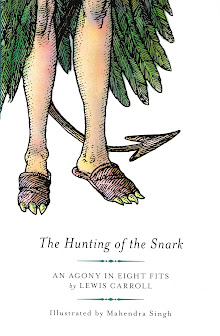
this blog who already possess a copy of my GN version of The Hunting of the
Snark will know that the artist's afterword which graces that already
gracious volume is a fine thing indeed. It purveys information
animal-vegetable-and-mineral about all things Snark in a handy, easy-to-swallow
format.
This
afterword was actually the second draft of the primal Ur-Wort which follows
below. After some reflection, both I and the publisher, Melville House, deemed
this original text to be too "hot" and "spicy" for the
average North American reader. Apparently the latter prefer their Snarkiana al
dente, as opposed to we Indo-Germanic Snarkistas, who prefer our Snark
well-oiled and lascivious.
NB. Follow
me on Twitter … and find
out why oulipo is words crucified upon numbers but epistemology is numbers
crucified upon words. Plus lots of naughty shop-talk as I illustrate the next
volume in J.C. Valtat's New Venice steampunk series, Luminous Chaos,
coming soon from Melville House.
______________________________________
The
Inking of the Snark
Our hunt
began with a stroll. On the morning of July 18, 1874, a Christ Church
mathematics tutor, Charles Lutwidge Dodgson, happened to be taking one around
Guildford, a village in Surrey. He had spent the night nursing his consumptive
nephew and as he now walked through the bright English countryside, a curious
and unexpected thought came to him, a random line of Nonsense verse that
flashed through his mind:
For the
Snark was a Boojum, you see.
Even more to
our purpose, at that precise moment a startling personal transformation took
place, a metamorphosis, in fact: the rather unassuming personage of C.L.
Dodgson suddenly vanished and in its place reappeared the celebrated literary
genius, Lewis Carroll.
The more
flamboyant Carroll had already made his reputation with British readers as the
author of two masterpieces of children’s literature and high Nonsense: Alice
in Wonderland and Through the Looking Glass. Yet he had not produced
any other significant work for several years afterwards until that July morning
when an odd fragment of unexpected and semi-intelligible verse set in motion
his final and most controversial work of Nonsense.
The obliging
Dodgson withdrew from public view for the next two years to allow Carroll the
time and privacy necessary to compose the remaining 563 lines of that poem
which we know today as The Hunting of the Snark. It was a difficult and
time consuming task; the poem was essentially composed backwards in bits and
pieces from the initial fragment and Dodgson’s hectic schedule often required
the poet to set aside his pen so that the busy academic could attend to his
less glamorous professional and family duties.
The epic was
eventually published in 1876 to lackluster critical reviews yet the public paid
them no heed, so much so that the book has remained in print till this day and
in at least 16 languages to boot. Yet the Snark’s literary and
commercial success also proved to be Carroll’s literary Boojum. From this point
onwards, Dodgson demanded a far greater creative role at Carroll’s expense, a
difficult state of affairs which culminated in the debacle of Sylvie and
Bruno a few years later.
In any case,
the Snark itself thrived as only genuine Nonsense can in this supposedly
hard-nosed world. Proving to be a subversively addictive earworm for
connoisseurs of linguistic and logical mayhem, it exerted a cult-like spell
upon many of its readers and equally important, the many artists who seized
upon its raw matter for their own uses over the years. Its curious, almost
symbiotic ability to re-evolve itself to fit the changing needs of its
artist-hosts eventually put it in the ranks of such archetypical works as the Faust-Buch
or the Odyssey; classic texts which transmogrify themselves so often
that one could say that they have literally taken on a life of their own.
Yet the
poem’s appeal and purpose seem to have mystified the author. Carroll repeatedly
stated that he had no idea what the Snark meant or even what it actually
was and he would often ask his questioners to inform him post haste if they
ever discovered the meaning. Hence, if we were in a charitable mood, we could
put his mind at posthumous ease by informing him that we have classified his Snark
as an independent minded and rather prolific creature endowed with such
evolutionary and metamorphic super-powers that its hidden meaning is impossible
to pin down and hence open to all.
But alas,
charity can go only so far in the cut-throat world of Carrollian research! Our
Symbiotic Theory of Snarkian Evolution would be swiftly pooh-poohed by those
legions of up-to-date Snarkistas who would point out the poem’s many references
to contemporary Victorian events and issues as furnishing a good enough sort of
meaning.
They would
bandy about certain facts, facts of both a public and personal nature. To begin
with, the resemblance between the Baker and Carroll himself is striking: the
Baker’s boxes numbering 42, which was Carroll’s age in 1874; the Baker’s
references to a dear uncle, possibly the same greatly loved uncle from whom
Dodgson gained his middle name (and who was murdered by a lunatic armed with a
sharpened nail); and finally the descriptive similarities between the meek and
rather comical personalities of both the Baker and the author.
The
Bellman’s Rule of Three could be a reference to a popular Victorian
arithmetical crib and perhaps even the American philosopher Charles Peirce and
his trinitary obsessions. The Barrister’s Dream smacks of both the infamous
trial of the Tichbourne Claimant and Gilbert and Sullivan’s operetta Trial
by Jury, while the Beaver’s Lesson pokes fun at Dodgson’s own wearisome
profession of teaching mathematics to the disinterested progeny of the upper
classes.
On closer
inspection, even the word Snark seems to be a linguistic rat’s nest of tattered
references. Carroll himself claimed, jokingly as was his frustrating wont, that
the word was a portmanteau of snail and shark (with a soupçon of snake) while
more sober minded etymologists have laid the beast’s paternity at the
promiscuous feet of the modern German verb schnarren, to jar or buzz, which
itself is cognate with the Low German snarren, to snarl. One Australian
researcher has even unearthed an obscure 18th-century reference to
the tattooed face of a Maori warrior as being “a face all snark’d”, a usage
which bodes ill for today’s ubiquitious tattooed hipsters.
In short,
the entire poem is bursting at the seams with topical references to all of the
above and much more besides: English banking practices and naval history,
sea-side bathing, Shakespeare, music hall crosstalk and even poolhall loafers;
so much so that even the most jejune reader is bound to notice that Something
Is Going on Here.
Unfortunately
for the jejune amongst us, the quest for meaning in modern Snarkonomics has
higher standards of proof than a mere suspicion about a certain something.
Simply saying that Lewis Carroll had embarked on a
protofreudian, hyperontological or even crypto-existential Snark Hunting
crusade may sound impressive at cocktail parties but we Snarkards are made of
sterner stuff, we demand proof with our drinks!
This
writer could present a second theory at this point, even more bloviated than his earlier Darwinian concoction. He could
point out that a drearily earnest
Snarquistadore might consider regenerating all 4,452
words of the Snark’s verses into a matrix roughly congruent in
morphology, syntax and grammar to the original, commencing on or about July 18,
1874. The resulting text file might provide them with an optimized WYSIWYG
explanation of the meaning of the Snark, assuming of course that they
had not taken religious orders beyond the level of Deacon but that they did
have a minimal pedagogical experience in college-level mathematics; and also
assuming that they could "read" the resultant codex with a false
recursive memory of having composed it themselves whilst seeing it for the
first time; all while bearing in mind that the physical location of this
generation process would be unimportant, that anywhere in the English rain
while wearing scratchy woolens and mudcaked wellies would do.
This
second theory, the so-called Pierre Menard Theory, leads us inevitably into the
pythonesque coils of a yet another and mercifully terminal theory. This one
summarizes the entire, teeming expanse of the Snarkian Multiverse and the
multiply occluded meanings of Carroll’s Agony in Eight Fits thus:
maybe.
Alas,
if only things were that simple! For it so happens that when this artist
decided to take up his inking of the Snark, he did so knowing that
starving artists such as himself have a
certain traditional obligation to provide employment to their equally
impecunious academic brethren. Call it noblesse oblige if you must, but every
page, every panel, every inky jot and tittle of this Snark would have to
be imbued with a gallant spirit of selfless fraternal thing-um-a-jig with the
above-mentioned what-you-may-call-ums. In short, only an impenetrably recondite
version of Carroll’s Snark would provide those legions of graduate
students and other itinerant savants with sufficient gainful employment to
justify their generations of stipends to come.
But how to
make good on such a philanthropic promise? Metamorphic verse composed by a
metamorphic poet poses a certain problem for the conscientious illustrator,
that is to say it requires a good amount of hard work and as another
metamorphic poet once noted, work is the curse of the inking classes.
Fortunately
for this ink-stained wretch, his handpicked team of elite ninja-cum-nautch-girl
research assistants quickly unearthed the necessary dirt on the Admirable
Carroll. They discovered that Lewis Carroll had long ago been appropriated by
the French Surrealists as one of their own; the Pope of Surrealism, André
Breton, and his faithful henchman, Louis Aragon, had anointed Carroll quite
early on as a worthy precursor to their own utopian crusade of remaking the
human race in the image of its own dreams. The poet’s disdain of the usual
variety of quotidian logic on offer in most Victorian bookstores in favor of
his own concoctions of the finest dreams money could buy had always fascinated
the founding fathers of Surrealism. Like all good revolutionaries, these
founding fathers secretly craved the bourgeois respectability of an illustrious
pedigree and so they eagerly inducted the long-dead Carroll into the elect
ranks of their so-called protosurrealist saints.
What Carroll
himself would have thought of being lumped together with the likes of the
Marquis de Sade, Raymond Roussel and the Comte de Lautréamont is beside the point, we
can’t all of us choose the company we posthumously keep anyway. But with a bit
of deft legwork to avoid the aforementioned zombie protosurrealists (a bit too
much for the kiddies, even in these postlapsarian times) a clever artist could
easily scavenge the more genteel quarters of Surrealism and its antecedents for
sufficiently toothsome goodies to flesh out the mutated words and ideas which
roam the Snark.
With all of
that in mind, this artist established an entirely new stylistic school
exclusively for the production of this Snark, the artistic genre of
Protosurrealism. This would allow him to illustrate the verses of the 19th-century
Surrealist precursor, Lewis Carroll, with suitable images referring to a future
the poet never knew or probably would have cared to know.
One moment,
the alert reader will now ask, just what is this thing called Surrealism? The
simultaneous dream-memory of everything, we answer back rather too quickly. So
what then is Protosurrealism, continues this persistent reader? The same as
above with an added frisson of remembering an impossible future, we smugly
reply. We might also add that Protosurrealism is the 21st-century application
of 19th-century answers to 20th-century problems or even that the true
Protosurrealist is a postmodernist (or even a postpostmodernist) who telescopes
his Surrealist past into a Victorian intellectual’s expected future until his
own past becomes his future and his nostalgia becomes his anticipation.
Even better,
we might simply announce that this Protosurrealist Snark you hold in
your hands is the full text of the finest Nonsense poem ever written, now
copiously illustrated with the dream imagery of Surrealism. You can safely read
and even recommend this book knowing that its attempt at believing in a
brighter future by building upon the better rubbish of the past is at worst
nothing more than a bit of middle-aged nostalgia slightly run amuck.
In short, there
is no cause for concern or need for panic amongst the well-oiled literary set;
it’s just that the Snark, the only truly epic poem of all Victorian
literature, has metamorphosized itself here into an artist’s homage to those
masters and their works — not only Surrealist — who form our visual, literary
and philosophical collective conscious*. Each drawing tries to follow in some
manner the tangled web of meaning and allusion which binds together the
cultural history of art and thought. So for example, do not be alarmed by the
curious fact that the second panel on page 4 depicts the Baker’s 42 boxes on
the beach as being labeled with his alias “candlestub” by using the Chinese
ideogram known as “xié”. The boxes and the girl with the fan are directly taken
from one of Carroll’s own photographs, a portrait of Alexandra “Xie” Kitchins
posing as an off-duty Chinese tea merchant. The gentleman at the easel is the
late and sorely missed British author Douglas Adams, whose Hitchhiker’s
Guide to the Galaxy proved conclusively that the Answer to the Meaning of
Life, the Universe and Everything In It is 42. The painting of a box that he is
working at is labeled with a variation upon Magritte’s famous anti-dictum,
“this is not my box” and is itself a play upon the Belgian’s seminal work, The
Human Condition I.
In short,
this artist will have his little jokes and he begs your pardon for his inky
sense of humor. He would like to submit certain mitigating circumstances in his
favor to his more easily pixillated readers by pointing
out that the true worth of this enterprise, our ever so ‘umble Snark,
will only be realized when curious readers, particularly the younger ones, are
intrigued enough by what they glimpse here to further pursue on their own that
immense cultural heritage which silently — and so faithfully — awaits them.
At the very
least, such selfless ambitions might gain this author a brief respite from the
otherwise chilly reception he expects from the poet, Lewis Carroll, when we
eventually meet in whatever hereafter has been laid on for us.
______________________
* Including
but not limited to, in either direct or indirect reference: Douglas Adams, Agesander, St. Anthony of Egypt, Aristotle, Jean and
Hans Arp, Athenodoros & Polyclitus LLC, Hans
Bellmer, Denise Bellon, Jean Benoit, Arnold Böcklin, Hieronymus Bosch, Constantin Brancusi, Sebastian
Brant, Augustus Caesar, John Coates and George
Dunning and Heinz Edelman, Diogenes the Cynic,
Salvador Dalí, Charles Darwin, Jacques-Louis
David, Giorgio De Chirico, Eugène Delacroix, C.L.
Dodgson (appearing here as Lewis Carroll), Marcel Duchamp, Albrecht Dürer, Max Ernst, Gustave
Flaubert, Sigmund Freud, Théodore Géricault,
Jean-Léon Gérôme, Gilbert and Sullivan, Vincent van Gogh, Mathias
Grünewald, Beatrice Hatch, Heraclitus, George Herriman, Martin Heidegger, William Hogarth, Henry Holiday, Jean Auguste Dominique
Ingres, Judas Iscariot, Edward James, Alfred Jarry, Alexandra Kitchins, the Comte de Lautréamont, V.I. Lenin, Dora Maar, René
Magritte, Édouard Manet, Karl Marx, Masaccio, Michelangelo, Joan Miró, Kiki de Montparnasse, Richard Müller, Friedrich
Nietzsche, Edgar Allan Poe, Plato, Raphael, Man Ray, Madame Récamier, Oscar Rejlander, Raymond
Roussel, Erik Satie, Alberto Savinio, Socrates, Duns
Scotus, Yves Tanguy, Sir John Tenniel, James
Tissot, Titian, Leonardo da Vinci, Jean-Antoine
Watteau, et alia. In a final
nonsensical twist to all of the above, the most-quoted artists in this work (de
Chirico, Magritte, Savinio, Dalí and Bosch) were never card-carrying
Surrealists to begin with, being either expelled from the ranks of the elect by
Breton or just too dead to qualify. As for the actual works of art, literature,
music and even locales referred to in this Snark, hunting down their names and provenances should provide
even the most obsessive reader with sufficient fodder for his tediously baroque
fantasies of world domination through better systems of information management.