Showing posts with label Martin Gardner. Show all posts

Monday, April 25, 2011

The Snark Whisperer


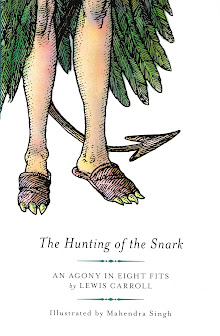
This explication of my GN version of Lewis Carroll's The Hunting of the Snark resumes its Jubjubian subplot for yet another stanzel … we are in the midst of Fit the Fifth and discussing the ways of the Jubjub Bird …

Lewis Carroll regales us here with a spirited description of a Jubjub being tortured by a variety of methods whose diabolical ingenuity and inventive discomfort seem uncomfortably redolent of an impromptu herd of schoolboys possessing the usual cretinous surplus of high spirits and moral pygmyism.

Carroll’s closest associate, C.L. Dodgson, would have been quite familiar with such goings-on, both as grim memories of his own public-schooling at Rugby and more to the point, as part of his quotidian duties as a maths tutor at Christ Church, where we can have little doubt that the vast majority of his students possessed a similar burning enthusiasm to make things hot for all creatures great and small.

This implicit connection twixt torture and mathematics must have troubled Dodgson’s gentle soul; no doubt he shared his unease with the more worldly Carroll, who then incorporated all of the above into this snappy bit of verse which we are chewing over right now.

In his Annotated Snark, Martin Gardner briefly discussed Prof. John Leech’s observations upon the mathematical implications of this stanza. Leech noted that by substituting locuses (or loci) for locusts, and tape measure for tape, one is then provided with the rudimentary instructions for the sawing and gluing together of the various wooden rods necessary for the skeletal framework of a regular polyhedron.

One can have little doubt that these instructions for the construction of a geometric solid would have provided Dodgson’s students with some considerable discomfort! From their 19th-century British discomfort they would have slipped, inevitably, into the very graphic slough of a fullblown 16th-century German melancholia, with all its attendant polyhedronal tortures!

Huzzah for the symmetrical mathematical-moral shape of things in our cozy world of boiled and salted Jubjubs-cum-schoolboys, ‘tis all very well thought out, Messers Carroll and Dodgson! The morally high-minded reader can chuckle appreciatively at all this, the rest of you just rattle your jewelry in a passing gust of old-fashioned schadenfreude.

NB. I must draw your attention, my dear Watson, to the curious incident of the dog barking at the moon. It is a Catalonian, 20th-century dog prone to bouts of selenic melancolia originating from its anachronistic exile to Nuremberg.

Monday, March 21, 2011

Snark fishing in America


We continue our GN version of Lewis Carroll's The Hunting of the Snark thusly …

When Lewis Carroll sat down at his writing desk to compose his masterpiece of passive-aggressive nonsense, The Hunting of the Snark, he often chewed reflexively upon his quill pen as he pondered what effect his words might have upon future readers.


Words, words, words! They have naughty bits which we cover up in polite company, they have sad bits to make the grownups cry, and sometimes, if you push ‘em together just so, their silly bits will make the kiddies giggle!

Of course, every word needs a voice and the above stanzel’s assemblage of words, birds, quills, desks and notes is stuffed with ‘em. Alas, poor Beaver, chronically outgrabed and all those voices in your head to boot! One of them, sounding suspiciously like the Mad Hatter, is wondering why a raven is like a writing-desk? Another (rather familiar) voice is telling her that this is so "because it can produce a few notes, tho they are very flat; and it is nevar put with the wrong end in front". Yet another voice (craftily mimicking Sam Lyod) is telling her that the correct answer is simply that Poe wrote on both. There’s even a voice chiming in about them both having quills dipped in ink.

These words are all meant to answer those other arrangements of words which more evolved thinkers call riddles, that is to say, an augural flock of words meant to signify something despite themselves. Replete with all the requisite overtones of linguistic juju, riddles were once all the rage in the Good Old Days. They served as social icebreakers for all manner of homicidal and imaginary beasts such as sphinxes, trolls, dragons and even — yes! — Jubjub Birds!

I shall cue the evil laughter now for our jolly little metafictional cabal stands revealed at last! Outgrabe all you like, Miss Beaver, but the bird you are really riddling here is no mere raven, it is the Urschreckvogel, the dreaded Jubjub itself!

And so, dear reader, can you enlighten the Beaver as to why a Jubjub is like a writing desk? Simple, you reply — because none has an o in it (pace Huxley). Then run as fast as you can before all these birds wreak their Hitchcockian vengeance upon your person!

Saturday, July 24, 2010

Looking for Mister Goodsnark


More Jubjubbery, something about polyhedrons and super-glue and winged insects fleeing the less fashionable bit of the Bible.

Readers seeking the correct explanation of the above stanzel will find it here … readers simply looking for a bit of fun with a Jubjub (single or divorced, with or without children and still retaining her perfectly symmetrical shape) are encouraged to send their particulars on the back of a twenty-rupee bill to this blog.

When deadlines press, inspiration takes a powder!

Friday, May 28, 2010

Martin Gardner


The news of Martin Gardner’s death on May 22nd, 2010 marks the end to a spectacular era in not only Snarkian but Carrollian studies, perhaps even a Golden Age of sorts. Which is not to say that there are no new discoveries or insights to be made nor adequately perceptive scholars to make them, rather that it is unlikely that we’ll see a similar renaissance again.

Gardner’s Annotated Snark was my first reading of the poem. I was a young lad and I will confess that Gardner’s approach fascinated me as much as Carroll’s epic masterpiece, perhaps even more in a certain way. Gardner’s genius (in this and in the Alice books) lay in his talent of explaining the Carrollian Multiverse in plain-spoken terms which encouraged the curious reader — and not just the specialists or scholars — to proceed further upon the obscure quest of Culture, Art and Knowledge at all costs.

And all while making sure that nothing got in the way of the Ripping Yarn itself, which is far too often the chief fault of certain academics. My own Snark owes much to Gardner and I hope that I’ve done some sort of justice to the man and his philosophy of Enlightened Rationalism.

Above is an example of my rendering of the infamous Snarkhunters’ refrain, the galdor, as I’ve called it before. Here is what the magisterial Gardner had to say about this stanza …

“ The fact that essentially the same stanza occurs altogether six times in the poem has led some to suspect that it may conceal a private, cryptic message. If so, the message has never been decoded.

My theory — the reader may be able to formulate a better one — is that thimbles, forks, a railway share, smiles and soap are connected with the Snark’s five unmistakeable marks mentioned in Fit 2. The forks are for eating crisp Snark meat. The railway share appeals to the Snark’s ambition to become wealthy and so can be used for baiting a death trap. Smiles are to let the Snark know when a pun has been perpetrated. The soap is, of course, for the bathing machines that the Snark carries about, and the thimble is used for thumping the side of the creature’s head to wake him in time for five-o’clock tea.”

And there you have it — exegesis from the master!

Wednesday, July 29, 2009

Fit the Fifth, Page 36, Panel 4 … Jubjub, at first though sweet, bitter ere long back on itself recoils


“You boil it in sawdust: you salt it in glue:
You condense it with locusts and tape:
Still keeping one principal object in view —
To preserve its symmetrical shape.”

Our Hunting of the Snark resumes its Jubjubian subplot for yet another stanzel; Lewis Carroll regales us here with a spirited description of a Jubjub being tortured by a variety of methods whose diabolical ingenuity and inventive discomfort seem uncomfortably redolent of an impromptu herd of schoolboys possessing the usual cretinous surplus of high spirits and moral pygmyism.

Carroll’s closest associate, C.L. Dodgson, would have been quite familiar with such goings-on, both as grim memories of his own public-schooling at Rugby and more to the point, as part of his quotidian duties as a maths tutor at Christ Church, where we can have little doubt that the vast majority of his students possessed a similar burning enthusiasm to make things hot for all creatures great and small.

This implicit connection twixt torture and mathematics must have troubled Dodgson’s gentle soul; no doubt he shared his unease with the more worldly Carroll, who then incorporated all of the above into this snappy bit of verse which we are chewing over right now.

In his Annotated Snark, Martin Gardner briefly discussed Prof. John Leech’s observations upon the mathematical implications of this stanza. Leech noted that by substituting locuses (or loci) for locusts, and tape measure for tape, one is then provided with the rudimentary instructions for the sawing and gluing together of the various wooden rods necessary for the skeletal framework of a regular polyhedron.

One can have little doubt that these instructions for the construction of a geometric solid would have provided Dodgson’s students with some considerable discomfort! From their 19th-century British discomfort they would have slipped, inevitably, into the very graphic slough of a fullblown 16th-century German melancholia, with all its attendant polyhedronal tortures!

Huzzah for the symmetrical mathematical-moral shape of things in our cozy world of boiled and salted Jubjubs-cum-schoolboys, ‘tis all very well thought out, Messers Carroll and Dodgson! The morally high-minded reader can chuckle appreciatively at all this, the rest of you just rattle your jewelry in a passing gust of old-fashioned schadenfreude.

NB. I must draw your attention, my dear Watson, to the curious incident of the dog barking at the moon. It is a Catalonian, 20th-century dog prone to bouts of selenic melancolia originating from its anachronistic exile to Nuremberg.

Wednesday, April 22, 2009

Fit the Fifth, Page 33, Panel 3 … oh brave new world that hath such snarks in it!


The Beaver had counted with scrupulous care,
Attending to every word:
But it fairly lost heart, and outgrabe in despair,
When the third repetition occurred.

When Lewis Carroll sat down at his writing desk to compose his masterpiece of passive-aggressive nonsense, The Hunting of the Snark, he often chewed reflexively upon his quill pen as he pondered what effect his words might have upon future readers.

Words, words, words! They have naughty bits which we cover up in polite company, they have sad bits to make the grownups cry, and sometimes, if you push ‘em together just so, their silly bits will make the kiddies giggle!

Of course, every word needs a voice and the above stanzel’s assemblage of words, birds, quills, desks and notes is stuffed with ‘em. Alas, poor Beaver, chronically outgrabed and all those voices in your head to boot! One of them, sounding suspiciously like the Mad Hatter, is wondering why a raven is like a writing-desk? Another (rather familiar) voice is telling her that this is so "because it can produce a few notes, tho they are very flat; and it is nevar put with the wrong end in front". Yet another voice (craftily mimicking Sam Lyod) is telling her that the correct answer is simply that Poe wrote on both. There’s even a voice chiming in about them both having quills dipped in ink.

These words are all meant to answer those other arrangements of words which more evolved thinkers call riddles, that is to say, an augural flock of words meant to signify something despite themselves. Replete with all the requisite overtones of linguistic juju, riddles were once all the rage in the Good Old Days. They served as social icebreakers for all manner of homicidal and imaginary beasts such as sphinxes, trolls, dragons and even — yes! — Jubjub Birds!

I shall cue the evil laughter now for our jolly little metafictional cabal stands revealed at last! Outgrabe all you like, Miss Beaver, but the bird you are really riddling here is no mere raven, it is the Urschreckvogel, the dreaded Jubjub itself!

And so, dear reader, can you enlighten the Beaver as to why a Jubjub is like a writing desk? Simple, you reply — because none has an o in it (pace Huxley). Then run as fast as you can before all these birds wreak their Hitchcockian vengeance upon your person!
_________________

NB. Apropos of none of the above, the unwelcome news of J.G. Ballard's death. Young people following this blog who might be unfamiliar with his work are recommended to search it out. Ballard's work in SF is a sharp reminder to many mainstream authors and artists that the genuine avant-garde of the last third of the 20th-century was SF, in particular the British flavor. Deeply influenced by Surrealism throughout, at times he also pursued a less aggressive vein of visionary art (more palatable, I think, to many Carrollians), in such semi-neglected novels as The Unlimited Dream Company. Eschewing the transatlantic temptation of commodifying and infantilizing the imagination, Ballard upheld the grand tradition of Blake, Carroll, Peake and Angela Carter.

Wednesday, June 4, 2008

Fit Three, Page 18, Panel 2 … ecce pistor!


When at length he sat up and was able to speak,
His sad story he offered to tell;
And the Bellman cried "Silence! Not even a shriek!"
And excitedly tingled his bell.
There was silence supreme! Not a shriek, not a scream,
Scarcely even a howl or a groan,
As the man they called "Ho!" told his story of woe
In an antediluvian tone.

Martin Gardner, in his indispensible Annotated Snark, cites Eric Partridge’s assertion that the Baker’s use of antediluvian is "one of those rare instances in which Carroll uses a standard word in a completely whimsical sense". Gardner also notes the opposing theory of antediluvian being used as a foreshadowing of the Baker’s tears-to-come.

However, you and I know that he’s speaking Adamic, the universal language spoken before the Flood and the dispersal of tongues at the Tower of Babel. This antediluvian language, designed to facilitate Edenic communication between discreet data points in a secure and lossless environment (think FORTRAN or KVIKKALKUL), remains the Baker’s preferred flavor of postlapsarian blarney*. If we waxed poetic, we might even say it’s the angelic language in which animals dream and children babble when the adults are gone to bed.

But we’ll wax not, as yet, for deep, deep, deep underneath the surface, the Baker’s very shallow. Bless his simple Adamic soul but he’s just a Chomskian idiot-savant suffering from untreated postdiluvian stress syndrome. He sees the sun going down and the world spinning round and he macadamizes a postmodern, postlapsarian, postdiluvian and postbabelian man of sorrows on the comeback trail.

As for the Baker’s curious epithet of Ho; it is a typical bit of Snarkolinguistic bandinage, an orientalist snarkwallah’s reference to the eponymous language spoken in eastern India and Bangladesh, a language whose word for man is ho.

The word, the language, the man — all together now — tally ho!
___________________________________

* The reconstruction of the Adamic language is a wholesome pastime for the protosurrealist insomniac. Its a priori ontological perfection requires an infinite vocabulary in which every word is a homophone of the other. All conjugations in the infinitive, all declensions nominative, no prepositions needed since every speaker is every thing and thus consubstantial, no interrogatives since they imply a lack of faith, etc. Might we not conjecture that Adamic survives today as the uneasy silence between phonemes?