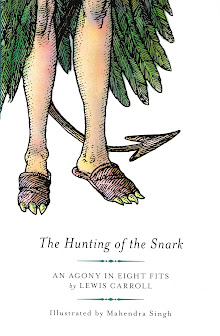
He came as a Baker: but owned, when too late —
And it drove the poor Bellman half-mad —
He could only bake Bridecake — for which, I may state,
No materials were to be had.
Overheard by our foreign correspondent whilst loitering in the Immigration and Customs queue boarding the HMS Snark :
Immigration and Customs Officer: Have you any personal articles of clothing which you are taking aboard?
A Baker resembling Lewis Carroll: I don't know.
Immigration and Customs Officer: Have you any luggage or packages which you are taking aboard?
A Baker resembling Lewis Carroll: I don't know.
Immigration and Customs Officer: Can you state your own name?
A Baker resembling Lewis Carroll: I don't know.
Immigration and Customs Officer: Can you make bridecake?
A Baker resembling Lewis Carroll: I don't know.
Immigration and Customs Officer: Do you not know whether you can make bridecake or are you simply unable to procure the materials to do so?
A Baker resembling Lewis Carroll: I don't know.
Immigration and Customs Officer: (in a heated manner while vigorously waving his arms at the HMS Snark) But confound it all, sir, what does all this mean?
A Baker resembling Lewis Carroll: I don't know.
Note
that the Baker consistently eschews the binary either-or of
conventional logic upon which his interlocutor is depending, resorting
instead to the triunary-based logic of "I don't know". We have already
seen how the principle of threes supersedes all other logical statements
(what I tell you three times is true) aboard the HMS Snark. Thus, the
Baker disposes of the boojum of binary Marxist dialectical materialism,
its frumious one-two is slain by his manxome one-two-three! Huzzah! The
vorpal blade of the trinitarian Snarkist trialectic immaterialism goes
snicker-snack! Oh, there's a PhD dissertation somewhere in all of this,
my beamish boys and girls — oh frabjous day! Callooh! Callay!
In
the meantime our correspondent had fled the scene and was unable to
record any more of what transpired. She had observed that this
exasperated public official was being approached now by the pallidly
neat, pitiably respectable, incurably forlorn figure of Bartleby the Scrivener — a signal for general bedlam to ensue, huzzah again!
NB.
If you ever had to deal with a real Bartleby in either your
professional or private life, you will agree with me when I say that
there's nothing particularly profound, nor artistic, nor even bathetic
in such people. Slack-jawed loafers, I call 'em.
Monday, August 20, 2012
Monday, August 13, 2012
Snarkness at noon
Yet still, ever after that sorrowful day,
Whenever the Butcher was by,
The Beaver kept looking the opposite way,
And appeared unaccountably shy.
The aversion of the Beaver's eyes is motivated by the primitive belief that whatever cannot be seen by oneself, cannot itself see you.* This charming simplicity of thought is the innocent basis of all epistemologies, and it can be said, with some justice, that all of Western philosophy is but footnotes to the nursery-room game of peek-a-boo.
And so … we are indulging in a pre-Socratic, pre-school tautology of existential hide-and-go-seek … the Beaver dematerializes her stony-faced surrealist nemesis, the Butcher, by averting her eyes. Lewis Carroll disarms his Boojum by composing the Snark backwards and thus placing the former into a perpetually receding, invisible future of the latter. As for myself, when that moment arrives when I shall have to tackle the illustrative challenges of drawing the dreaded Boojum … well … I'm one of those literal-minded draughtsmen who cannot draw what he cannot see.
I shall spurn Rule Number One of Illustration (if you cannot draw it, place a bush in front of it) for I am above such petty stratagems — a plague on all manner of foliage, those leaves, so many, so many, is there no end to them? The naked Boojum shall remain a naked, undrawn, unseeing Boojum.
To see a Boojum, ladies and gentlemen, is to be seen by a Boojum! Eschew the lethal gaze of all negating nonentities and all will be well! Focus instead your nondiscerning gaze upon the perfectly rendered nonchalance of this cool drawing. Nothing to see here folks, just move right along.
_______________________________________
*Vide the protosurrealist Andrei Vyshinsky's observation: "The fact that it is dark at night proves merely that I am not paying attention." ("Clinical Morphology of the Parimutuel — Impressions of Mr. Pyridine", Berlin, 1897 – LINK FIXED)
Monday, August 6, 2012
Beware of Greeks Baring Snarks!

They roused him with muffins — they roused him with ice —
They roused him with mustard and cress —
They roused him with jam and judicious advice —
They set him conundrums to guess.
The very mention of that hateful word Boojum had sent our Baker into a swoon and he now reclines artfully upon his hot-buttered-charpoy, just so. His duenna, a woman whose two-faced duplicity beggars the imagination, intercepts the stimulating nourishment which rains upon him like pennies from heaven. The ice, greens, jams and muffins, all of ‘em will vanish into her outstretched apron to reappear in a day-old half-baked no-goods shop she runs on the side. The Baker is left with only a conundrum to guess. Naturally, the conundrum is to guess what the conundrum is.
Oh, these Boojums! Is there no deviltry that they will not stoop to? Great god, save the earth from ever bearing such monsters! No history has proved that there were any such. Through the efforts of the authorities, no one will be exposed to them any longer.
To-say-the-thing-which–is-not and to-draw-the-thing-which-is-not is the Way of the Boojum! That way leads to the Dark Side! Fortunately, our Baker is a simpleton and his foolish mind is the hobgoblin of more consistent ones. Like those buxom Greek girls locked up in bronze towers by their upset daddies, he has no need for conundrums, he just wants to have fun!
_______________________________
NB. A thankful tug of the ink-soaked fetlock towards the perceptive Mr. Adam Roberts at the Valve.org, whose learned and latinate Snarkiana commentary upon the Way of the Boojum is pure catnip for all snarkistes! These English conundrumists need not worry what it is that cannot be roused by muffins, ice, mustard, cress, jam or judicious advice? They know! ‘Tis a sleeping dog whose master shouts — obey, cur!
Monday, July 30, 2012
The French Lieutenant's Snark

"For the Snark’s a peculiar creature, that won’t
Be caught in a commonplace way.
Do all that you know, and try all that you don’t:
Not a chance must be wasted to-day!
Our favorite poet and Eminent Victorian Lewis Carroll has given us the late 19th-century equivalent of certain ubiquitious American psychobabbitries : do all that you know and try all that you don’t.
A peculiar prescription for a peculiar creature, a call of sorts to a half-hearted High Anglican Debauchery aimed at the titillation of the thinking classes. And what titillates the thinking (and unthinking) classes the very most? What is it they dream of, with their eyes wide shut … is it the Female of the Species?
Most likely. And shame on ‘em too, boo hiss boo! Objectifying women with their shameless gaze! These Surrealists, they are a menace to polite society in every city and a blight upon the land in every which way.
They are utterly unlike the respectable, petit-bourgeois Protosurrealist Snark-Hunters whom we see above, scrupulously averting their reifying gaze from La Snarque Nue concealed from them in my forest of lines. Would it surprise you to learn that I have entirely drawn the above with my eyes also firmly shut, trusting only in the animal-instincts of my feral pen to guide me safely through the labyrinth of lines in which the Snark has so cunningly concealed herself?
Monday, July 23, 2012
Who's afraid of Virginia Snark?

He was thoughtful and grave — but the orders he gave
Were enough to bewilder a crew.
When he cried "Steer to starboard, but keep her head larboard!"
What on earth was the helmsman to do?
Then the bowsprit got mixed with the rudder sometimes:
A thing, as the Bellman remarked,
That frequently happens in tropical climes,
When a vessel is, so to speak, "snarked."
Good artists borrow but great artists steal — and never from the merely good artists! I've mercilessly looted the Belgians, French and Italians for the visual furnishings of my GN version of The Hunting of the Snark, so the inspiration for this stanza will have to be purloined from the Germans.
Easier said than done, I soon discovered. Friedrich Nietzsche (The Bonnet-Maker) and Martin Heidegger (The Barrister) refused to countenance my scheme but Karl Marx (The Banker), that preternaturally prescient Protosurrealist, quickly came up with some snappy double-talk to justify my larcenous designs. He pointed out that crime is actually good for the likes of Lewis Carroll and his ilk (double-plus-good, in fact):
"The criminal produces not only crime but also the criminal law; he produces the professor who lectures on this law and even the inevitable textbook … the whole apparatus of the police and criminal justice … also art, literature, novels, even tragic dramas … he (the criminal) gives a new impulse to the productive forces."
That's pretty juicy stuff, so say no more, Karl! Within minutes, my crack team of ninja-idiot-savant-cat-burglar-draftsmen had illicitly purloined and haphazardly reproduced this picture of a giant thumb lusting after his maternal walnut from none other than Max Ernst, the noted German surrealist and an echt bon vivant with the consummate Carrollian taste to die the day before he was born.
Of course, you, the dear reader, may ask: what's this picture got to do with a vessel being snarked in tropical climes? I can only reply: It's a fair cop, guv'nor!
____________________
NB. Max Ernst's illustrations for the Snark are dadamax-loplop-good! One may wonder what Lewis Carroll would have made of them, but by using our Protosurrealist critical apparatus we can safely say: yes.
Monday, July 16, 2012
Happy Snark Day, Wanda June

"Let us take them in order. The first is the taste,
Which is meager and hollow, but crisp:
Like a coat that is rather too tight in the waist,
With a flavour of Will-o-the-wisp.
The question of the Snark’s flavor has exercised the minds and palates of the cognoscenti for many years. However, I am possessed of an indolent nature and prone to fits of take-out, such questions matter not a whit to me. The uncooked flesh of the Snark was sufficient for our more distant ancestors but today’s effete gastronomes must have their Snark curried, tandoori grilled or even minced into seekh kebabs — but never boiled à la anglaise (the hollowness vanishes and leaves behind a residue redolent of a fleet of bathing machines saturated in warm, flat beer).
To properly honor this Wednesday's Snark Day, the 138th anniversary of the genesis of the Hunting of the Snark, here's a traditional Assamese recipe for cooking Snark. Please try it, you won’t be disappointed!
Genuine Assamese Snark Curry
Mix the following together:
• 1 kilo of Snark meat, cubed (if no Snark is to be had, use beef, goat or lamb, preferably with bones)
• 6 medium onions, minced
• small head of garlic, minced
• an inch of fresh ginger, grated
• tablespoon of turmeric
• one cinnamon stick
• one cup of oil
• tablespoon of salt
• a sufficient amount of genuinely hot green chilis, slit
• if you wish to "Indianize" this curry, also add a tablespoon of ground cumin, a tablespoon of ground coriander and a tablespoon of garam masala. This might be preferable for those who are accustomed to the somewhat ubiquitious flavors of Northern Indian cuisine and enjoy a certain familiarity in their curry. However, the authentic Assamese version has a delicious simplicity which is worth trying!
Mix and let sit overnight. Cook on low heat, with the lid on and stirring occasionally for 30 minutes. Add one cup of water, bring to boil, and then reduce heat to a simmer. The curry should finish up with a thick gravy, not at all runny. Cook for about 90 minutes or until meat is tender. Taste for salt, etc. The curry can be garnished with ghee and/or tamarind water. If beef, lamb or goat meat was used, serve with rice, vegetables and dahl.
However, if you used Snark, serve with greens, using forks and hope. Wash it all down with copious amounts of Golden Eagle beer and the stimulating gyrations of two dissipated nautch girls named Anna and Paisa. What ho, memsahibs!
Genuine Assamese Snark Curry
Mix the following together:
• 1 kilo of Snark meat, cubed (if no Snark is to be had, use beef, goat or lamb, preferably with bones)
• 6 medium onions, minced
• small head of garlic, minced
• an inch of fresh ginger, grated
• tablespoon of turmeric
• one cinnamon stick
• one cup of oil
• tablespoon of salt
• a sufficient amount of genuinely hot green chilis, slit
• if you wish to "Indianize" this curry, also add a tablespoon of ground cumin, a tablespoon of ground coriander and a tablespoon of garam masala. This might be preferable for those who are accustomed to the somewhat ubiquitious flavors of Northern Indian cuisine and enjoy a certain familiarity in their curry. However, the authentic Assamese version has a delicious simplicity which is worth trying!
Mix and let sit overnight. Cook on low heat, with the lid on and stirring occasionally for 30 minutes. Add one cup of water, bring to boil, and then reduce heat to a simmer. The curry should finish up with a thick gravy, not at all runny. Cook for about 90 minutes or until meat is tender. Taste for salt, etc. The curry can be garnished with ghee and/or tamarind water. If beef, lamb or goat meat was used, serve with rice, vegetables and dahl.
However, if you used Snark, serve with greens, using forks and hope. Wash it all down with copious amounts of Golden Eagle beer and the stimulating gyrations of two dissipated nautch girls named Anna and Paisa. What ho, memsahibs!
Monday, July 9, 2012
The Bellman Always Rings Thrice

"We have sailed many months, we have sailed many weeks,
(Four weeks to the month you may mark),
But never as yet ('tis your Captain who speaks)
Have we caught the least glimpse of a Snark!
There are those who might quibble and look askance at my rather ideologically vacant interpretation of this stanza. Yes, it is a trifle irrelevant … perhaps even mendacious to illustrate a purported lack of Snarks with a veritable indefectibility of Snarks. The concerned reader might well ask : by whose leave do you have artistic license to mangle the words of Lewis Carroll so? Have you no decency, sir? At long last, have you left no sense of decency?
The eminent Oxford don and man-about-town, Charles Dodgson, was probably the only person who could genuinely claim to be intimate with Lewis Carroll. Mr. Dodgson had this to say about the so-called sanctity of Carrollian texts, their meaning and interpretation:
... I maintain that any writer of a book is fully authorised in attaching any meaning he likes to any word or phrase he intends to use. If I find an author saying, at the beginning of his book, "Let it be understood that by the word black I shall always mean white, and that by the word white I shall always mean black," I meekly accept his ruling, however injudicious I may think it.
Well, that’s pretty much QED, I should think. Simply substitute the word "illustrator" for "writer"; it’s a mere indefectibility of semantic and orthographic difference and expressly allowed for by the above-mentioned axiom. In fact, upon further reflection, we can see that the vast bulk of modern art, philosophy, politics and commerce is based upon Dodgson’s diabolically simple postulate.
So stop fussing over these drawings and rest a spell under the ole Boojum tree with me. Goshdarned wordpeople, always making trouble for poor picturefolk …
Monday, July 2, 2012
East o' the Sun and West o' the Snark!

But the principal failing occurred in the sailing,
And the Bellman, perplexed and distressed,
Said he had hoped, at least, when the wind blew due East,
That the ship would not travel due West!
And so, even the least of the Bellman's hopes shall be occidentally disoriented. What wind blew you hither, noble Bellman? Not the ill wind which blows no man to good. Nor that wind which is winding the watch of your wit; so that by and by it will strike.
I think this wind is what the learned scholastic Flann O'Brien would call the ultimate and inexorable and supreme pancake at the back of the whole shooting match, ie., omnium. And what is this omnium of this wind that we hear so much of on the tellyvision? It is the essential, inherent, interior essence which is hidden inside the root of the kernel of everything and it is always the same. The bane of Boojum and Bellmen alike, the curse of the drinking classes, this here omnium-wind is the wind of an indefinite divisibility.
Monday, June 25, 2012
Some snarks do 'ave 'em

" 'You may seek it with thimbles — and seek it with care;
You may hunt it with forks and hope;
You may threaten its life with a railway-share;
You may charm it with smiles and soap —' "
Do not mistake this infamous stanza as a magical refrain or prescription designed by Lewis Carroll to assist the B-Boyz in their Snark hunt, nothing could be further from the truth. Such misthinking is an anthrosemiotic bogeyman put forth by certain academics & philosophies of the Sir James Frazer ilk, Cheapside tailors peddling "ready-made suits" for their naked and the dead.
Consider instead the internal Mind of this poem (yes, there are such boojums), which lives a life independent of its creator, its inhabitants & even its readers. All works of art have these primeval Minds, each according to its national character. The Mind of this poem, being English, roams the midsummer nights daubed in woad, speaks in runes at high tea, shares small beer with the Mind of the Domesday Book and Prospero’s Books in the Mermaid Tavern, and dosses behind hedges with the Mind of Bradshaw’s Railway Guide, a direct descendent of Achilles’ Shield presently down on her luck.
Before you can voice your objections, I must interject — pshaw! Be unperplexed, dear reader! — the Snark and the Mind of The Hunting of the Snark are not the same beast. The latter is a deliberate fiction bandied about by Lewis Carroll. The former is the Art behind the fiction — a magic which the Muses have excused from the lie of being truthful.
Oh, ye of too much faith! Can’t you see that all your seeking and hunting and threatening and charming, that all of your sacrifices are meant for you, you alone, that they serve only to distract you from the truth? We heap up our sacrificial relics at the feet of the Mind of the Snark: the thimbles, the cares, the forks and hope, the railway shares, the smiles and soap, all that Victorian bourgeois clutter mouldering in our mental attic — for ourselves only!
Pack up your smiles and soap, abandon all forks and hope, ye überliterati! Repent and understand at last that the Hunting of the Snark is a robinsonade (the mysterious island from whence all Nonsense springs) and that the Mind of the Snark is its pagan god-chieftain at whose feet we pile gifts useful to no one but ourselves.
Monday, June 18, 2012
I sing of snark and the man …

In a world without words, only the small-minded will be tongue-tied. Although our gallant crew aboard the HMS Snark is none of the above, they are maintaining strict radio silence as they slip by the pictorially-fortified beaches of the deadly Festung Schnark. The tension is palpable, our brave lads (and lass) are straining every nerve as they man (and miss) their weapons.
And what weapons are these? Steam-powered concussion-primed pencils? Petrol-driven semi-automatic violins? Pshaw to such antiquated music-hall-cross-talk-claptrap! Our snarqistadores are armed with only an indifferent somnolence, punctuated by an insouciant nasal susurration … they are snoring, they are snorting, they are sniffing and sneezing, they are speaking that most ancient, somatic and asemic dialect of the body physical, proof positive against all visual illusions and cognitive man-traps of the so-called higher intellect.
Hold on, what’s all this, you say? Lost in the disorienting farrago of my mixed metaphors and strained allusions? Missing the connection, the old brain-box gone off-track, signals crossed somewhere? Don’t panic! I shall refer you to the classic solace of the dislocated and confused Victorian bourgeois Snark hunter — a Bradshaw’s Guide!
Look here, sirrah, here it is writ out, plain as can be! All the lost luggage and missed connections of long-dead phonemes, waiting on long-gone railway platforms for a linguistic rendez-vous with a common usage that never arrived … schnarren, schnarchen, snarren, snerka … and yes, dare we say it — SNARK!
I think I’d better go and have a nice lie-down now. To sleep, perchance to snore — aye, there’s the snark.
_____________________________
NB. A tip of the ink-stained tuque to goofy, the proprietor of the wonderful and highly recommended Bradshaw of the Future, whose etymological assistance in our Snark hunt has been invaluable and fascinating. BOTF’s provenance stems from that " desperate wrong-doer " in Lewis Carroll’s " A Tangled Tale ". Any resemblance to railroad Bradshaws real or fictional , either living or dead, is purely coincidental on my part … dismiss it all as a false cognate destined to plague as-yet-unborn googlistas surfing the digital Bradshaw of the future.
Monday, June 11, 2012
The heart of a snark is a lonely hunter of darkness

"To seek it with thimbles, to seek it with care;
To pursue it with forks and hope;
To threaten its life with a railway-share;
To charm it with smiles and soap!
A reiteration of the Snarkic Galdor … a type of verse-charm first overheard by the poet Lewis Carroll whilst sipping his tea and mentally searching for rhymes in the commons room of Christ Church College in the depths of the latter half of the 19th century. No doubt Carroll was puzzled by this sudden outbreak of cryptoskáldic fervour in what was then a bastion of High Church Anglicanism but he was a discreet man and kept his thoughts to himself.
However, I am congenitally incapable of keeping any thoughts to myself! At this very moment I am mentally whirling along certain transient nodes of thought careening through a cosmic vapor of invention, as the infamous Hedly Lamar once pensed aloud to the uncomprehending Slim Pickens.
Unlike Slim Pickens, gentle readers, you will easily grasp the essence of my thoughts, which I’ve thoroughly illustrated above. The Snarkic Galdor is baited, literally, with the tempting person of the Baker himself! Lured by his smile and a bar of soap, the unsuspecting Snark will venture underneath the requisite giant thimble and then be trapped there by the quick and concerted action of the Baker’s Fellows!
The Baker’s transient nodes of thought on the matter can only be guessed at. However, thanks to the learned Adam Roberts’ ingeniously cosmic vapors of invention, we now know that the Baker’s earlier polylingual attempts at communication with his fellow B-Boyz (see Page 25, Panel 2) were simply an enunciation of the observation that Humanorum hetaeria es auto (you are yourself the brotherhood of all men). His comrades have taken this generous, fraternal gesture of self-sacrifice on the Baker’s part as carte blanche to proffer him up as living Snark-Bait.
This business of offering oneself up as a bait for Evil must inevitably occupy the whirling, transient thought-nodes of anyone enjoying his tiffin at the aptly-named Christ Church College. Perhaps, as Carroll munched his bread and butter sandwiches and plotted his rhymes, he was entertaining first, second or even third thoughts about his own personal Boojums … or perhaps he was merely biding his time till the invention of the talking-type-wireless with which the ubiquitious Slim Pickens would finally set all of his religious doubts to rest!
Monday, June 4, 2012
The infernal bathing machines of Dr. Hoffman

"The fourth is its fondness for bathing-machines,
Which it constantly carries about,
And believes that they add to the beauty of scenes —
A sentiment open to doubt.
Given : Only with one’s bathing-machine can one bathe properly and thoroughly.
Given : The divinely-ordained, absolute and ineffable perfection of any place cannot be achieved without a bathing-machine.
Ergo : Cleanliness is next to godliness.
Not a surprising sentiment coming from the pen of an English clergyman’s son but it is an accurate depiction of the Snark’s true character and motives? Read on, MacDuff …
Given : The Snark’s sentimental attachment to bathing-machines does nothing to improve the beauty of scenes.
Given : The Snark’s sentiments are open to doubt.
Ergo : When in doubt, do nothing.
A Fabian approach to the hunting of Snarks but will the poilu tolerate it? History warns us otherwise! Je me souviens de Cannae …
Given : The utility of a bathing-machine lies solely in its property of not allowing an observer to know what is inside it.
Given : The Snark’s chief happiness is the transportation of its bathing-machine from one place to another.
Ergo : Ignorance is bliss.
And there you have it, another Clochetic validation of the platitudinous proverbs with which we usually stave off our lexical and cognitive horror vacui. I have illustrated all of the above palaver with another infamous platitude, one of the Comte de Lautrémont’s most infamous bromides: the chance meeting on a dissecting-table of a sewing machine and an umbrella. I think the bathing machine lends a certain banality to the whole thing, don’t you? Even surrealism (and especially protosurrealism) has its sentimental, even hackneyed picture-postcard moments!
Monday, May 28, 2012
Don't care if it rains or freezes, long as I have my plastic Snark on the dashboard of my car

When at length he sat up and was able to speak,
His sad story he offered to tell;
And the Bellman cried "Silence! Not even a shriek!"
And excitedly tingled his bell.
There was silence supreme! Not a shriek, not a scream,
Scarcely even a howl or a groan,
As the man they called "Ho!" told his story of woe
In an antediluvian tone.
Martin Gardner, in his indispensible Annotated Snark, cites Eric Partridge’s assertion that the Baker’s use of antediluvian is "one of those rare instances in which Carroll uses a standard word in a completely whimsical sense". Gardner also notes the opposing theory of antediluvian being used as a foreshadowing of the Baker’s tears-to-come.
However, you and I know that he’s speaking Adamic, the universal language spoken before the Flood and the dispersal of tongues at the Tower of Babel. This antediluvian language, designed to facilitate Edenic communication between discreet data points in a secure and lossless environment (think FORTRAN or KVIKKALKUL), remains the Baker’s preferred flavor of postlapsarian blarney*. If we waxed poetic, we might even say it’s the angelic language which animals and children babble when the adults aren't about.
But we’ll wax not, as yet, for deep, deep, deep underneath the surface, the Baker’s very shallow. Bless his simple Adamic soul but he’s just a Chomskian idiot-savant suffering from untreated Postdiluvian Stress Syndrome. He sees the sun going down and the world spinning round and he macadamizes a postmodern, postlapsarian, postdiluvian and postbabelian man of sorrows on the comeback trail.
As for the Baker’s curious epithet of Ho; it is a typical bit of Snarkolinguistic bandinage, an orientalist snarkwallah’s reference to the eponymous language spoken in eastern India and Bangladesh, a language whose word for man is ho.
The word, the language, the man — all together now — tally ho!
___________________________________
* The reconstruction of the Adamic language is a wholesome pastime for the protosurrealist insomniac. Its a priori ontological perfection requires an infinite vocabulary in which every word is a homophone of the other. All conjugations in the infinitive, all declensions nominative, no prepositions needed since every speaker is every thing and thus consubstantial, no interrogatives since they imply a lack of faith, etc. Might we not conjecture that Adamic survives today as the uneasy silence between phonemes?
Monday, May 21, 2012
I am an invisible snark

“Introduce me, now there’s a good fellow,” he said,
“If we happen to meet it together!”
And the Bellman, sagaciously nodding his head,
Said “That must depend on the weather.”
The above stanza may be a bit unclear to some readers (particularly those possessing an iota of common sense). The Butcher, seen above as a lugubrious sort of rude mechanical’s nightmare of an Easter-Island-Pierrot, is requesting the Bellman to formally introduce him to the Snark whenever they might encounter it. The Bellman is noncommittal, stating that either the introduction* or the meeting itself (or both) is entirely contingent upon the weather.
What gives, Lewis Carroll? Are we still hunting snark or are we just marking time now? Are we waiting for Godot or even his late-Victorian progenitor, Mistuh Kurtz? Very well then, so be it! We shall once again call upon Oscar Wilde for some quick and snappy enlightenment. Being both Irish and dry-witted, he was particularly qualified to make the following pronouncement upon the English and their mildewed sense of meteorology :
"Pray don't talk to me about the weather … Whenever people talk to me about the weather, I always feel quite certain that they mean something else.”
Following this trail of bread crumbs deeper into the naughty forest of edible children, we stumble over the twitching presence of the Great Cham himself, Dr. Johnson, who tossed off this trite observation with his customary gravitas:
“It is commonly observed, that when two Englishmen meet, their first talk is of the weather.”
A thing that always means something else, a thing that is always the prime topic of discussion … hmmm … we will proceed by mentally triangulating all of this with our above, freshly-minted illustration of a Bellman under the weather.
End result? A compact semioglyph of an Englishman feeling out of sorts because he is compelled by national habit to say something that always means something else, in short, to say the thing that was not! Yoicks, the game’s afoot at last! Behind the jolly good sport of our Snark Hunt, behind the labyrinthine hedgerows of English Nonsense, we have once again detected the spoor of that irascible Yahoo, Dean Swift! Oh, to say the thing that is not is all the rage these days, you add a dollop of Nonsense to it and it will cover a veritable multitude of sins, not the least of which is my penchant for the most byzantine mixing of metaphors yet known to man!
To horse, to Houyhnhnm, the Yahoos are let loose, there’s a scent of Snark in the wind and the weather’s fine!
_______________
*One can imagine the grim consequences of any letter of introduction to a beast such as a Snark or even, heavens forfend, a Boojum! Pity the poor Butcher as he hands over his letter to some supercilious flunky in a glacial waiting room, the contents of which letter are invisible to him but which we already have guessed to be a simple mandate of utter Boojumistic malevolence — keep this Butcher running!
Monday, May 14, 2012
Gödel, Escher and Snark

“Taking Three as the subject to reason about —
A convenient number to state—
We add Seven, and Ten, and then multiply out
By One Thousand diminished by Eight.
This is not a medically approved mathematical operation …
This is not an insight into the Essence of the Number Three …
This is not the Royal Road to 19840 …
This is not a comment upon the intractable unreality of all Numbers …
This is not a jaded Christ Church don’s comment upon the futility of impressing the intractable unreality of all Numbers upon his all-too-real thickheaded students …
This is not a Montreal illustrator’s comment upon the futility of impressing his long-suffering wife with yet another display of his useless facility* in mimicking the Victorian wood engraving style instead of mimicking a freshly-served hot supper …
This is not an image of an image which is not what it seems to be …
This is not the sort of thing which the general public has come to expect, thank god …
This is not the unexpected work of a far better artist …
This is not a clue to the fabled and elusive meaning of The Hunting of the Snark, for this is not clairvoyance.
_____________
* Nor is this a pathetic attempt to gain the attention of any readers interested in my illustrations to J-C Valtat's impending steampunk opus, Luminous Chaos, (coming out from Melville House this Fall) illustrations done as a groveling homage to the various Vernian illustrators whose works were themselves a misguided attempt to gain the attentions of readers in a dimly perceived future whose disdain for contemplating any illustrative work more complex than the ink-daubed meanderings of a concussed bumblebee would eventually stagger all of our collective, transtemporal, illustrative minds.
Monday, May 7, 2012
The Adventures of Huckleberry Snark
Readers of
this blog who already possess a copy of my GN version of The Hunting of the
Snark will know that the artist's afterword which graces that already
gracious volume is a fine thing indeed. It purveys information
animal-vegetable-and-mineral about all things Snark in a handy, easy-to-swallow
format.
This
afterword was actually the second draft of the primal Ur-Wort which follows
below. After some reflection, both I and the publisher, Melville House, deemed
this original text to be too "hot" and "spicy" for the
average North American reader. Apparently the latter prefer their Snarkiana al
dente, as opposed to we Indo-Germanic Snarkistas, who prefer our Snark
well-oiled and lascivious.
NB. Follow
me on Twitter … and find
out why oulipo is words crucified upon numbers but epistemology is numbers
crucified upon words. Plus lots of naughty shop-talk as I illustrate the next
volume in J.C. Valtat's New Venice steampunk series, Luminous Chaos,
coming soon from Melville House.
______________________________________
The
Inking of the Snark
Our hunt
began with a stroll. On the morning of July 18, 1874, a Christ Church
mathematics tutor, Charles Lutwidge Dodgson, happened to be taking one around
Guildford, a village in Surrey. He had spent the night nursing his consumptive
nephew and as he now walked through the bright English countryside, a curious
and unexpected thought came to him, a random line of Nonsense verse that
flashed through his mind:
For the
Snark was a Boojum, you see.
Even more to
our purpose, at that precise moment a startling personal transformation took
place, a metamorphosis, in fact: the rather unassuming personage of C.L.
Dodgson suddenly vanished and in its place reappeared the celebrated literary
genius, Lewis Carroll.
The more
flamboyant Carroll had already made his reputation with British readers as the
author of two masterpieces of children’s literature and high Nonsense: Alice
in Wonderland and Through the Looking Glass. Yet he had not produced
any other significant work for several years afterwards until that July morning
when an odd fragment of unexpected and semi-intelligible verse set in motion
his final and most controversial work of Nonsense.
The obliging
Dodgson withdrew from public view for the next two years to allow Carroll the
time and privacy necessary to compose the remaining 563 lines of that poem
which we know today as The Hunting of the Snark. It was a difficult and
time consuming task; the poem was essentially composed backwards in bits and
pieces from the initial fragment and Dodgson’s hectic schedule often required
the poet to set aside his pen so that the busy academic could attend to his
less glamorous professional and family duties.
The epic was
eventually published in 1876 to lackluster critical reviews yet the public paid
them no heed, so much so that the book has remained in print till this day and
in at least 16 languages to boot. Yet the Snark’s literary and
commercial success also proved to be Carroll’s literary Boojum. From this point
onwards, Dodgson demanded a far greater creative role at Carroll’s expense, a
difficult state of affairs which culminated in the debacle of Sylvie and
Bruno a few years later.
In any case,
the Snark itself thrived as only genuine Nonsense can in this supposedly
hard-nosed world. Proving to be a subversively addictive earworm for
connoisseurs of linguistic and logical mayhem, it exerted a cult-like spell
upon many of its readers and equally important, the many artists who seized
upon its raw matter for their own uses over the years. Its curious, almost
symbiotic ability to re-evolve itself to fit the changing needs of its
artist-hosts eventually put it in the ranks of such archetypical works as the Faust-Buch
or the Odyssey; classic texts which transmogrify themselves so often
that one could say that they have literally taken on a life of their own.
Yet the
poem’s appeal and purpose seem to have mystified the author. Carroll repeatedly
stated that he had no idea what the Snark meant or even what it actually
was and he would often ask his questioners to inform him post haste if they
ever discovered the meaning. Hence, if we were in a charitable mood, we could
put his mind at posthumous ease by informing him that we have classified his Snark
as an independent minded and rather prolific creature endowed with such
evolutionary and metamorphic super-powers that its hidden meaning is impossible
to pin down and hence open to all.
But alas,
charity can go only so far in the cut-throat world of Carrollian research! Our
Symbiotic Theory of Snarkian Evolution would be swiftly pooh-poohed by those
legions of up-to-date Snarkistas who would point out the poem’s many references
to contemporary Victorian events and issues as furnishing a good enough sort of
meaning.
They would
bandy about certain facts, facts of both a public and personal nature. To begin
with, the resemblance between the Baker and Carroll himself is striking: the
Baker’s boxes numbering 42, which was Carroll’s age in 1874; the Baker’s
references to a dear uncle, possibly the same greatly loved uncle from whom
Dodgson gained his middle name (and who was murdered by a lunatic armed with a
sharpened nail); and finally the descriptive similarities between the meek and
rather comical personalities of both the Baker and the author.
The
Bellman’s Rule of Three could be a reference to a popular Victorian
arithmetical crib and perhaps even the American philosopher Charles Peirce and
his trinitary obsessions. The Barrister’s Dream smacks of both the infamous
trial of the Tichbourne Claimant and Gilbert and Sullivan’s operetta Trial
by Jury, while the Beaver’s Lesson pokes fun at Dodgson’s own wearisome
profession of teaching mathematics to the disinterested progeny of the upper
classes.
On closer
inspection, even the word Snark seems to be a linguistic rat’s nest of tattered
references. Carroll himself claimed, jokingly as was his frustrating wont, that
the word was a portmanteau of snail and shark (with a soupçon of snake) while
more sober minded etymologists have laid the beast’s paternity at the
promiscuous feet of the modern German verb schnarren, to jar or buzz, which
itself is cognate with the Low German snarren, to snarl. One Australian
researcher has even unearthed an obscure 18th-century reference to
the tattooed face of a Maori warrior as being “a face all snark’d”, a usage
which bodes ill for today’s ubiquitious tattooed hipsters.
In short,
the entire poem is bursting at the seams with topical references to all of the
above and much more besides: English banking practices and naval history,
sea-side bathing, Shakespeare, music hall crosstalk and even poolhall loafers;
so much so that even the most jejune reader is bound to notice that Something
Is Going on Here.
Unfortunately
for the jejune amongst us, the quest for meaning in modern Snarkonomics has
higher standards of proof than a mere suspicion about a certain something.
Simply saying that Lewis Carroll had embarked on a
protofreudian, hyperontological or even crypto-existential Snark Hunting
crusade may sound impressive at cocktail parties but we Snarkards are made of
sterner stuff, we demand proof with our drinks!
This
writer could present a second theory at this point, even more bloviated than his earlier Darwinian concoction. He could
point out that a drearily earnest
Snarquistadore might consider regenerating all 4,452
words of the Snark’s verses into a matrix roughly congruent in
morphology, syntax and grammar to the original, commencing on or about July 18,
1874. The resulting text file might provide them with an optimized WYSIWYG
explanation of the meaning of the Snark, assuming of course that they
had not taken religious orders beyond the level of Deacon but that they did
have a minimal pedagogical experience in college-level mathematics; and also
assuming that they could "read" the resultant codex with a false
recursive memory of having composed it themselves whilst seeing it for the
first time; all while bearing in mind that the physical location of this
generation process would be unimportant, that anywhere in the English rain
while wearing scratchy woolens and mudcaked wellies would do.
This
second theory, the so-called Pierre Menard Theory, leads us inevitably into the
pythonesque coils of a yet another and mercifully terminal theory. This one
summarizes the entire, teeming expanse of the Snarkian Multiverse and the
multiply occluded meanings of Carroll’s Agony in Eight Fits thus:
maybe.
Alas,
if only things were that simple! For it so happens that when this artist
decided to take up his inking of the Snark, he did so knowing that
starving artists such as himself have a
certain traditional obligation to provide employment to their equally
impecunious academic brethren. Call it noblesse oblige if you must, but every
page, every panel, every inky jot and tittle of this Snark would have to
be imbued with a gallant spirit of selfless fraternal thing-um-a-jig with the
above-mentioned what-you-may-call-ums. In short, only an impenetrably recondite
version of Carroll’s Snark would provide those legions of graduate
students and other itinerant savants with sufficient gainful employment to
justify their generations of stipends to come.
But how to
make good on such a philanthropic promise? Metamorphic verse composed by a
metamorphic poet poses a certain problem for the conscientious illustrator,
that is to say it requires a good amount of hard work and as another
metamorphic poet once noted, work is the curse of the inking classes.
Fortunately
for this ink-stained wretch, his handpicked team of elite ninja-cum-nautch-girl
research assistants quickly unearthed the necessary dirt on the Admirable
Carroll. They discovered that Lewis Carroll had long ago been appropriated by
the French Surrealists as one of their own; the Pope of Surrealism, André
Breton, and his faithful henchman, Louis Aragon, had anointed Carroll quite
early on as a worthy precursor to their own utopian crusade of remaking the
human race in the image of its own dreams. The poet’s disdain of the usual
variety of quotidian logic on offer in most Victorian bookstores in favor of
his own concoctions of the finest dreams money could buy had always fascinated
the founding fathers of Surrealism. Like all good revolutionaries, these
founding fathers secretly craved the bourgeois respectability of an illustrious
pedigree and so they eagerly inducted the long-dead Carroll into the elect
ranks of their so-called protosurrealist saints.
What Carroll
himself would have thought of being lumped together with the likes of the
Marquis de Sade, Raymond Roussel and the Comte de Lautréamont is beside the point, we
can’t all of us choose the company we posthumously keep anyway. But with a bit
of deft legwork to avoid the aforementioned zombie protosurrealists (a bit too
much for the kiddies, even in these postlapsarian times) a clever artist could
easily scavenge the more genteel quarters of Surrealism and its antecedents for
sufficiently toothsome goodies to flesh out the mutated words and ideas which
roam the Snark.
With all of
that in mind, this artist established an entirely new stylistic school
exclusively for the production of this Snark, the artistic genre of
Protosurrealism. This would allow him to illustrate the verses of the 19th-century
Surrealist precursor, Lewis Carroll, with suitable images referring to a future
the poet never knew or probably would have cared to know.
One moment,
the alert reader will now ask, just what is this thing called Surrealism? The
simultaneous dream-memory of everything, we answer back rather too quickly. So
what then is Protosurrealism, continues this persistent reader? The same as
above with an added frisson of remembering an impossible future, we smugly
reply. We might also add that Protosurrealism is the 21st-century application
of 19th-century answers to 20th-century problems or even that the true
Protosurrealist is a postmodernist (or even a postpostmodernist) who telescopes
his Surrealist past into a Victorian intellectual’s expected future until his
own past becomes his future and his nostalgia becomes his anticipation.
Even better,
we might simply announce that this Protosurrealist Snark you hold in
your hands is the full text of the finest Nonsense poem ever written, now
copiously illustrated with the dream imagery of Surrealism. You can safely read
and even recommend this book knowing that its attempt at believing in a
brighter future by building upon the better rubbish of the past is at worst
nothing more than a bit of middle-aged nostalgia slightly run amuck.
In short, there
is no cause for concern or need for panic amongst the well-oiled literary set;
it’s just that the Snark, the only truly epic poem of all Victorian
literature, has metamorphosized itself here into an artist’s homage to those
masters and their works — not only Surrealist — who form our visual, literary
and philosophical collective conscious*. Each drawing tries to follow in some
manner the tangled web of meaning and allusion which binds together the
cultural history of art and thought. So for example, do not be alarmed by the
curious fact that the second panel on page 4 depicts the Baker’s 42 boxes on
the beach as being labeled with his alias “candlestub” by using the Chinese
ideogram known as “xié”. The boxes and the girl with the fan are directly taken
from one of Carroll’s own photographs, a portrait of Alexandra “Xie” Kitchins
posing as an off-duty Chinese tea merchant. The gentleman at the easel is the
late and sorely missed British author Douglas Adams, whose Hitchhiker’s
Guide to the Galaxy proved conclusively that the Answer to the Meaning of
Life, the Universe and Everything In It is 42. The painting of a box that he is
working at is labeled with a variation upon Magritte’s famous anti-dictum,
“this is not my box” and is itself a play upon the Belgian’s seminal work, The
Human Condition I.
In short,
this artist will have his little jokes and he begs your pardon for his inky
sense of humor. He would like to submit certain mitigating circumstances in his
favor to his more easily pixillated readers by pointing
out that the true worth of this enterprise, our ever so ‘umble Snark,
will only be realized when curious readers, particularly the younger ones, are
intrigued enough by what they glimpse here to further pursue on their own that
immense cultural heritage which silently — and so faithfully — awaits them.
At the very
least, such selfless ambitions might gain this author a brief respite from the
otherwise chilly reception he expects from the poet, Lewis Carroll, when we
eventually meet in whatever hereafter has been laid on for us.
______________________
* Including
but not limited to, in either direct or indirect reference: Douglas Adams, Agesander, St. Anthony of Egypt, Aristotle, Jean and
Hans Arp, Athenodoros & Polyclitus LLC, Hans
Bellmer, Denise Bellon, Jean Benoit, Arnold Böcklin, Hieronymus Bosch, Constantin Brancusi, Sebastian
Brant, Augustus Caesar, John Coates and George
Dunning and Heinz Edelman, Diogenes the Cynic,
Salvador Dalí, Charles Darwin, Jacques-Louis
David, Giorgio De Chirico, Eugène Delacroix, C.L.
Dodgson (appearing here as Lewis Carroll), Marcel Duchamp, Albrecht Dürer, Max Ernst, Gustave
Flaubert, Sigmund Freud, Théodore Géricault,
Jean-Léon Gérôme, Gilbert and Sullivan, Vincent van Gogh, Mathias
Grünewald, Beatrice Hatch, Heraclitus, George Herriman, Martin Heidegger, William Hogarth, Henry Holiday, Jean Auguste Dominique
Ingres, Judas Iscariot, Edward James, Alfred Jarry, Alexandra Kitchins, the Comte de Lautréamont, V.I. Lenin, Dora Maar, René
Magritte, Édouard Manet, Karl Marx, Masaccio, Michelangelo, Joan Miró, Kiki de Montparnasse, Richard Müller, Friedrich
Nietzsche, Edgar Allan Poe, Plato, Raphael, Man Ray, Madame Récamier, Oscar Rejlander, Raymond
Roussel, Erik Satie, Alberto Savinio, Socrates, Duns
Scotus, Yves Tanguy, Sir John Tenniel, James
Tissot, Titian, Leonardo da Vinci, Jean-Antoine
Watteau, et alia. In a final
nonsensical twist to all of the above, the most-quoted artists in this work (de
Chirico, Magritte, Savinio, Dalí and Bosch) were never card-carrying
Surrealists to begin with, being either expelled from the ranks of the elect by
Breton or just too dead to qualify. As for the actual works of art, literature,
music and even locales referred to in this Snark, hunting down their names and provenances should provide
even the most obsessive reader with sufficient fodder for his tediously baroque
fantasies of world domination through better systems of information management.
Subscribe to:
Posts (Atom)