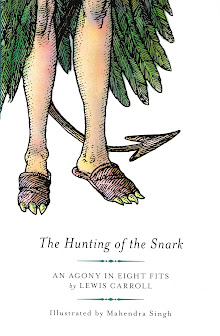
We're plodding through yet another exegesis of my Snark GN … deep in the anapestic bowels of Fit the Second …
There are some who might say this artist's conception of the Bellman is a
base and underhanded attack upon the same, suggesting as it does that the Bellman was literally birdbrained and furthermore, that his colleagues (depicted here and here) possessed the collective wisdom and general prescience of a flock of chickens on the way to the abattoir.
But this is not the case.
I
put it to you that the English penchant for all things avian is
well-known. I put it to you that Lewis Carroll populated his verse and
prose with many avian and semi-avian portmanteaux (or portmantanimaux?) such as the Jubjub Bird and the Borogrove.
I put it to you that the Bellman has suffered the ill-effects of a Violent Unknown Event and that he has metamorphasized into an avian state common amongst avant-garde English cineastes. The wisdom on his face is actually the smug look of a sporting wallah who finally knows for certain which came first, the chicken or the egg.
Monday, January 13, 2014
Monday, January 6, 2014
Cry havoc and let slip the snarks of war
We're plodding through yet another exegesis of my Snark GN … deep in the anapestic bowels of Fit the Second …
Each Fit begins with a frontispiece involving a pun of some sort — the feebler the better — and a clumsily hidden depiction of the Snark. Alert readers will remember that the Snark is I, hence, the Snark as Eye is liberally scattered throughout the book. Less alert readers can look it all up on google.
The Bellman's speech is of that particular British provenance yclept "fruity". Not so much "plummy" but rather … "peachy". If one removes the fuzzy skin thereof (the burr, so to speak) one is left with a nectarine. This fruit (spelled n-e-c-t-a-r-i-n-e but pronounced "stuffed cabbage") was the preferred nutrition of most cavemen and it was they who first domesticated the dog.
We see here a sample of that species, a young pup named Laelaps, who attends upon his master's fruity voice. And what does he hear? A sonorous mussitation which leaves no impression upon him at all, for, as Thomas Aquinas noted, dogs have no souls. Hence their proverbial high fidelity is but a marketing ploy.
A dog, a peach, a gramophone — after all these years, my own 3-piece jazz combo! At last, I can take a bath. And just in time too, my gin-driven ink-pen's almost run dry.
Monday, December 30, 2013
The Bellman rings twice

THE HUNTING OF THE SNARK by Lewis Carroll, a graphic novel by this artist and explained here, page by page, panel by panel, squiggle by squiggle … right now we're in Fit the Seventh …
Leaving someone to their fate is all the rage in certain philosophical circles. The smart set calls it a feeble-minded tautology but we think it's a splendid excuse for yet another obsessively cross-hatched depiction of Karl Marx shaking his fat German booty in a tight-fitting Hindustani harem outfit.
Of course, if you just tuned in to this GN version of The Hunting of the Snark, you're probably eying the exit by now, eager to get away from all this eschatological psychobabble but if you're a regular habitue of these parts, you'll know that all of the above is just another example of this artist's singular inability to clearly explain whatever it is that he's up to.
The shehnai-playing monkey and the bewigged barrister-pig are window-dressing for the real "meat" of this stanzel is the squiggly, blobby bits of ink encrusted on the right-hand margin, the ones that spell out the word "BOO". This word's grim import will become clearer later on but for now, I suggest that you avoid making eye contact with it.
Snark drawings are the New York subway-riding winos and psychos of the illustration and comix world; reeking of strong ink and sour, week-old tautologies fished out of filth-ridden dumpsters, they spell nothing but trouble, especially of the B-O-O ilk.
So go ahead, give 'em your spare change if you want to but you know what they'll do with it, don't you? … far better to leave them to their fate while you scurry back to your cozy, safe home in the predestinarian suburbs …
Meanwhile, a propos of nothing in particular … here's Terry Gilliam's take on making a living in the arts:
"If I'd actually learned any of the lessons, I wouldn't be making films anymore. I try not to learn. I spend most of my life unlearning …"
Soyez zen, Mr. Gilliam!
Monday, December 23, 2013
Everywhere man is born free and everywhere man is snarked

You know that your professional life has taken a turn for the better when people will pay to see your drawings of The Banker, AKA Karl Marx, vamping his way through the British Raj in blackface (or brownface, to be precise). But I digress …
This stanzel is jam-packed with jolly bits of scrumptious, Nonsense-soaked Carrollian references. Would it interest you to know that:
1. Mimsy is a portmanteau of miserable and flimsy. The word is current throughout the Carrollian Multiverse, ranging from Snark Island to Looking Glass Land. Pessimistic linguists call this sort of thing a Grimm Shift, while their more psychologically attuned colleagues prefer to call it a Freudian Slip. The main thing is getting the word out of her knickers and into something a little more comfortable.
2. The Banker is rattling his bones and fingering his hair; the former is a reference to Mister Bones, a stock character in Victorian minstrel shows who would literally play himself, ie., play the bones … and the latter is a probably just the Banker luxuriating in his newly-minted, windswept locks. Dialectical materialism works wonders on the dreaded Bed Head.
![]() |
| The Bone Player, by William Stanley Mount |
3. The deliciously well-turned line, "words whose utter inanity proved his insanity," is a cleverly veiled jab at the letter "S", whose appearance inside a word, say inanity, seems sufficient here to render it unfit to operate heavy machinery or make major financial decisions. This petty defamation of the letter "S" is itself a classic example of the inability of most phonemes to just get along. Why can't they learn to live in peace with one another? It's utter insanity, their communal inanity.
Monday, December 16, 2013
The Jewel in the Snark

THE HUNTING OF THE SNARK by Lewis Carroll, a graphic novel by this artist and explained here, page by page, panel by panel, squiggle by squiggle … right now we're in Fit the Seventh … the Banker, played by Karl Marx, is going blackface …
What better way to get into the genuine spirit of the holidays than to ogle this salacious image of Karl Marx in blackface, doing a Carrollian bump and grind?
Lesser-minded readers will reach for their politically correct smelling salts or even their attorneys but well-oiled Carrollians will heave a self-satisfied sigh of relief at all of this, for they know that in this, Fit the Seventh of our GN version of the Hunting of the Snark, the Banker has been transmogrified twice! First by this artist, who has been depicting him throughout this Snark as Karl Marx and second, by his nemesis, the Bandersnatch, who has reversed his various Caucasian, upper-crust British Victorian polarities into those of a rupee-less, paan-chomping Hindustani rickshaw wallah slumming his way through the salad days of the British Raj.
All of this is per the instruction of the Admirable Carroll, naturally, so don't look askance. He wrote it all down in black and white anapaestics, in a coded message entitled The Hunting of the Snark which this artist then de-ciphered into anapaestic, Protosurrealist crosshatchings of the darkest, inkiest splendor.
It is horrible and senseless and rather confusing, this Carrollian Multiverse we call the Snark and as the observant reader can see below, its gravitational perturbations are rippling through the very fabric of time and space as we speak. Observe this oddly-shelved copy of our Snark which was spotted at a bookstore, endeavouring to say what its tongue could no longer express …
Thanks to my keen-eyed friend and poet Sommer Browning for alerting me to this curious incident and please, if the person responsible for this shelving is reading this, accept my heartfelt thanks. I salute your innate sense of Surrealist horror, your senseless grimace at the pigeon-holing, soul-crushing dictates of modern commerce.
Lewis Carroll rubbing his tweedy shoulders with Sappho and Ovid, the mind boggles deliciously.
_______________________
NB. My essay on draftsmanship, Art Spiegelman and graphic novels is up at the Hooded Utilitarian. To tell the truth, the entire subject of draftsmanship wearies me … it seems immaterial to most readers and many artists and yet the literary equivalent of bad writing is (mostly) unacceptable in print. Why are the public's standards for drawing so much lower than writing?
Monday, December 9, 2013
I am an Invisible Snark

THE HUNTING OF THE SNARK by Lewis Carroll, a graphic novel by this artist and explained here, page by page, panel by panel, squiggle by squiggle … right now we're in Fit the Seventh … the Banker, played by Karl Marx, is going blackface …
In an earlier stanzel we subjected The Banker/Karl Marx to the indignities of vamping as a perfumed houri in the lascivious environs of a Turkish harem but that is nothing to his current employment in a Carrollian minstrel show.
Yes, the Bandersnatch has worked its magic at last, the hypnotic spell of the Orient has done its groovy hypno thing and both reader and Snarquista stand amazed at this climactic thing-um-a-bob at the heart of Fit the Seventh.
Reflexive readers will grasp that there is a bit of artistic commentary going on here, most of it focussed upon Victorian British attitudes towards their Indian subjects but lighter-hearted readers can just go ahead and spit up their mulligatawny soup whilst sitting in their bungalow, enjoying their calico pajamas and taking a good dekko at this latest instalment of The Hunting of the Snark.
And why not? It's all Nonsense and has hardly any bearing on anything at all except whatever I've surreptitiously meant it to have, ie. it's a wonderful thing to be seen!
Clear as rain, I should think.
NB. My memory is its usual swiss cheese holey thing but I remember reading somewhere of a minstrel show version of the Snark performed in the USA shortly after its publication … perhaps one of Doug Howick's more startling discoveries?
The ultimate Christmas gift for the Adventure Time fan …
… my original art for the cover/interiors of the NYT-best selling Adventure Time Encyclopaedia (2013, Abrams) … on sale at The Beguiling. This original art is unlike any other contemporary inking you’ll see: resembles copper-plate engraving on Japanese rice paper … extremely tight and delicate line-work floating above a translucent matrix … crosshatched like a dollar bill but TIGHTER, RETINA-CRUSHINGLY-TIGHT … no pro-white, no scraping. Just pure “mathematical”, psychotropically linear eye-candy. There's more description at The Beguiling's blog …
Monday, December 2, 2013
A Snark's Christmas in Wales

THE HUNTING OF THE SNARK by Lewis Carroll, a graphic novel by this artist, and explained here, page by page, panel by panel, squiggle by squiggle … right now we're in Fit the Seventh …
A sudden outbreak of paranoid Orientalism has overwhelmed every drop of precious ink spilled upon this stanzel. Where once we saw pleasantly buffoonish Snark Hunters disporting themselves against a backdrop of English garden parties and nursery room labyrinths, we are now confronted with the raw animal passions of … well, animals.
The role of animals in Marxism is only lightly touched upon in academia but thanks to our cunning stratagem of employing Karl Marx to play the role of the Banker in this GN version of the Snark, it's about time we put an end to all that sort of thing.
As always, it was the Italian supra-surrealist Alberto Savinio who first grasped the essence of the animal-proletariat's dilemma:
Totemism is a sign of the dignity animals once enjoyed, a testimony that the earth was once a paradise. But the memory of this paradise grows more and more dim.
Paradise is precisely what both capitalism (the Banker) and Marxism (Karl Marx) promise all humans foolish enough to check in their brains at the door whenever invited to warm themselves beside any sort of comfy, warm mental fire.
And what was Orientalism for the Victorians but just more of the same? A paradise peopled by commodified humans regarded as monkey-like primitives (the worst sort of totems) until they clapped you inside a Bandersnatch's basket.
Go ahead and threaten them with your mass-produced, rationalist's forks and hope and smiles and soap but it's just as you feared: ask not for whom the bell tolls, it tolls for thee, just as you feared …
_______________________
The ultimate Christmas gift for the Adventure Time fan …
… my original art for the cover/interiors of the NYT-best selling Adventure Time Encyclopaedia (2013, Abrams) … on sale at The Beguiling. This original art is unlike any other contemporary inking you’ll see: resembles copper-plate engraving on Japanese rice paper … extremely tight and delicate line-work floating above a translucent matrix … crosshatched like a dollar bill but TIGHTER, RETINA-CRUSHINGLY-TIGHT … no pro-white, no scraping. Just pure “mathematical”, psychotropically linear eye-candy. There's more description at The Beguiling's blog …
Monday, November 25, 2013
Good snark will hunting

THE HUNTING OF THE SNARK by Lewis Carroll, a graphic novel by this artist and explained here, page by page, panel by panel, squiggle by squiggle … right now we're in Fit the Seventh …
There are times in one's life when one realizes that one has simply drawn too many lines for one's own good. Not in the above stanzel, of course, which has precisely the number of lines and squiggles necessary to evoke the horror of a fat, timorous Banker (played here by Karl Marx) being done away with by a snappy, savage Bandersnatch, played here by a Hindustani monkey who spends his spare time inside a snake charmer's basket.
This business of lines without rest or pause makes a middle-aged cross-hatcher wonder at times: what's it all about, eh? One skips and hops one's way across a page and once one is done, good lord, there's another page! And another and another.
To those readers who come here regularly for a bit of snappy analysis and pithy tomfoolery concerning whatever page of my GN Snark happens to be up for it this week, this must all come as a bit of a surprise.
There are no deep thoughts behind the above stanzel. There is no meaning, hidden or otherwise, nor any subtle message. It's genuine Nonsense of the highest, inkiest, most linear order.
It's just a bunch of subcontinental monkeys and a possessed hookah shanghaing a Banker dressed up to look like Karl Marx until, like this rather depleted illustrator, fainting he falls to the ground.
Next week: more lines! Who would have thought it?
________________________
NB. Saturnalia is fast approaching and smart shoppers know that no child's stocking is properly stuffed without a copy of this artist's GN version of the Snark. Not only is it the best thing Lewis Carroll ever wrote but this version goes all out to furnish the little tykes with what one reviewer called a "Surrealist version of Where's Waldo."

And why not lavish a fresh copy of Martin Olson's Encyclopaedia of Hell onto any disaffected, black-clad gothic teenagers you are compelled to know? The LA Weekly has an excellent review of it here and even better, you can buy the full-color poster here. It sure beats having Kurt Cobain on the wall, mom and dad. Available from Feral House or even Amazon.
Monday, November 18, 2013
A snark for Mr. Biswas

THE HUNTING OF THE SNARK by Lewis Carroll, a graphic novel by this artist and explained here, page by page, panel by panel, squiggle by squiggle … right now we're in Fit the Seventh … the Banker, played by Karl Marx, will soon discover that a certain pesky specter haunting Europe is none other than the dreaded Hindustani Bandersnatch! …
The Banker’s annihilation, or rather, impending deracination, at the hands of a Bandersnatch provides an excellent opportunity to shift the entire setting of this Snark into the farther reaches of the British Raj. We are in Old Delhi now and in the background of this Fit one can spot the distinctive silhouette of Delhi’s Red Fort, the last bastion of the Mughal emperors.
As for the Bandersnatch … modern Delhi is plagued by monkeys (they’ve even assassinated the deputy mayor) and the word for these sacred and homicidal creatures in Hindi, bander, combines perfectly with snatch for our deadly, Nonsensical purposes.
Was this deliberate on Carroll’s part? Who knows. Both the bander and his hookah have ensnared our Banker into playing the fatal role of the priest Laocoön, as immortalized in the immensely influential Greco-Roman sculpture of the same name.
![]() |
| The Laocoön: the marriage of rhetoric & draftsmanship … yow! |
No scene of Carrollian tragedy would be complete without a pun of some sort and in this case, I’ve ensured that the cheque drawn to bearer really does bare her. Such a splendid specimen of well-inked feminine Snark-hunting pulchritude, eh, Carroll sahib?
___________________
NB. Apropos of nothing in particular except the desire to emphasize the importance of being paid to any young illustrators/writers/designers who happen to be reading this, Harlan Ellison has this to say:
… I did a very long, very interesting on-camera interview about the making of Babylon Five early on. So she calls me and she tells me they’d like to use it on the DVD, and can that be arranged? And I said, “Absolutely, all you gotta do is pay me,” and she said, “What?” And I said, “You gotta pay me!” She said, “Well, everybody else is, just, you know, doing it for nothing.”
There's more here and it's worth reading. If the suits are stiffing Harlan Ellison, what do you think they're going to do to the likes of you and me? And doesn't this imply that certain artists/writers with marquee value equivalent to Mr. Ellison must be doing it for free?
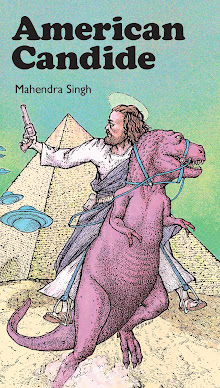
As Miss Cunegonde put it in my translation of Dr. Jacques O'Bean's classic satire of American politics and mores, American Candide:
“Doctor Pangloss always said that the business of Freedonia is business … that means don’t do anything for free, unless you want everyone to disrespect you and call you a really cheap slut. And that kind of sucks.”
Monday, November 11, 2013
The Snarkrunners of Bengal

THE HUNTING OF THE SNARK by Lewis Carroll, a graphic novel by this artist and explained here, page by page, panel by panel, squiggle by squiggle … right now we're in Fit the Seventh … the Banker, played by Karl Marx, will soon discover that a certain pesky specter haunting Europe is none other than the dreaded Hindustani Bandersnatch! …
We've arrived at the central conceit of this particular Fit of the Snark. The Banker, played here by the Eminent Continental Steamer, Karl Marx, is about to be assaulted by his nemesis, the Bandersnatch. You can see the latter's oddly mishapen hand clutching at the rotund Teuton's bloated ankle.
Karl Marx never visited the Old Delhi Railway Station, nor did the Admirable Carroll but we can be fairly certain that if they did, the general tenor of their surroundings would have appeared much as this artist has depicted them. The animal and mannequin headed bystanders, the bazaar atmosphere of narghila-puffing loafers, complete with a snake-charmer awakening the mysterious inhabitant of his basket, it's all there.
Perhaps the less-travelled reader will be taken aback by this local color but those of you who ever wandered into Old Delhi will heave an appreciative, paan-fumed sigh. It's all there, the latter will confirm, and the artist has done a slap-up job of capturing the ineffable, nonsensical air of the place.
In short, thanks to a little judicious visual interpolation and conflation by yours truly, the poet Carroll has done a superb job — despite himself — of conveying the air of a place where he had never been and probably never wished to be. And that is the very essence of hunting a Snark, a beast which conceals itself by cleverly non-existing wherever you are — you need to be where you aren't to pick up its ineffable trail.
To be where you cannot possibly be, that is the Snark Hunter's essential dilemma and you might as well get over it right now. It's not logical, Carrollian Nonsense, so go ahead and heave out your pathetic shriek of despair as you understand — too late! — that it's useless to fly!
Take a locally crosshatched scooter rickshaw instead, sahib, and above all, don't drink the water.
Monday, November 4, 2013
By their Marx of the Snarks shall ye know them

THE HUNTING OF THE SNARK by Lewis Carroll, a graphic novel by this artist and explained here, page by page, panel by panel, squiggle by squiggle … right now we're in Fit the Seventh … the Banker, played by Karl Marx, will soon discover that a certain pesky specter haunting Europe is none other than the dreaded Hindustani Bandersnatch! …
Framing devices are the very meat & drink of this illustrator's Snark, the very fritter-my-wig, as the Great One, Lewis Carroll, would have said. Careful examination of the above stanzel will reveal that the previous stanzel (72/1) is embedded within this one and that both of them are themselves the culmination of a 7-image train ride that departed an Old English Garden Party to arrive in an Old Delhi Railway Station, ca. 1876.
From whence comes this illustrator's penchant for the visual recursion of pictorial embedding? Was he lost as a child in a funhouse mirror? Was he reared by a family of Russian Matroushka dolls?
Or does he simply believe in giving his readers good value for money? So many illustrators today practice a sort of pictorial minimalism, cutting back on wasteful expenditures of either conceptual or visual complexity. Minimalism is all the rage these days with most commercial artists (understandably so when most of us are paid less than pizza delivery drivers) which means that this Snark's maximalism is the new minimalism.
The embedding of images within images and the dizzying vertigo induced by inflicting this unexpected pulling back of frames-within-frames allows the reader to rush madly ahead, like the Banker and even to be finally be lost to view if they so desire. And an unseen reader, that is the maximum desired effect of the genuine protosurrealist artist.
In short, if you can lose yourself in my Snark whilst seeking that very same Snark, my work in this Carrollian Multiverse will have been done and I can go to other worlds and places where illustrators are desperately needed to take naps on their readers' sofas, drink up all their readers' scotch, and borrow their readers' cars without permission. QED and all that, huh?
Monday, October 28, 2013
Sturgeon General's Warning: Hunting Snark May be Hazardous to Your Wealth
THE HUNTING OF THE SNARK by Lewis Carroll, a graphic novel by this artist and explained here, page by page, panel by panel, squiggle by squiggle … right now we're in Fit the Seventh …
For five panels now we've been tootling merrily along on our Snarkic Soul Train, through English garden parties and homunculi-haunted jungles into the depths of Page 72, where our train has debouched at last into the jumbled contents of a cigar box.
These contents are nothing less than the raw materials of the Snarkic Galdor which has resonated throughout this poem to such hypnagogic effect: soap, a thimble, hope (personified as an anchor), smiles (a Dali-esque sofa) and a railway share. But where's the care, more petty-minded Carrollians might ask?
To which this illustrator replies: care? You dare to question the care I've taken over this drawing? Go ahead and count the lines, squiggles, blobs and crochets of inky care I've lavished on this Snarkic semioglyph … even better, peruse the various labels & inscriptions embellishing the cigar box into which I've heaped up the raw stuff of our verse … all of 'em scraps torn from a larger whole:
Lo buscaron con dedales, con cuidado lo buscaron,
lo persiguieron con tenedores y con esperanza.
con acciones del ferrocarril lo amenarazon
y lo hechizaron con sonrisas y jabón.
Indeed, it is our Snark Hunter's Galdor-Refrain cast in the language of Castile, the language of Don Quixote, who must surely qualify as the Snark Hunter par excellence!
The cigars which once occupied this box were manufactured, as the upper label notes, in the manner of the Indians. Naturally, the Indians referred to here are the now-extinct Caribs & Arawaks who first introduced the Conquistadores to the joys of the evil weed, tobacco.
But we Snarquistadores are more literal-minded fellows and prefer a bit of geographic veracity with our cigars & porto; the Indians we refer to shall be the 100% genuine, curry-inflected East Indians of Uttar Pradesh and the Punjab, the Indians of Old Delhi, to be precise.
All shall become clear in good time, dear reader, for now, just remember that sometimes a cigar is just a cigar, even in the increasingly Orientalist labyrinths of our geographically discombobulated Snarkian Multiverse!
Monday, October 21, 2013
The Snark takes Manhattan

THE HUNTING OF THE SNARK by Lewis Carroll, a graphic novel by this artist and explained here, page by page, panel by panel, squiggle by squiggle … right now we're in Fit the Seventh … the Banker, played by Karl Marx, will soon discover that a certain pesky specter haunting Europe is none other than the dreaded Hindustani Bandersnatch! …
The Snark Hunters' Express continues its wordless journey into the jungles of Fit the 7th and the inquiring reader is already growing impatient with all this 19th-century transportation technology put at the service of 19th-century Nonsense Verse by a 21st-century illustrator wallowing in his 20th-century obsessions. Sure, it looks cool but in the immortal words of Flakey Foont: what does it all mean?
Indeed! Ideas are the bane of the more fashionable modern hipster and most of 'em avoid that sort of thing like the plague. It's hard to have an idea and listen to one's iPod and update the world on one's various bodily eructations on Twitter, it simply cannot be done without incurring the risk of stopping to think. Especially if one has nothing to think about besides oneself and one's accessorized relationship to other consumer units.
But this illustrator is brimming with ideas, both visual and verbal. He keeps them in a mental swipe file which he can access at any moment by merely lying on a comfy sofa, having a really good cup of tea and then taking a nice nap. Whilst asleep, the thousands of books, paintings, sculptures, drawings and movies he's seen and read do their mysterious mojo thing inside his cinematically furnished mind and when he awakes, bingo! An idea is born!

Richard Muller (German, 1874-1952) “Miracle of Training”, 1911
Our drawing of a Snark Hunting train in the jungle was spawned by a vague visual memory I had, an image which I later discovered to be a drypoint by Richard Muller, an obscure yet quite talented German artist from Dresden. The basic idea of training something to do the impossible was the starting point that Muller furnished me; it led me to eventually depict the training of a train by a jungle homunculus magician, a personage which fit perfectly into the earlier depiction of the same homunculus-magician luring the train out his snake-charmer's basket.
Muller's style of German Symbolism was similar to that of the better-known Max Klinger and eventually this style would merge into what we call Surrealism. There is a subtle difference between the precursor and its more celebrated descendant: the former depicted the reality of dreams by using the reality of waking, while the latter was a far more ad hoc business which eventually trafficked mostly in solipsism and amateurism.
Young illustrators take note! The technical rigor of the Symbolists' training and their conceptual precision came from a careful study and understanding of all the arts, ie., they did not reject the past as un-hip nor did they wallow in self-expression without self-analysis and self-correction. This precursor of Surrealism is not only a rich vein to mine for ideas but more importantly, a perfect example of the usefulness of learning draftsmanship to better depict that which cannot be seen.
Zen-like, huh? But don't worry, most art directors today could care less about all this and in fact, you'll get more work doing the exact opposite of what I just recommended. Double-Plus Zen-like, dude!
___________________
NB. Last week's signing
tour of NYC for the Adventure Time Encyclopaedia was a smash success
for all concerned, both fans and artists. Besides getting to hobnob with
Martin Olson and his daughter, the talented Celeste Moreno and all the
great people at Abrams, this illustrator was able to parade his
moustache all over Manhattan and Brooklyn without once being asked to autograph a pre-war Iraqi dinar …![]() |
From left to right: Mahendra Singh, Martin Olson, Celeste Moreno, Olivia Olson, Jessica DiCicco |
![]() |
| Photo courtesy of Vida Shi |
In any case, the overwhelming success of the NYT-best-selling Adventure Time Encyclopaedia has changed this artist's life. Put the banana peels on ice, Mrs. Singh, tonight we dine on … soylent green!
Monday, October 7, 2013
Iron Man vs. Lewis Carroll … Snark-down!

THE HUNTING OF THE SNARK by Lewis Carroll, a graphic novel by this artist and explained here, page by page, panel by panel, squiggle by squiggle … right now we're in Fit the Seventh … the Banker, played by Karl Marx, will soon discover that a certain pesky specter haunting Europe is none other than the dreaded Hindustani Bandersnatch! …
Attentive readers (shut-ins, penitentiary inmates, nursing home loafers, etc.) will have noticed by now that these last four panels share a common motif: a miniature train packed to bursting with all 10 of our Snark Hunting B-Boyz.
This is not an accident, this is what literary critics call a TRANSITIONAL MOTIF. You see, this illustrator needed to solve the problem of bridging two entirely different Fits; Fit the Sixth, which was set in a vaguely Gilbert & Sullivanesque inflected version of Pepperland and Fit the Seventh, which will eventually disembark into the British Raj of the Old Delhi Railway Station.
Lesser illustrators would have simply hired a charabanc or a palanquin or even a scooter rickshaw to schlepp their characters from one scene to another but this illustrator is made of sterner (and cheaper) stuff. In fact, if there's anything which makes this illustrator wax extra-wroth, it's the all-too-common phenomenon of artists choosing vague or irrelevant symbology to bind their pictures to their words. Just as the punishment must fit the crime, so must the conveyance fit the time!
Well-oiled Carrollians will sigh with appreciation at all of the above, for they are well aware that the Great One, Lewis Carroll, was fond of playing at trains in his youth, so much so that his undeservedly obscure puppet play, La Guida di Bragia, is set in a train station and features two station masters whose resemblance in manner & bearing to Vladimir and Estragon cannot be coincidental …
But more to the point, the very first time that the name of Lewis Carroll ever appeared in print was in a magazine entitled The Train. It was with that small poem, "Solitude", that Charles Lutwidge Dodgson (prompted by the editor Edmund Yates) hit upon the happy device of latinizing his name into Lewis Carroll. The year was 1853 and curiously enough, (1+8+5)x3=42 … and as all Carrollians know, the number 42 is the cabalistic key to the entire Snarkian Multiverse. And you thought I was making it all up as I went along, didn't you, admit it! Ha!
Of course, there are some other, equally pesky readers who are asking: from whence come these urbanite, minaret-and-souk-bedecked camels seen in the above picture? Is this another example of the dreaded Orientalism run amuck?
Perhaps it is, but I must also draw such readers' attention to the fact that from the Oriental point of view of the unseen inhabitants of these Camel-Cities, a point of view blighted by the sudden appearance of a steam-locomotive with various Victorian gentlemen aboard it, it's a case of the dreaded Occidentalism run amuck.
Occidentalism is the persistent belief shared by many Orientals that the West is crammed to the gills with purring, blonde sex kittens, gun-wielding Christian mullahs and shamelessly easy credit.
If only, huh?
___________________________________
NB. Along with several other illustrators, voice talents and the book's author, Martin Olson, I'll be appearing this week at the New York Comic Con — and other comix venues in NYC/Brooklyn — to promote the Adventure Time Encyclopaedia!
This Adventure Time thingie has made it onto the NYT best-seller list … this will be a rare chance to catch a glimpse of various illustrators, actors, writers and editors basking in the glow of success as opposed to our usual glow of abject fear and loathing. Come and see us interact with the hoi polloi … you won't be disappointed.
• Saturday, 12 October, 2013, New York Comic Con at the Javits Center, New York …
The Adventure Time Encyclopaedia Panel, Room 1A08, 5:30 PM-6:30 PM and …
a signing immediately following the panel from 6:45-7:45 in
autographing area at table 21
In this panel, editor Eric Klopfer will
moderate a conversation between Martin Olson (a.k.a The Lord of Evil) Olivia
Olson (a.k.a Marceline the Vampire Queen), Jessica DiCicco (a.k.a Flame
Princess), and evil illustrators Celeste Moreno and Mahendra Singh about the
recent release of Martin's new book The Adventure Time Encyclopedia. Events
include a slide show and a theatrical reading from the book. Hunson Abadeer
will make an appearance, there will be a possible surprise premier of a great
new music video from the Nightosphere and the official book trailer will be
screened.
Monday, September 30, 2013
The heart is a lonely snark-hunter

Fit the Seventh of my GN version of The Hunting of the Snark … the Banker, played by Karl Marx, will soon discover that a certain pesky specter haunting Europe is none other than the dreaded Hindustani Bandersnatch! Meanwhile, back at the paan-shop …
See the Snark Hunters run.
Run, Snark Hunters, run.
See the Snark Hunters on the train.
The train goes choo choo choo.
See Henry Holiday turned to stone.
Crumble, Henry, crumble.
Let's go to Fit the Seventh, said the Bellman.
Let's leave this basket for Fit the Seventh.
And the train went choo-choo.
And the snake-charmer tooted his flute.
And the Bellman rang his bell.
See the fetid Indian jungle.
See the freaky snake-charmer.
See the frightful choo-choo-train.
See the Banker's Fate.
Run, Banker, run!
Monday, September 23, 2013
Let them eat snark!

THE HUNTING OF THE SNARK by Lewis Carroll, a graphic novel by this artist (for sale here) and explained here, page by page, panel by panel, squiggle by squiggle …
At last, we've reached Fit the Seventh of this graphic novel version of Lewis Carroll's Hunting of the Snark. I drew a frontispiece for the first page of each Fit, each one usually involving a feeble pun and all of them concealing in some manner the All-Seeing Eye which I chose to represent the Snark.

Karl Marx, the working man's Marx Brother
This Fit concerns the Banker and I chose Karl Marx to depict the Banker for simple reasons of poetic justice. This canto of the poem will prove to be his downfall, his well-deserved sweeping into the dustbin of history, the ol' coot. Imagine that, doubting our capitalist masters.

The Sleeping Odalisque by J.A.D. Ingres
For the moment though, his Fate is being depicted as his fête, or birthday party, in French. His cake has the requisite 42 candles and the charming Alexandra “Xie” Kitchin is playing the violin for his amusement, just as she did in Carroll’s photo. Xie was one of the poet’s favorite child friends although I doubt that he would have approved of her presence in this Snarky up-date of the French painter Ingres’ famous harem scene.

Alexandra "Xie" Kitchin as photographed by Lewis Carroll
No matter, the Banker’s fan-waving monkey will soon restore some decorum. His name in Hindi, bander, summons up the spirit of the Carrollian Bandersnatch, the Banker’s soon-to-appear nemesis. His hookah will also figure in his downfall, a Marxist reminder that opium is the religion of the masses.
Just say nein, Karl!
Next week: The Gang of Four take five
Subscribe to:
Posts (Atom)