Monday, April 22, 2013

He who would make a Boojum of himself, gets rid of the pain of being a Snark


“Its flavour when cooked is more exquisite far
Than mutton, or oysters, or eggs:
(Some think it keeps best in an ivory jar,
And some, in mahogany kegs:)

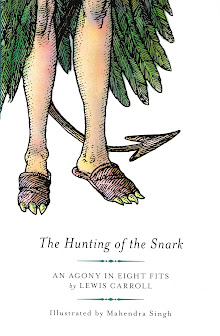
One can never have enough of a jolly, good Snark hunt, don’t you agree? The fresh country air, the Protosurrealist scenery, the anapaestic hurly-burly of one’s fellow Snarquistadores baying after their prey, it all gives one such an appetite!

Naturally, no Snark hunt is complete without a bit of Jubjub taken al fresco whilst in the saddle. Cooked Jubjub is both palatable and highly nutritious, coyly hinting as it does to three-quarters of the Classical Four Elements : earth in the form of mutton, water in the form of oysters and air in the form of the eggs of some unspecified bird. The fourth and final element of fire could easily be supplied by the judicious application of some spicy condiment or chutney.

If Lewis Carroll were alive, he would certainly agree with you when you assert that this poetic reference (a milestone in Victorian Table Verse) to mutton, oyster and eggs makes these gustatorially implicit items into allegorical symbols of themselves. This is a subtle point indeed, so subtle that I’ll skip over the boring old meat-and-two-vegs-reasoning and head straight for the more exciting porto-and-coffee-conclusion, as it were.

Symbols which specifically refer to only themselves are called "reality" by certain smarty-pants metaphysicans. These sort of crackerjack thinkers would point out that the mutton-oysters-eggs-thingy is subset within a Jubjub which is itself subset within the ivory jars and mahogany kegs, the latter containers being diametrically opposed in coloring, another indication that Something Fishy Is Going On Here.

Unfortunately, Lewis Carroll is not alive and hence unable to agree with all of the above. In fact, his lack of Reality makes him feel a bit unagreeable and even disagreeable with all this alimentontological twaddle you’re going on with. In fact, he’s feeling rather queasy and unsettled with the whole business and my goodness, I think that he’s going to faint! Quick, call the management while I relieve Mr. Carroll of the weight of his wallet upon his chest.

Poor fellow, struck down in his prime and not a moment too soon! It must have been the Jubjub — look at the expiration date! Good lord, man, this Jubjub’s nearly 137 years old! Why, it’s not even second-grade-fresh! Slow food, indeed! Criminally slow, I’d say!

Wednesday, April 10, 2013

Bohemian Snark Rhapsody


Apologies for the delayed posting … this is a
repeat posting anyway as I am currently
immured at an undisclosed location,
ie.
, deadlines …

“But it knows any friend it has met once before:

It never will look at a bribe:
And in charity-meetings it stands at the door,
And collects — though it does not subscribe.

No, your eyes are not deceiving you, this is not double vision but rather a mea culpa of sorts! Lewis Carroll always warned us not to bring home any Snarks we might find on the street and in today’s technological circs this applies double-plusly to any Snarks we might find on the internet, present company excluded, of course.

What brings all this to mind is the scandalous Case of the Missing Bribe, an affaire snarque which was first brought to my attention by the eminent Czech poet and Snark translator, Václav Z. J. Pinkava. It was he, who in discussing with me the above stanza regarding the Jubjub’s sordid personal habits, first detected the spurious substitution of the word bride with the word bribe in most internet texts. I shall watson Václav’s holmes thus …

"In the text I first based my translation upon, some years ago - the second b of bribe had become its mirror image, bride. It serves me right for working in IT, I should not have relied on electronic sources. I had also used Gutenberg, in 2005, so the Origin of Speciousness is now lucidly clear. The consequences of such a tiny but undetected 'program bug' are impressive. Snarkologists might find it curious that this shows up in the phrase "it never will look at a bribe" — nobody did look!"

Both Václav and I had run afoul of Gutenberg.org's tainted source copy! Shocking isn't it, dear reader, to discover that a certain someone is type-setting his raw copy from an internet site! Alas, I had already misdrawn the soiled stanza with its sordid Bride, the results of which you see above on the left. Fortunately, Václav is not only a poet, but a brainworker too, and his fertile mind was teeming with a scintillating maelstrom of myriad illustrative remedies à la Hedly Lamarr!

"Anyway, I may have a solution for you — or at least a talkaround … the Bride-as-Bribe is of course a theme reminiscent of classical Knight and Dragon stories, where the King offers his only daughter as a draconian bride-bribe to save the royal city from ruin. Rather a Grimm prospect. Tom Tower (the Christ Church background of the above drawings) looks rather like a hidden dragon to me, in your picture, with the gate as the mouth and the windows above as the eyes.

The b-d transform is, as hereto indicated, reminiscent of the two "eye" Tom Tower windows, with a bit of buttressing masonry as the uprights. Not unnaturally, then, given St George as the English patron saint, that this should be an undercurrent in any truly English literary endeavour. And, after all, on the blank part of old maps the inscription was either Hic Sunt Leones, or Hic Sunt Dracones, and so the brave Bellman has taken his crew not only into Snark country, but into Lion and Dragon country, too, just by using a blank map.

The Jubjub bird is, like most birds, not a creature of the KNight and so is much too unchivalrous to pay attention to any brides-as-bribes, lest the respective dragon-groom challenge the interloper to a fight. If Miguel de Cervantes made Don Quixote mistake windmills for Giants, then Lewis Carroll's opiated view of Tom Tower as a dragon is quite acceptable to me."


After ruminating upon Václav's advice, I finally roused myself from my usual torpor to remedy the whole unfortunate situation with an amended drawing, seen above on the right. With this hasty addition of a large and angry honeybee, the Bride had Bee-come a Bribe and all was well again — for now, at least!

For me, the entire episode was a painful reminder of the subtle dangers lurking in even the most innocuous Carrollian verse (and the necessity of actually reading what I’m drawing, eh?). However, in further correspondence with Václav, I discovered that his own Czech translation had also run afoul of various linguistic sandbanks, which he had navigated with some considerable panache …

"Czech’s visual compactness is a side effect of diacritical marks, invented by Jan Hus, the Protestant martyr who was burnt as a heretic in Constance — albeit not for his orthography. This diacritical scheme is a great idea, it makes Czech far shorter to look at than Polish, a related language. However, the alphabet has a Carrollian 42 letters, including one dipthong 'ch', pronounced like the word Loch.

I have indeed maintained and in fact in some places enhanced the eccentricity of the text, in Carrolian style. This has led to no end of controversy. Czechs, like the French, have an institution to guard purity of language, and they are averse to anyone taking liberties, such as putting in one or two portmanteau words when the rhythmic straightjacket got too tight.

Anyway, let those Czech translators who come after me make do with the plainer versification they long for. It is often annoyingly inescapable to me, when I read Carroll's seemingly plain-English Snark, how he plays with multiple meanings in simple words (or at least I think he does). For example, in the Second Fit — "Other maps are such shapes, with their islands and capes!" — makes me think of a personified Map wearing a cape! Another example of a bit of fun; in the Barrister's dream, I took a slight liberty with the translation of:

"The fact of Desertion I will not dispute;

But its guilt, as I trust, is removed
(So far as relates to the costs of this suit)
By the Alibi which has been proved."

It occurred to me that an Alibi literally means that the accused was somewhere else at the time, which, if one is being accused of desertion, can be interesting, if negated. So I translated this partly to say that the Alibi is proven by there being none, i.e. the pig was not somewhere else. As to the cost of the "suit", I hope there was no "gilt" implied; well at least it has been removed, and especially so in translation.

On the repeating mantra "They sought it with, etc.,", I had a great opportunity to use a double meaning in Czech, because "mydlit" (to soap) someone is an idiom for beating them up, for reigning blows upon them mercilessly; so I left out the smiles part and emphasized the soap, literally: "(they) confounded it with the way soap soaps/beats up." It has a nice euphony and alliteration about it in the Czech line. There is also an idiom to soap someone's stairs, i.e., to assist their downfall.

I initially surmised that I had to be very free with the translation when it came to the Snark's fondness for bathing machines, and their adding to the beauty of scenes, as no Czech reader would have a clue what a Victorian bathing machine is. No coastline here! So I took another angle on that, mentioning showers and (car-style) wash-machines, and the adding to the beauty of scenes being open to doubt because the view is cleaner but also drop-speckled. In the end I found a way of translating it as "wheeled bathing cabins" and left it up to the reader to research what they were. It seems to me that the assertion at the very beginning of the poem, "Just the place for a Snark", is best explained by envisaging numerous bathing machines liberally perched upon chasms and crags!

In Czech it is impossible to maintain all the tradesmen starting on B, or any one letter, without changing them. Incidentally, why is everyone convinced they had names beginning with B, when they are descriptions, and one in particular very oblique — the Bonnet Maker?

One of my greatest annoyances was how many Czechs have been led astray by their clichéd schooling, which mentions the Snark in the 3rd grade despite there not being a Czech translation until now. Accordingly, they consider the Snark to be predominantly shark-like, and so they wanted it translated into some Czech soundalike (czech for shark being Žralok pronounced zhrullock). I want the Snark to remain a Snark — I just added an accent on the á. I do rather wish Carroll had named him Xnark, though."

I do hope that you've have enjoyed this lengthy but detailed exposé into the hitherto concealed inner workings of the international Snark trade, both visual and linguistic. Sure, there’s plenty of glamour and gorgeous women and fast cars and forks and hope and all that but that’s 19th century British Nonsense poetry for you, isn’t it? It will all end in tears anyway …
___________

NB. Václav is a fine poet as well as translator and his verse is worth reading, as is his father's. Václav crafts his words with hope and care, as befits a truly talented and steadfast member of the Fellowship of the Snark! Bibliophiliac Snarkniks (and you know who you are) can find his Czech Snark readily available here and here and here. What I tell you three times, eh?

Tuesday, March 26, 2013

The eternal sunshine of the jubjub's mind


In his genial way he proceeded to say
(Forgetting all laws of propriety,
And that giving instruction, without introduction,
Would have caused quite a thrill in Society),
“As to temper the Jubjub’s a desperate bird,
Since it lives in perpetual passion:
Its taste in costume is entirely absurd —
It is ages ahead of the fashion:

We are very pleased to bring you this startling mental picture of a Jubjub, fleshed out, as it were, from the tattered blueprints provided to us by the engineering firm of Dodgson, Carroll & Associates. This once reputable British firm of snarkwrights, headquartered in Guildford, Surrey, had utterly cornered both the domestic and export trade in British Nonsense by the end of the 19th century.

Their patented Jubjub Bird, shown above, started out as a commoner’s garden-variety hoopoe-cum-popinjay but Carroll, a mad and impulsive boy at heart, kept adding on a bit here and bit there until he had invented what came to be known as "the bird of perpetual passion". Too spicy for staid British tastes, it enjoyed a certain vogue in France until the advent of lurid mass-produced, paperback novels rendered it obsolete.

This particular example is a fine example of the classic Victorian penchant for thick-ankled avians swaddled in the finest watered gutta-percha silk. It was discovered by this artist, roosting in the most meager, luxury suite of the Ritz-Carleton, subsisting on a paltry diet of sugar daddies and hot buttered toffs until it was lovingly restored to its original bird-brained splendor by a poultice of blank checks and a strict regimen of breakfast at Tiffanys.

I think it would look rather fetching hanging on your arm, whenever you appear at the Drones Club or wherever it is that you roost at night.

Tuesday, March 12, 2013

Brother Sun, Sister Snark


“The method employed I would gladly explain,
While I have it so clear in my head,
If I had but the time and you had but the brain —
But much yet remains to be said.
“In one moment I’ve seen what has hitherto been
Enveloped in absolute mystery,
And without extra charge I will give you at large
A Lesson in Natural History.”

Lewis Carroll is too polite to say so but I’m going to give the kiddies a scare by telling ‘em that Natural History is an unnatural construct. It’s a False Boojum hatched by the machinations of a power-hungry 19th-century bourgeois patriarchy determined to crush the legitimate political and social aspirations of a downtrodden proletariat animal, vegetable and mineral kingdom.

Just look at ‘em, this riffraff of the finest art museums of Europe and the Americas, the lumpenproletariat of Bosch’s crypto-Christo-Malthusian nightmares forced to rub shoulders with the decadent, antisocial pictosemiotic propaganda of René Magritte! Scandalous! And has anyone noticed that both of these so-called artistes hailed from the Low Countries? Coincidence? I think not!

It is indeed low, ‘tis very low indeed when the legitimate hopes and aspirations of an entire roomful of creepy-crawly delirium tremens-type habitues must get a snootful of this kind of pseudoscience at the sweaty hands of a boisterously glandular, Polynesian moai afflicted with a pseudoclerical penchant for faith-based crossdressing.

Boo, hiss, boo! Have you ever heard such a thing? This is not the sort of Hunting of the Snark for which our gallant forefathers shed their precious blood on distant, foreign shores! It’s something else entirely and if I had but the time and you had but the brain, we’d sort it out, you betcha!

Sunday, March 3, 2013

French-fried snark … les pommes frites snarkaises


The roar of the deadlines, the smell of the publishers, all these combine today to leave this over-worked illustrator no time for the usual Snark posting … so instead, I'll leave you with some links to recent reviews of my Snark GN, plus a really cool blog devoted to J.-H. Rosny aîné! Sorry, they're in French, so you'll have to stick a babelfish in your ear and carry on as best as you can. Don't panic, just suck on your towel …

Pour mes lecteurs francais … aujourd'hui, les travaux snarkaises me laissent enervé, epuisé … la puanteur d'encre et l'enfer blanche des planches vides me fatiguent. Au lieu de cela, je vous offre quelques bonnes critiques de mon BD Snark et aussi, un blog très interessant, dévoué à J.-H. Rosny aîné, avec les échantillons de mes dessins science-fiction.

• Soli Loci
• Echos Art
• J.-H. Rosny aîné

And by the way, the Slusser/Chatelaine translation of Rosny's SF novellas (Wesleyan Press) is available here. These are truly amazing and avant-garde works of SF, a must-read for anyone who wishes to blow their minds with a genuinely alien point-of-view in story-telling. Curious how little SF is really avant-garde … most authors' vision of alternate realities and futures is depressingly small-minded.

NB. If the Québec language police are reading this, they'll probably revoke my licence to write French, so order my Snark now before I'm buried alive under a thick, gooey mountain of maple-syrup saturated pasta.


Monday, February 25, 2013

Through a scanner, snarkly


“The result we proceed to divide, as you see,
By Nine Hundred and Ninety and Two:
Then subtract Seventeen, and the answer must be
Exactly and perfectly true.

This baffling stanzel of The Hunting of the Snark (known to Continental snarkologists as the Pons Asinorum) presents the illustrator of all things Lewis Carrollian with a genuine head-scratcher.

Unlike some illustrators who invariably resort to a stylistic and conceptual flight behind the faux-ironic concealment of an adorably semi-infantile aesthetic when confronted by any text more complex than, let us say, the plot précis of a sharp blow to the head, this illustrator (pauses to take a deep breath and a swift gulp of the restorative gin gimlet splashed upon him by the nubile Assamese hootch-kootchie girl languishing pool-side at his every beck and call), this illustrator likes to give his public some honest value for their hard-earned money.

And since this entire mighty enterprise which I call The Hunting of the Snark is offered to you through the good offices of Melville House Publishing and Editions Seghers, one would expect a certain modicum of cognitive consonance in these drawings. And yet … of cognition, there is none. And as for consonance — begone! Enter … Nonsense!

Indeed, the jig is up and I'll raise high my gin gimlet in a cheerful acknowledgment of the utterly baldfaced cheekiness of the above illustration. It’s all hokum, every last bit of it. Lewis Carroll has clearly described some sort of mathematical thingum-a-jig and all I’ve come up with is a hazy, second-hand memory of an obscure Magritte semiopictulum of Edward James going through a looking glass and finding that the more you turn around to face oneself, the more you must turn one’s back on all that. Or something like that. Mirrors and mathematics alike give me a headache with their slavish devotion to reality and all that sort of thing, each claiming to demonstrate only that which is perfectly and exactly true.

The creepily eagle-eyed reader will notice that a copy of E.A. Poe’s Narrative of Arthur Gordon Pym is lurking in Magritte’s painting, a novel which this author boldly and a bit drunkenly asserts to be the Great American Novel. Take that, you big fat white whale! And if this opinion does not please you, sirrah, my Assamese spitfire is perfectly willing to fight you upon any terms you please!

Monday, February 18, 2013

Night of the Snark Hunter


“Taking Three as the subject to reason about —
A convenient number to state—
We add Seven, and Ten, and then multiply out
By One Thousand diminished by Eight.

This is not a medically approved mathematical operation …

This is not an insight into the Essence of the Number Three …

This is not the Royal Road to 19840 …

This is not a comment upon the intractable unreality of all Numbers …

This is not a jaded Christ Church don’s comment upon the futility of impressing the intractable unreality of all Numbers upon his all-too-real thickheaded students …

This is not a jaded Montreal illustrator’s comment upon the futility of impressing his long-suffering wife with yet another impecunious display of his useless facility in mimicking the Victorian wood engraving style …

This is not an image of an image which is not what it seems to be …

This is not the sort of thing which the general public has come to expect, thank god …

This is not the unexpected work of a far better artist …

This is not a clue to the fabled and elusive meaning of The Hunting of the Snark, for this is not clairvoyance.

Monday, February 11, 2013

When the going gets wierd, the wierd turn snark


Chers lecteurs, je suis ravi de vous annoncer 
la parution de mon BD, La Chasse au Snark — en français!  
Grâce aux Editions Seghers, la traduction par Louis Aragon s'image avec des rêves les plus ravissantes que l'argent peut acheter … et enfin, le nonsense anglais sera le non-sens français avec mes dessins surréalistes, anachroniques et sémiotiques. 
Le non-sense classique, la poésie la plus parfaite de Lewis Carroll, peut-etre la seule épopée victorienne … ma chasse au snark en BD, la graine obscure que nous fournit la moisson surréaliste!
Quelle bonheur pour les chasseurs galliques au snark (britannique!) … disponible á Seghers ou Amazon.


So engrossed was the Butcher, he heeded them not,
As he wrote with a pen in each hand,
And explained all the while in a popular style
Which the Beaver could well understand.

It’s not often that one finds Lewis Carroll, St. Anthony the Great, Hieronymus Bosch and the late Dr. Hunter S. Thompson mentioned in the very same breath but such are the rarified quiddities of this inkster’s inspiration.

The Butcher is shown here writing a footnote, two of ‘em since he’s ambipedextrous, an affectation rampant amongst Liberians and Americans, both of whom share an affinity for feet over meters, the rascals! One of the most prodigal of these American meterphobes was the journalist, Dr. Hunter S. Thompson, who gained a considerable notoriety for "explaining it all in a popular style" to an otherwise unsuspecting American public.

Thompson’s most notorious national apologia was the jeremiad, Fear and Loathing in Las Vegas, which detailed (in an autohagio-cum-psychedelic style known as gonzo) his quest for spiritual enlightenment in the nearest available desert. Having no recourse to any secluded grottos, Thompson pursued his ascetic devotions in the general direction of Las Vegas with astonishing success, and like St. Anthony, he quickly attracted quite an entourage of devilish phantoms in a variety of tormenting styles and sizes.

"We were somewhere around Barstow on the edge of the desert … suddenly there was a terrible roar all around us and the sky was full of what looked like huge bats, all swooping and screeching and diving around the car, which was going about a hundred miles an hour with the top down to Las Vegas. And a voice was screaming, 'Holy Jesus! What are these goddamn animals?'"

The well-gargled Flemish painter, Hieronymus Bosch, whilst under the influence of an anachronistic plagiarism, had already worked up a police identification sketch of some of Thompson’s assailants, of which I have made the above drawing of a fax of a snapshot of a xerox. This startling image of a group of out-of-town snarkhunters taking in Wayne Newton and the lobster special at Circus Circus bears an eerie and uncanny resemblance to both the turgid cerebral froth of Messers Anthony, Bosch and Thompson, Esq., and a certain little stanza of The Hunting of the Snark which we’ve been seeing far too much of around here lately!

As your attorney, dear readers, I advise you to avoid eye contact with all these suspect, hallucinatory inhabitants of weirdo drawings brandishing their trippy, second-hand anapaests and uncomfortably reminding us that when the going gets weird, the weird turn pro. We are but amateurs of the Snark, you and I, and as such, cuddly little fluffy things ill-suited to the rigors of modern life and all that other mental stuff.

Monday, January 28, 2013

Apeneck Sweeney spreads his snark


The Beaver brought paper, portfolio, pens,
And ink in unfailing supplies:
While strange creepy creatures came out of their dens,
And watched them with wondering eyes.

Strange, creepy creatures are the bane of modern life and both Lewis Carroll and myself have seen fit to embellish this crucial stanzel of The Hunting of the Snark with a surfeit of ‘em. Suitably alarmed, the Butcher has darted into a convenient telephone booth and re-emerged in the guise of St. Anthony, the father of Christian monasticism and more to our purposes, a veritable bit of human fly-paper for all manner of hallucinatory things that go bump in the night.

The attentive reader will remember that the very first stanzel of this Snark involved a direct quotation from Mathias Grünewald’s version of St. Anthony, a quotation which involved a fair bit of mirror-work and the cramming of a very hirsute and oddly fey Saint into the sturdy 19th-century country-squire’s boots of the Boots, AKA Charles Darwin. This saint-bashing mania of mine is shared with many other artists; throughout the ages, we picture-folk (or Bildervolk, gesundheit) have mass-produced St. Anthonys by the bucketful. Even Henry Holiday joined in the fun, establishing an Antonine precedent for Fit the Fifth which even the religiously fastidious Lewis Carroll approved!

From whence comes this Antiantonimania? Are Salvador Dali (the Norman Rockwell of Surrealism), Hieronymus Bosch, Feliciens Rops and Gustave Flaubert all victims of a sudden outbreak of religious fervor? Or is it all just an excuse to draw legions of naked women and creepy circus sideshow freaks mobbing a defenseless old man in a desert?

To be sure, there is a certain visual, even Luis Buñuel kind of appeal to such a proposition but nonetheless, dear reader, it’s just not very sporting, is it? The genuinely Christian thing to do is to insist that all these unreal phenomena besetting a very real person are promptly replaced with a new and improved denful of very real phenomena besetting a patently unreal person! The latter personage would be, of course, our Snark, and I’m certain that you, the readers and thus the ultimate — and only! — reality of this poem, will do a splendid job of standing in as the former.

So, that’s all settled, is it? I’ll go and have a nice lie-down while you slip into your new Snark-baiting role. Just study the above drawing very carefully and do whatever Mister Bosch says. He does have an active imagination and if anyone asks you why this is so, hint vaguely that it’s just that Hieronymo's mad againe.

Monday, January 21, 2013

Killing me softly with his snark, telling my whole life with nonsense


“Two added to one — if that could but be done,”
It said, “with one’s fingers and thumbs!”
Recollecting with tears how, in earlier years,
It had taken no pains with its sums.
“The thing can be done,” said the Butcher, “I think.
The thing must be done, I am sure.
The thing shall be done! Bring me paper and ink,
The best there is time to procure.”

One can say what one likes about Lewis Carroll, one can say what one likes about The Hunting of the Snark, one might even cast aspersions at Carroll’s secretive doppelgänger, C.L. Dodgson, but one cannot say that any of the above ever ignored the intellectual and literary ramifications of what we now call common, garden-variety Stupidity.

The above stanzel is proof positive of all of the above blather, 100-proof positive, I should think, with all its various pictolinguistic bits and pieces denoting a thorough inability on the part of its protagonists to perform even the simplest of arithmetical tasks.

We know that C.L. Dodgson, in his capacity as a maths tutor at Christ Church, had many opportunities to complain to his associate Carroll of the genuine dunderheadedness of most of his pupils. Many of these young scholars, being scions of the British upper classes, abjured all thought whatsoever and devoted themselves instead to the less mentally taxing pastimes of drinking, gambling — and yes! — hunting!

Can we venture to guess that Carroll, sympathizing with and perhaps even assisted by the unlucky Dodgson, undertook an elaborate scheme of passive-aggressive revenge, composing a cunning lampoon which in its essence is nothing more than a verse epic dedicated to the Stupidity of the Hunting Classes, a Victorian Dunciad, so to speak?

We know that the entire Hunting of the Snark is predicated mostly upon the Clochetic Rule-of-Three, a shining example of logical inanity. We know that this poem’s very title admits of two, very opposite meanings: either a hunting for a snark, or rather, a hunting undertaken by a snark! In either case, a nitwittery is produced since the Snark is unreal and thus unavailable for hunting in any sense of the word.

Furthermore, Dodgson’s fellow Oxonian, the inestimable Dr. Johnson, himself noted that no man but a blockhead ever wrote but for money*, a pertinent observation in light of the fact that Carroll wrote all his Nonsense solely for the sake of Nonsense.

And so, in the most approved clochetic manner, we will triangulate from all of the above and arrive at the inescapable conclusion that the very Genius of Stupidity thoroughly permeates every phoneme of the Snark! We’ll then fritter all of the above’s wig by quickly dredging it in Jules Renan’s oh-so-Gallic remark that he never understood the concept of infinity until he contemplated the stupidity of the human race, in particular, the blockheaded stubbornness of those sportsmen who persist in chasing an infinitely receding prey!

The result is a infinitely-toasted-cheese sort of thing of utterly mixed metaphors which lets you, dear reader, off a certain hook entirely, for the fact that you have followed this ungainly argument so far is double-plus-proof-positive that you’re a Genuine Smartie and no Thickie at all! Huzzah for good breeding and the finest education that Mummy and Daddy’s pelf can buy, eh?

Now, join with Messers Carroll, Dodgson and myself in a spot of jolly good schadenfreude as we observe the Beaver and Butcher chase after those mysterious semioglyphs of numbers and language which puzzle them so. Ignore their tears, please, pay them no heed for they are but the tears of a clown!

____________________________

*A statement itself proved true by the Clochetic Rule of Three in light of its triple-negative syntax! Darn these pesky liberals and their sin tax!

Monday, January 14, 2013

New riders of the purple snark


It felt that, in spite of all possible pains,
It had somehow contrived to lose count,
And the only thing now was to rack its poor brains
By reckoning up the amount.

Ladies and gentlemen, please gather around this small table which I just happen to have upon me, and pay attention, you might get lucky. The name of the game is Hunting the Snark and today we’ll try to find a Jubjub Bird, a beast just like the Snark but even better.

Finding one is child’s play, especially for a smart operator such as you. Simply lay your money down and watch the origami cranes closely, the clue you seek is beneath one of them. Pay no attention to the young gentleman with the fieldstone head and vacant expression, he’s a Polynesian exchange student studying mid-19th-century British abattoir practices and he has nothing to do with me, I assure you. The epithet of shill worries him not, it's idle speculation and his empty head is entirely innocent of such nefarious thing-um-a-jigs.

Using the Clochetic Rule of Three (known to polite society as the Logician’s Variation Upon Three Card Monte) the Butcher has already won a Jubjub Bird, the lucky guy! Alas, his fellow gamester, the plucky Beaver, has lost count. Last week’s byzantine labyrinth of puzzling quills and Poes and desks and birds has befuddled her pretty head; and she now is, as they say, a flummoxed castorian incapable of reckoning the amount of anything in this farrago of pictoversical sleights-of-hand.

She is, in popular parlance, a mark, and as such, quite appealing to homi-and-femicidal beasts such as Jubjub Birds! In fact, her dizzy-headed state of pixilation is the only correct strategy to defeat this nefarious, thimblerigged scheme! Dispossessed of all common sense, proudly ignorant of all logical acumen, she blithely chooses the closest origami crane — et voilà — all the fluttering, flying, flittering semioglyphs concealed therein are freed at last!

Yes, dear readers, it’s all rather zenlike, most confidence games are, you know. Truth and deception, sense and nonsense, all enfolded upon themselves into origamic puzzles which, when upended, release into the wild the crypto-Jubjubian fledgings of raw meaning.

And if all the above crosstalk wracks your poor brains, then beware the Jubjub, my son, and watch the telly instead, it do the Snark in different voices!

Monday, January 7, 2013

The Count of Monte Snarko


The Beaver had counted with scrupulous care,
Attending to every word:
But it fairly lost heart, and outgrabe in despair,
When the third repetition occurred.

When Lewis Carroll sat down at his writing desk to compose his masterpiece of passive-aggressive nonsense, The Hunting of the Snark, he often chewed reflexively upon his quill pen as he pondered what effect his words might have upon future readers.

Words, words, words! They have naughty bits which we cover up in polite company, they have sad bits to make the grownups cry, and sometimes, if you push ‘em together just so, their silly bits will make the kiddies giggle!

Of course, every word needs a voice and the above stanzel’s assemblage of words, birds, quills, desks and notes is stuffed with ‘em. Alas, poor Beaver, chronically outgrabed and all those voices in your head to boot! One of them, sounding suspiciously like the (Mad) Hatter, is wondering why a raven is like a writing-desk? Another (rather familiar) voice is telling her that this is so "because it can produce a few notes, tho they are very flat; and it is nevar put with the wrong end in front". Yet another voice (craftily mimicking Sam Lyod) is telling her that the correct answer is simply that Poe wrote on both. There’s even a voice chiming in about them both having quills dipped in ink.

These words are all meant to answer those other arrangements of words which more evolved thinkers call riddles, that is to say, an augural flock of words meant to signify something despite themselves. Replete with all the requisite overtones of linguistic juju, riddles were once all the rage in the Good Old Days. They served as social icebreakers for all manner of homicidal and imaginary beasts such as sphinxes, trolls, dragons and even — yes! — Jubjub Birds!

I shall cue the evil laughter now for our jolly little metafictional cabal stands revealed at last! Outgrabe all you like, Miss Beaver, but the bird you are really riddling here is no mere raven, it is the Urschreckvogel, the dreaded Jubjub itself!

And so, dear reader, can you enlighten the Beaver as to why a Jubjub is like a writing desk? Simple, you reply — because none has an o in it (pace Huxley). Then run as fast as you can before all these birds wreak their Hitchcockian vengeance upon your person!

Tuesday, December 25, 2012

Adam Roberts vs. Adventure Time: When Astounding Worlds Collide!


Readers expecting graphic Snark on this holiday posting will be disappointed; I have to confess that I'm too pooped to come up with the requisite Snarkian goods.

Instead, I'll regale you with some behind-the-illustrative-scenes gossip which you can mull over while enjoying your Christmas Gluhwein and curry … because here at chez Snark we're busy turning out not one but two books at once, as befits our bipolarsexual book mania:

The highly esteemed & talented SF writer, Adam Roberts, have very kindly allowed me to illustrate his latest novel, 20 Trillion Leagues Under the Sea. I adore the works of Jules Verne and frankly, most contemporary variations & updates of his oeuvre leave me unimpressed if not revulsed. But Adam has delivered the goods with this one, it's a corker on every level and I think that even Jules would approve.

Adam's novels are as tightly written, mind-blowing and well-plotted as anything from the earlier British New Wave — perhaps more so, to be honest — and for this illustrator, those far-off days remain a fond memory of SF's (second) salad days. North American SF is now healthier than the 1970s but to be honest, the vast bulk of it is still as thoughtless and timid as ever. But 20 Trillion Leagues demonstrates that SF can be both a Ripping Yarn and a conceptual tour-de-force complex enough to satisfy even the pickiest thesis-hunting post-grad.

In any case, it's a highly humid book and I'm fast becoming an expert on drawing terrified sailors in a doomed submarine. Plus, the villain is super cool and there's some sly Snark references! In fact, there's something vaguely Lovecraftian about this work, better than Lovecraft actually … god, there's a boring author who deserves to return to pulp Limbo. I'll take Robertsian horror any day, it's more … crafty …


I'm also contributing to the new Adventure Time Encyclopaedia by Martin Olson. Readers may remember Martin as the sick, twisted genius behind The Encyclopaedia of Hell and he's recruited most of the same talented team of fellow twisted, easily gulled sickos to do this new book for Abrams. It's been almost 30 years since I did some kid's stuff (Don Diego and his Time-Travelling Llama, remember that?) and Adventure Time seems to be a bit more popular with the kids. My agent assures me that fame and fortune are soon to follow, or at least a clever simulacrum of them.

I can't divulge any details of the book but I can assure younger readers that neither Finn nor Jake are sucked into a watery abyss bent upon the annihilation and subjugation (or is it the other way 'round?) of the human race, just for cheap humid thrills. That's Adam Robert's speciality.

Instead, they are crosshatched within an inch of their lives by a ink and tea-swilling Indo-Germanic proto-surrealist hack, plus Tony Millionaire, Celeste Moreno, Sean Tejaratchi and Aisleen Romano do something unspeakably Californian to them. Awesome, huh?

But don't worry, that's nothing compared to what Hunson Abadeer has planned for them, the honey-tongued scamp!

Alors … quelle heure est il? Il est le temps d'aventure!

Tuesday, December 18, 2012

Snark vs. Adventure Time: The Final Battle


“’Tis the note of the Jubjub! Keep count, I entreat;
You will find I have told it you twice.
‘Tis the song of the Jubjub! The proof is complete,
If only I’ve stated it thrice.”

Another crypto-scholastic cri de coeur from the Subtle Don, Lewis Carroll, cunningly palmed off by him as the Butcher’s usual Snark Hunting blather. For the benefit of readers who may have just emerged from the washroom and are discreetly eying the exit whilst wondering what all the ruckus is about, scholasticism was an insidious bit of Continental thinkery brought over to England in unlicensed bathing machines and then peddled discreetly in certain no-questions-asked academic circles frequented by the finest medieval chatteratti of the day.

Scholasticism was advertised as strong medicine for all manner of mental boojums, in particular, the disconcerting lapse between how we think things should be and how we actually find them to be. Such lapses seemed to plague the rook racked and river-rounded purlieus of Oxford in particular, so much so that Gerard Manley Hopkins found it necessary to work his inimitable brand of poetical juju upon the place …

… these walls are what
He haunted who of all men most sways my spirits to peace;
Of realty the rarest-veinèd unraveller …


The unvaricose Oxonian unraveller that Hopkins is rhapsodizing is none other than Duns Scotus, the professional theologian and fiendish disputant of all things trinitarian. If his name is not one which is lightly bandied about your dinner table, fret not; his Warholian fifteen minutes will be over before you have even finished your dessert!

This will be a simple transmogrification. We liberally apply several gallons of india ink recycled from an obscure Surrealist travel poster atop the hapless Duns; then we accessorize him with an appropriate chapeau and finish by triumvirating him.

Gosh, dada was right, the hat does make the man! Our rather pasty-faced theologian is now become a strapping, young specimen of a Snark Hunter flexing his rhetorical muscles with a showstopping visual demonstration of the Clochetic Rule of Three!

Yes indeed, gentle readers, this successful demonstration of a tautological trinity of Jubjubs is proof positive that wishful thinking trumps logic as far as Snark Hunting goes. Henceforth, please keep your minds empty and your beliefs in an upright and locked position for the road to hell is paved with good intentions.*
__________________

* Yes, yes, I know. And while we’re on the subject of the Great Cham, have you seen this?
__________________

Apropos of nothing in particular … what time is it? It's Adventure Time! Thanks to the honeyed tongue of Martin Olson, this artist and a host of other talented artists and designers are eschewing the usual holiday festivities to cobble together what promises to be the publishing event of the post-Armageddon year … more to come, but for now, feast your hipster eyes upon this oddly compelling cover, designed by Sean Tejaratchi and illustrated by yours truly. 


Monday, December 10, 2012

Hardboiled Snark


“’Tis the voice of the Jubjub!” he suddenly cried.
(This man, that they used to call “Dunce.”)
“As the Bellman would tell you,” he added with pride,
“I have uttered that sentiment once.

The story so far: An Oxford don, known to the authorities as Charles Lutwidge Dodgson, has been apprehended whilst soliciting various persons whose names begin with the letter B, urging them to participate in what he calls his "hunting of the snark". When pressed for more substantial details, the self-styled Mr. Lewis Carroll claimed that he had absolutely no idea what it all meant and that furthermore, he was himself being harassed by a certain Jubjub, a person of unspecified origin with possible links to a notorious organized-poetry syndicate.

And now …

A screaming comes across the sky. Somewhere a Jubjub bird was wreaking havoc on some other, less fortunate part of Oxford but the Butcher wasn’t buying it. Not anymore, not today. The Bellman had warned him long ago. Be a man, he’d said, three times, like he really meant it … but that was long ago … the Bellman was gone now.

They were all gone, it was just him and the Beaver. And she’d lost it way back in Fit the Fourth, in that freakshow scene with all that black lace and the Barrister just watching her, just watching her blow her mind.

It was all up to him now, Carroll had said, take it easy.

Sure, take it easy, try taking it easy when the anapaests are hammering your skull like jackhammers and the crosshatching makes your skin crawl. Yeah, take it easy while every two-bit, punk academic with a jones for a quickie dissertation topic takes a cheap shot at you. Like the Butcher needed a college degree to know that it was all absurd, that it was all just nonsense and that there was a Boojum waiting at the end of the road.

The Beaver said something incomprehensible in Japanese and an origami crane fluttered by. It’s time, the Butcher thought to himself.

Without thinking at all, with his mind totally empty of any thought save one, the Butcher raised his hand, slowly at first and then faster, ever faster; he raised it as high as he could, even higher than that disembodied hand with which they had all grappled every night after dark, as high as the Hand which was now turning and pointing towards him and the Butcher thought to himself, you must go on, I can’t go on, I’ll go on, and then it was over; he’d already forgotten the question and it was too late, the Hand had passed him over — again!

“Like a dunce!” the Butcher said, it was as if the shame of it must outlive him.

Monday, December 3, 2012

The snarkish prime of Miss Jean Brodie


He thought of his childhood, left far far behind —
That blissful and innocent state —
The sound so exactly recalled to his mind
A pencil that squeaks on a slate!

Go ahead, think of your own childhood. Was it a labyrinthine Hunt for an indefinable Snark? Was it an interminable stretch of anapaestized nonsense? Did you secretly wish that you could just softly and suddenly vanish away? Of course, Victorian childhood was an entirely different matter. The uprearing and education of children in those days was a Gradgrindish matter of Facts and just the Facts, harrumph, harrumph!

Look here! The Beaver and Butcher are busy at their lessons right now, this is a perfect opportunity to observe how one can transmute Nonsense into Facts in an approved pedagogical manner with minimal expense to the taxpayer.

The Butcher is an idiot man-child, we can safely ignore him for the nonce but the Beaver is a tougher nut to crack, as we educators like to say! She seems to be constructing an origami crane according to the diagram being sketched out upon the squeaky slate by a disembodied hand. Referring to the previous stanzel of last week, we see the same hand employed with its fellow hand in the casting of a shadow, the shadow of an immense and threatening bird, the dreaded Jubjub!

The overly excitable amongst us might think that all of this is some species of symbolic play which you rather fancy, but Mister Gradgrind, the proprietor of this particular school, will have none of that. He will point out to you, after the necessary light flogging conducive to Victorian pedagogy, that you are not to fancy, no, you are to Fact! Fact, Fact, Fact!

If the artist responsible for this drawing had wished to depict a Jubjub Bird, he would have done so. In fact, Mr. Gradgrind adds (idly re-adjusting your thumbscrew), this business of human and castorian hands manipulating Jubjubian references which are typologically generating additional motifs of birds, childrens’ play and postlapsarian anxiety is not a Fact at all! If it was, the Jubjub, a patently imaginary creature, would have to exist, QED.

After a bit more pedagogically necessary fiddling about with alligator clips and car batteries, Mr. Gradgrind will point out, with a world-weary smile, that this is how it always begins, that someone starts supposing that one thing actually means another, and so on and so on and before you know it, we’re living in a Snarkian Multiverse where the very fabric of language and logic itself is ripped asunder by the unleashed superpowers of Symbolic Metaphor.

And if you dare to point out to him that language itself is symbolic metaphor, why, he’ll give you a flogging that you’ll never forget. Cheeky thing, the bliss and innocence of childhood is too good for the likes of you! And that’s a Fact!

Next week: Winston Smith substitutes for Mr. Gradgrind 

________________________________

Attention Snarkistas!

Michael McNeff's short film adaptation of The Hunting of the Snark has recently launched a Kickstarter campaign here.  The film was narrated by Sir Christopher Lee and features over 150 visual effects shots.  The movie is almost complete and funds raised will be used to finish up the visual effects.  By pledging just $5 you can get a digital download of the film and a making of documentary.  Let's face it, if you shelled out $20 to watch any of the visual atrocities that Hollywood has inflicted upon us of late, then Michael's Snark at $5 is a steal. And your brain cells will thank you afterwards.