NB. Before we get snarking, I urge you to read Tom Spurgeon's interview with Alexander Theroux, whose book, The Strange World of Edward Gorey is being re-issued by Fantagraphics.
Needless to say, I'm a Gorey-maniac and the interview is worth reading, especially for any one contemplating a life in the world of book illustration. At one point Tom asks Alexander why Gorey was (and is) so neglected by comix fans … I think I'll raise my inky hand and answer that one: because too many comix readers are visually infantilized from childhood by a relentless barrage of visual crap … the depth and complexity of good cross-hatching overwhelms their medulla oblongatas. Just a thought.
Meanwhile, back on Snark Island …
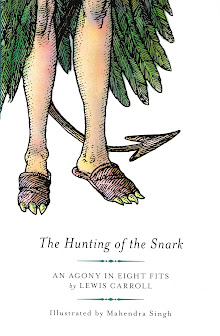
The Butcher’s ingenious plan is accomplished, as we see above, by first opening one of the doors of perception that are so handily scattered about my GN version of The Hunting of the Snark. Beyond this door lies a dismal and desolate valley where he can sally to his heart’s content, undisturbed by his too-frequent fellow man.
These sort of desolate Valleys of the Shadows of Various Deaths weighed heavily upon Victorian sensibilities, lurking as they did amidst the poetry of Lewis Carroll, Kings David-and-James and Lord Tennyson alike. Vast armies of betanomic chasseurs, semi-anointed sinners and gin-pickled light-cavalrymen were regularly herded into their several depths, there to endure the shot and shell of secular and sacred verse competing mano a mano, or to be more exact, pied à pied. Strong stuff but the Butcher seems up for it, he fears no evil nor anapests at all — what ho for the crystalline noggin of feckless youth!
If all this sounds a bit too allusive for you, why, there’s another picture done by another artist, a long time ago, of another inquisitive Carrollian protagonist bent upon making her own separate sally. It’s a very good drawing and I have half-a-mind to snatch it away from its rightful owner and carry it off to some desolate spot unfrequented by man where I can copy it to my heart’s content, by printing it in the infernal method, by corrosives, which in Hell are salutary and medicinal, melting apparent surfaces away, and displaying the infinite which was hid.
And there you have it, ladies and gentlemen … an infinite plenum of poetical kings, lords, dons and even nudists charging forth from this very door, all of 'em dragooned into our Snark Hunt!
__________
NB. Those are snarks that were his eyes; nothing of him that doth fade, but doth suffer an inky-change