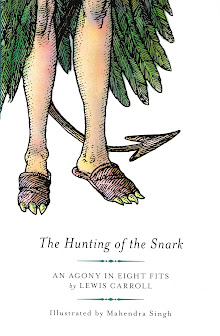
With this sumptuous page spread, we are taking Lewis Carroll and his Hunting of the Snark in tow across the Channel, away from the cozy confines of the Victorian British circus in which Fit the Fourth took its spills and pratfalls, and into the Gallic flâneries of Fit the Fifth, following the baguette-crumbs-trail of the Flaubertian hierophant of La Tentation de saint Antoine.
Those readers who have been following this Snark for a long time will have noticed the considerable French influence upon my interpretation, and with good reason, for my modus operandi has always been to steal from the best! And to any nogoodniks who look askance at this francophilia, perhaps thinking it misplaced in the Snark — the very heartland of English Nonsense! — I shall reply by threatening them with this stoutly bound and suitably weighty volume of Carrollian criticism which was just published by the LCSNA — Lewis Carroll: Voices From France, by the late Elizabeth Sewell.
Truthfully, this book’s genuine potential for mayhem is slight, for Sewell’s lack of jargon and academic doubletalk renders her work refreshingly amiable to all who follow the Way of the Snark. Her Snark comments are especially lucid and profitable, focussing on an intriguing comparison between that poem and the works of Stéphane Mallarmé. She finds a common denominator in their various inclinations towards the Great Nothing (le néant), that après-ultimate-double-plus-full-stop of fin de siècle literature and a classic symptom of the budding Modernism plaguing the youth of that day.
Sewell then closes in on her real prey, the deep structural and emotional relationship between Nonsense and the absolute sort of poetry that Mallarmé wrote, a poetry in which language breaks from the world, abandoning logic, syntax and even meaning, right down to the ultimate granular levels of the phonemes themselves. This rupture between words and the world and its fracturing of selves which Modernist hipsters so revel in is the defining moment of Western art and Sewell very neatly ties this back into the splintering of Carroll’s persona into our ten-fold Snark Hunters.
Afterwards, we are treated to a merry romp through the classic French obsessions with Marxist, Surrealist and Psychoanalytic critical methods, all of ‘em employed upon Carroll with varying degrees of success, and all of ‘em culminating in Deconstructionism, ie., talking about talking about talking.
For my part, I have never thought Carroll to be a precursor of Classical Surrealism such as the Comte de Lautréamont; the authoritarian Breton and the somewhat confused Aragon misread his texts and intentions. Sewell points out the congruencies but the essentially aggressive, utopian nature of Surrealism has little to do with Carroll. Perhaps we should reclassify Carroll as an protoOulipian of sorts, perhaps even a protoRousselian? In a similar vein, Antonin Artaud’s attack upon Carroll is a genuinely insouciant crypto-Romantic temper tantrum. The former accuses the latter of inauthenticity and dilettantism, of peddling a second-grade-fresh Nonsense instead of the undiluted linguistic chaos which Artaud (and certain other French critics) felt was his own Byronic, schizophrenic birthright.
In all such matters Sewell’s thoughts are invaluable, not only for her concision but for the exposure she might give younger readers to an older, gentler style of High Thinkery which she rather cheekily calls Englishness. Even more educational for the young ‘uns (and certain hypertestosteronic North American politicos) is her refusal to make this into an Anglo-French kulturkampf; instead, she assigns credit where credit is due, applauding the rigorous, penetrating taxonomy of French Carrollians, as they assigned his Nonsense to its rightful niche upon the surface of logic, words and mathematics. They also noted the Carrollian reluctance to descend any further into those depths where Messers Marx and Freud lurked (half-naked with painted faces and bones through their noses, one suspects) and where the French firmly placed their own Boojums of authenticity, nihilism and meaning.
And here is where Sewell draws her line in the sands of La Manche; on one side the bravura French approach of a vertical integration from the surface of art to the depths of culture and on the other side the English preference for a sort of sporting compromise, for a recognition of the essential Poetry of Carroll’s Nonsense. The English will always rap our knuckles to remind us that Carroll’s best work never succumbs to the aggressive, nihilism of pure logic-play. There is no vandalistic breaking through the surfaces of things to plumb the depths of the reductio ad absurdam favored by the French. Instead, Carroll’s art is always tempered by the gentle touch of Poetry, of Dream, and gosh! — perhaps even a quietly expressed belief in Goodness!
The implications of all this are left to Sewell’s readers to sort out (the mark of a genuine scholar); if you’re in the mood for the addictive rigors of French thinkery, you can search very deeply and very fruitfully indeed for a solution of sorts; or if you feel more Anglo-Irish, you can dabble happily upon the formal top-side of things, knowing that all art is at once surface and symbol and those who go beneath the surface do so at their peril.
For myself, I shall heed Marcel Duchamp’s warning that there is no solution because there is no problem. We few, we happy few, we band of franglais Snark chasseurs!