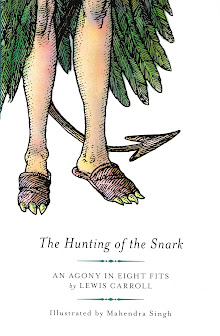
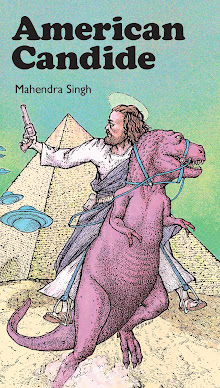
The coin of the realm these postlapsarian days seems to be the last and
greatest bastion of that very same unblinking faith-in-the-unseen which
characterized the salad days of the Middle Ages. Nowadays, most
governments print and mint the stuff by the bushel with nothing more to
back it up save a vague promise of an tattered xerox of a smudged fax of
a unfocussed photograph of a crude drawing of a shifty rumour of
someone, somewhere, actually doing something of value sufficient to prop
up the coin in question.
However, in the Nonsense world of Lewis Carroll, and more to the point, in the Barrister’s Dream of The Hunting of the Snark,
we find a refreshingly hard-nosed, Victorian mentality vis-a-vis
whatever coin of the realm you might be trying to palm off on the
locals. Messers Carroll & Dodgson had a healthy respect for money,
struggling as they did to support various spinster sisters (AKA spinsisters
in certain musical circles) and even the odd charity case on an
academic’s meager salary. Hence, it is with heavy heart (and light
kidney, groan) that they would have regarded the Snark’s pooh-poohing of
the charge of Insolvency on the part of his piggish client.
The
Snark’s defense of "never indebted" must come as a vindication of sorts
to the Pig, whose depiction here as a piggy bank will no doubt amuse the
simpler-minded reader. Giant, auspicious pigs with financial and
psychic clout were once all the rage in certain mythical, Celtic quarters and such cheap visual sleights-of-hand are this artist’s inky stock-in-trade.
But
the Barrister would also like to draw your attention to the chorus line
of Martin Heideggers who are shimmying seductively to the delightful
tune of When it Rains, It Rains Pennies From Heaven.
It’s a comforting melody composed to allay the Judge’s crypto-Calvinist
suspicions of any rumored pay-offs emanating from Upstairs and to also
lull the Jury into contemplating the possibility that the Pig isn’t
responsible for his actions since Society Made Him Do It Anyway (a legal defense employed, curiously enough, by the real Martin Heidegger).
But
what’s this, the Judge sputters in dismay! These are no pennies
cascading into the Heidegger-Pig, these are — gasp! — shekels! Even more
suspicious, these are Tyrian shekels! These notorious coins,
adorned with the likeness of the Phoenician god Melqart or Baal, were
the favored form of payment for the most infamous act of Treason ever
done, yes, they were the fee earned by Judas when he threw his lot in
with you-know-who — Beelzebub & Assoc., Esq.! This same Beelzebub,
associated in Jewish legal circles with the afore-mentioned Baal (and
both of 'em B-Boyz like our entire Snark-Hunting crew, eh?), has also been seen in company with that pesky
Lord of the Flies so memorably depicted by William Golding as a big, fat
pig’s head impaled on a stick for the amusement of a crowd of hooting
under-age lager louts on holiday.
To sum up, milord and dear
readers, this tragic descent of a benevolent, well-moneyed Celtic pig
into a satanic, treasonous Judeo-Christian pig is no mere question of
fudge, as my learned Snark colleague would have it. No, it is even
worse, it is a prime example of Gresham’s Law — bad pigs drive out good!
The defense rests in a crouched, fetal position, as ever, till next week …
Monday, August 5, 2013
Monday, July 29, 2013
A snark for Mr. Biswas
The late, great Strother Martin (probably one of the Heiddeger Martins
from Heidelberg, back in the old country) once noted, in a similar
situation involving some other dunderheads messing about with the law,
phenomenology and life’s problems in general, that what we have here is a
failure to communicate.
But how to illustrate such a situation without in turn failing to communicate one’s own self? How can we avoid the relentless, downward spiral of miscommunication, and distrust which so plagues modern youth?
Such logical intricacies were a sort of busman’s holiday for a certain class of Hindu (and Buddhist) philosophers and sages of yore whose otherwise innocuous turbans concealed brains possessed with a fiendish capacity for splitting hairs. The very antithesis of the plain-talking Strother Martin, these learned gentlemen delighted in concocting the metaphysical equivalent of the blazing hot curries on which they subsisted; arguments possessed of such piquancy that they were often disguised as bland, easy-to-swallow parables lest they frighten the kiddies or scare the livestock.
The most famous of such parables describes the misguided attempt by a group of blind brahmins to describe what an elephant is like through touch alone. One brahmin, grasping the trunk, thinks the elephant is rope-like, the other hugs a leg and finds the elephant to be tree-like, and so on until you, the befuddled reader trapped in your occidental web of illusion, get the point and purchase another round of curry for the house.
Needless to say, this illusion business (better known as maya in the finer sort of new — and old — deli) is further compounded by this artist with the addition of a really top-knotch epistemological corker: the multivalent confusion generated by having everyone concerned being the same person.
In such a case, when observer and observed are one and the same, one can truly say that anything anyone might have to say about anything will be best classified as everyone speaking at once and hence no one knowing what is said (pauses to wipe forehead with a tea-dampened dosa). Or as a certain neologizing German thinkwallah might have put it, what we have here is a failure to überselbstzeichnungangstgemachen.
Stay tuned, tolerant reader, for next week’s exciting, hijacked episode of Lewis Carroll’s Hunting of the Snark … or something like that …
But how to illustrate such a situation without in turn failing to communicate one’s own self? How can we avoid the relentless, downward spiral of miscommunication, and distrust which so plagues modern youth?
Such logical intricacies were a sort of busman’s holiday for a certain class of Hindu (and Buddhist) philosophers and sages of yore whose otherwise innocuous turbans concealed brains possessed with a fiendish capacity for splitting hairs. The very antithesis of the plain-talking Strother Martin, these learned gentlemen delighted in concocting the metaphysical equivalent of the blazing hot curries on which they subsisted; arguments possessed of such piquancy that they were often disguised as bland, easy-to-swallow parables lest they frighten the kiddies or scare the livestock.
The most famous of such parables describes the misguided attempt by a group of blind brahmins to describe what an elephant is like through touch alone. One brahmin, grasping the trunk, thinks the elephant is rope-like, the other hugs a leg and finds the elephant to be tree-like, and so on until you, the befuddled reader trapped in your occidental web of illusion, get the point and purchase another round of curry for the house.
Needless to say, this illusion business (better known as maya in the finer sort of new — and old — deli) is further compounded by this artist with the addition of a really top-knotch epistemological corker: the multivalent confusion generated by having everyone concerned being the same person.
In such a case, when observer and observed are one and the same, one can truly say that anything anyone might have to say about anything will be best classified as everyone speaking at once and hence no one knowing what is said (pauses to wipe forehead with a tea-dampened dosa). Or as a certain neologizing German thinkwallah might have put it, what we have here is a failure to überselbstzeichnungangstgemachen.
Stay tuned, tolerant reader, for next week’s exciting, hijacked episode of Lewis Carroll’s Hunting of the Snark … or something like that …
Monday, July 22, 2013
The Trumpeter and the Snark
If you’ve been assiduously following our nonsensical res publica, The Hunting of the Snark, you might have noticed that there has been a steady accumulation of visual details as the story progresses. Such a gradual amplification of things is what the critics call fritter-my-wig or even what-you-may-call-um and believe me, it’s all the rage in the right sort of literary circles.
However, we ‘umble visual artists, (fixated as always on more alimentary matters) call such an accumulation of visual tchotchkes "chicken fat". The late, great Will Elder coined the term whilst inking a drowned fly into a late night rendering of Harvey Kurtzman’s matzoh-ball soup as a practical joke. After a bit of the usual overheated vaudeville cross-talk-cum-haberule®-brandishing and some soft-shoeing with the Pro-White on Elder’s part, the moniker stuck and generations of artists have been ladling the chicken fat (or even schmalz if it’s germane to the proceedings) into their more soup-like drawings ever since.
All of which is a very convoluted and uselessly byzantine way of saying that you should keep a close eye on the progression of our Snark Hunt for it’s growing ever richer in unsaturated animal lipids such as chicken fat and Martin Heidegger. Naturally, one wonders what Lewis Carroll would have made of all our messing about with his otherwise perfectly normal recipe for a bowl of soup … would he have smacked his lips appreciatively at the our addition of the accurately-besmocked and bestyed pigherder Witnesses demonstrating the swineless vacuity of this comic operetta of a legal farce? Would he have slurped greedily at the tasty bits of the timeless humour of Mister Piggy’s magnum opus hoisted aloft before the proceedings like some sort of philosophical pearls before swine?
Or would Mister Carroll have paused in mid-luncheon, his spoon poised at his lips, and angrily demanded this artist to explain post haste what this other bird, this nonchicken and perhaps even swan-like bird masquerading as a legal bagpipe is doing in our collation of a Snark Hunt?
Alas, for Mr. Carroll and his delicate Victorian sense and sensibilities! This unexpectedly swannish creature is probably the grotesque and unexpected consequence of this artist using second-grade-fresh chicken fat in his cheapster drawings, a fly-by-night chicken fat cunningly adulterated with etymological preservatives of unknown provenance.
Yes, dear reader, this sudden outbreak of swans and bagpipes is no accident, on the contrary, it is a Significant Detail! Curiously, the word "sound", deriving as it does from the Old English word "swan," (properly, the sounding bird) seems to provide a perfect excuse for this artist to wreak further havoc on the entire chicken fat paradigm and perhaps even clear the way for a future swan-fat thing-um-a-jig. Or something along these metaphorically miscegenated lines of reasoning which so bedevil this production of the Snark …
Without error or flaw indeed, eh?
Monday, July 15, 2013
The only good Heidegger is a dead Heidegger
Melodramatic courtroom scenes are the crack cocaine of modern cinema and television; the average viewer must have a regular dose at certain intervals or they will soon lose interest in whatever televisual dog’s-breakfast is being served ‘em by the sweaty-palmed, hysterically gibbering minions of Hollywood or Bollywood or whatever-wood they happen to find themselves lost in quasi-Dantesque peril.
However, our watchword for today is — eschew the obvious! Pester me not for your cheap thrills of courtroom antics leavened by lurid, torn-from-the-headlines social issues! You shall have none of that here and I do not care if you lapse into oddly compelling convulsions. Instead, you shall have a wholesome bit of this week’s episode of Lewis Carroll’s Snark Hunt, in which we find the Barrister heaving onto his hind legs before an English judge and jury, all for the benefit of a porcine defendant of no fixed address. There are no lurid social issues being mooted about in this courtroom, just the sweaty business of Man vs. Swine with a pinch of Desertion to lend it all an air of forensic veracity,
Good lord, I hear you mutter, everyone looks like everyone else, what’s going on here? Fret not, dear reader, you are not hallucinating nor is this artist suffering from idiopathic monofacia, in fact this is a prime example of what legal experts call habeas corpus (or more correctly, habeo corpus, for the benefit of congenitally officious readers).
In fact, we have here the body and the face of the Barrister, AKA Martin Heidegger, multiplied ten-fold so that he can simultaneously play all the necessary roles of this Carrollian nightmare of a courtroom drama. In doing so, not only do we cut down on unnecessary expenditures of our favorite brand of second-grade-fresh, reheated cafeteria-style india ink but we can also avoid the bothersome necessity of accurately drawing the many different faces of a full complement of judge, jury, defendant, spectators and string section.
Good lord, I hear you mutter, string section? Why yes, a string section and I think they are playing something rather jolly, a spritely tune which could even serve as an overture to the impending legal machinations of Messers Heidegger, Heidegger, Heidegger and Heidegger (gesundheit). It sounds rather like a bit of Gilbert and Sullivan and the hypernaturally eagle-eyed reader will have already noted the bit of foolscap in the Barrister’s hand upon which we can observe that hark, the hour of ten is sounding!
Cryptically sound advice indeed, for it might serve as both an indicator of the numerical quantity of Heideggers facially cluttering the landscape and more to the point, perhaps even the opening verses of Gilbert and Sullivan’s forensic benchwarmer, Trial By Jury.
The well-oiled Carrollian will sigh appreciatively at all this, knowing as they do that Carroll once harbored designs of collaborating with Sir Arthur Seymour Sullivan. These designs were crushed by something or the other, such was (and is) the topsy-turvy world of the crushing theater.
It is only now, over 130 years later, that the reader can judge for himself what such a collaboration might have looked like as he peruses our artistic reconstruction of a Carroll and Sullivan collaboration. I suggest that with glass in eye, you observe in a melodiously crosshatched manner that Heideggers with anxious fears are abounding, breathing hope and fear — for to-day in this arena, summoned by a stern subpoena, the Snark shortly will appear.
Monday, July 8, 2013
Draw, memory!
I'm still on my semi-Snark-hiatus … like MacArthur, my Hunting of the Snark GN shall return (remember, kids, never fight a land-Snark in Asia) … and in the meantime, here's something from the files:
The Art of the Fugue, which appeared in Fantagraphic's Prime Cuts in 1987. I guess those were my salad days, at least Gary Groth must have thought so. This was my first comix in print so please be gentle with her, she's a delicate, colicky thing, not at all like a Snark GN.
Monday, July 1, 2013
Twentieth Century Fox, Nineteenth Century Crow
The semi-hiatus continues … I'll resume posting art from my Snark GN next week … as soon as I finish "vacationing" whilst digging out a septic pit for my mum, fixing the invisible fencing, cleaning the gutters, trimming the goats' hooves and of course, getting a healthy dose of maternal advice on every possible subject. Meanwhile, for the kiddies, here's …
The Fox and the Crow
There was once a Crow who flew to the most fancy restaurant in town and
ordered the most expensive dish on the menu. While he was waiting for his food,
he saw a badly dressed Fox staring at him from the window.
The Crow told the waiter to invite the poor beast inside. He probably
thought that letting the Fox watch him eat his dinner would make the food taste
even better — that’s the sort of Crow he was, I’m afraid.
As soon as the Fox sat down, the Crow began eating his Chicken Marengo,
the speciality of the restaurant. “Do you even know what’s in that dish you are
eating?” asked the Fox. The Crow did not answer; he kept his beak shut. He did
not stop chewing. He suspected a trap.
“You’re eating a bird,” announced the Fox, “a big, dumb bird just like
you. How does that make you feel?” The Crow opened his beak in horror at
hearing this and some of his Chicken Marengo fell on the floor. The hungry Fox
gobbled it up and ran out the door.
“That ignorant Crow!” said the Fox. “He doesn’t even know that Chicken
Marengo is made from marengos, not chickens.” He was so pleased at his own
cleverness in getting a free meal that he forgot to look both ways when
crossing the street. A farmer on his way to the market with a wagon full of
fresh marengos ran over the Fox.
The Crow paid for the Fox’s funeral. He even bought colour-coordinated,
monogrammed silk handkerchiefs for all the other foxes to blow their noses with
during the funeral. Luckily for the Crow, one fox blew his nose so hard that
his brain malfunctioned and he let slip the truth: the Fox had not died in the
marengo accident, he had only damaged his tail. He was recovering at home with
his mother, who had forbidden him to eat dinner with strange crows ever again.
Moral: Don’t listen to people who
talk with their mouths full unless you want to eat crow afterwards.
Monday, June 24, 2013
Remembering to forget …
I'm on a semi-hiatus this week, a quasi-lacuna or even a mini-interruptus of sorts, and in lieu of the usual Snarkish blather, I post this pencil comp for a graphic novel I'm trying to get started. It's a re-telling of Shakuntala and on this page we can see the royal rishi Kaushika taking a hiatus of his own, from the hectic urban realities of Connaugh Place to the quieter surroundings of the ur-forest of the Mahabharat.
Alas, there's a woman involved and Kaushika's holiday is soon going to degenerate into a quick bit of nooky and then post-coital trip to Wal-Mart to get more stuff for the ashram …
yow!
Alas, there's a woman involved and Kaushika's holiday is soon going to degenerate into a quick bit of nooky and then post-coital trip to Wal-Mart to get more stuff for the ashram …
yow!
Monday, June 17, 2013
Smells Like Teen Snark
And on the sixth Fit, the Barrister slept.
Played here by the notorious Continental steamer, Martin Heidegger, (right Zeit up and left Sein down) the Barrister has been overwhelmed by the fumes of cheap plonk and the Beaver’s well-turned ankles and has sunk into a torpid sort of slumber upon a thickly inked lawn.
Our reader, who eschews cheap drink and chorus girls in favor of the headier vintages of Carrollian verse, will note that the Barrister has been furnished here with dreams in the plural. He or she will nod knowingly, perhaps even smugly, for every Carrollian worth their mustard and cress is cognizant of the Master’s mysterious penchant for dreams.
In fact, Lewis Carroll never met a novel or poem in which he didn’t feel obliged to stuff in the odd bit of dreamwork to move the plot along, and by providing the luckless Barrister with an multiplicity of dreams our poet may be betraying his own crypto-Hindu sympathies! Classical Hindu epistemology, bursting at the seams as it does with a nightmarish superfluity of dreams and illusions, all of ‘em nested one within the other, would have been pure catnip for the likes of Carroll.
This artist is aware that there are those amongst us who will object to the above theory, they might mutter darkly about a certain virulent strain of Neo-Platonism run amuck on the playing fields of Eton from which Carroll may have been infected, rather than some curry-inflected metaphysics hailing from god knows where. Well, they can toss their Neo-Platonic influences into the dust bin as far as we’re concerned, for it’s Hinduism which has the real pukka goods on Runaway Idealism and this Floating Metadream We Call Life. Like the Red King in Through the Looking Glass, we are all of us, readers, artist, poet and Barrister, dreaming of one another and if we ever do wake up to find out what’s Real, well, what is Reality anyway, huh?
After mentally digesting all of this, the less tolerant reader will start things off by giving this over-heated illustrator a gentle boxing about the ears and a light touching up with a lead featherduster. They will then will reach for their Bradshaw of the Future (our preferred etymological opium den) and look pensive whilst they peruse the pedigree of the word "dream", a word which in Old English meant "joy" or even curiouser and curiouser, "music".
Tossing aside their Bradshaw with an insouciant pshaw, the less tolerant reader will then gird their loins and push their way past the more tolerant reader (still asleep and reeking of cheap plonk and ankles, no doubt) and towards the well-inked anthropomorphic forks afflicted with the Amorous Gigantism of Inanimate Objects, the Beaver’s size 9 chukka boots, the winged goblets and obligatory bar of soap, the Man-Ray-smiles and the cloth-headed judge-and-jury — all of ‘em merely a smokescreen for the 9-piece band ensconced in their band-shell in the background of this etymological-cum-epistemological mis-en-scene!
And what is this joyful music that our dream orchestra* is producing for the benefit of our dream Barrister? Is it the melodious warblings of some Hindustani songstress afflicted with a keening adenoidal distress? Is it the rock ‘n roll oompah-oompah of some hipster, Platonic cave-dwellers? To find out, dear readers, stay tuned for next week’s episode of The Hunting of the Snark!
____________________
*Our readers might even be more bewildered than usual to learn that this illustrator is personally afflicted with the rather enjoyable syndrome of musical dreaming; that for many years his dreams have been provided with a sort of involuntary cinematic soundtrack, not of his choosing although usually of a classical nature with full symphonic scoring and occasional instrumental soloists. On occasion a bit of pop rubbish gets by, the theme to Star Wars or suchlike, but this artist is the sort of high-minded fellow who thinks nothing of walking out of a bad film or dream.
Monday, June 10, 2013
Sumer is icumen in, lhude sing snark!
Well, isn’t this jolly, all of us having our tiffin in this lovely English garden waiting for the sun, and if the sun don't come, we’ll get a tan from standing in the English rain. What a clever way with words these Brits have, always joking around and making light of the darkest (and wettest) situations. Here we are, in the very thing-um-a-jig of a Snark Hunt, crosshatching to the left of us, crosshatching to the right of us, and our merry lads have seen fit to burst forth into song, a semimelodious bit of Old English galdor reminiscent of the salad days of Aethelred the Unready and suchlike skaldic mumbo-jumbery.
All of which affords this illustrator a bit of artistic license sufficient to render a thimble, some forks, an esperant anchor, a smile and some soap, ie., five-sevenths of the afore-mentioned Snarkic prophylaxes. He’s also taken the liberty of laying on some cakes and ale (on an illustrator’s meager pittance of a moon and sixpence, no less!) and has even hired a band-cum-bandshell, all of which should provide sufficient innocent merriment for the B-Boyz and their Protosurrealist demimondaines, at least enough to show ‘em that this illustrator cares.
Naturally, this illustrative care increases our stanzel’s Combined Snarkic Prophylactic Level (CSPL) to six-sevenths, which fraction, when its numerator and denominator are multiplied, provides us with the number 42, a number mooted by some to be The Answer to Life, the Universe and Everything in It.
Lewis Carroll thought enough of the number 42 to provide it with a comfortable home and small pension, way back in the Good Old Days of Fit the First. There are certain small-minded persons who will always look askance at such instances of numerophilia, they will mutter darkly of alphanumeric miscegenation and cryptokabbalistic cabals and all that sort of thing which they suspect is always going on at parties like the one pictured above. Which is why those sort of people never get invited to this sort of party, huzzah!
And so, ladies and gentlemen and sundry weirdos, proclaims this illustrator as he sways drunkenly onto his feet, I propose a toast!
Let’s hear it for Lewis Carroll (tipsy shouts of hear, hear!) … the best Anglican maths-tutor-cum-nonsense-wallah Oxford ever produced (gurgled cries of approval emanating from a giant thimble full of wine) … a true friend of man and anapest alike (slurred bleats of rhubarb-rhubarb, custard-custard) … and the most important Victorian poet to ever use the words "railway-share"! (exeunt all, with general bedlam light to variable).
Monday, June 3, 2013
To snark a mockingbird
With a nightmarish fanfare of snores and snorts, Fit the Sixth of Lewis Carroll’s cri-de-cœur, AKA The Hunting of the Snark, now heaves into view. This page of my graphic novel version, a little number which I call The Barrister’s Dream, is an illustrative poke-in-the-snoot aimed squarely at the grand English tradition of Oneiric Verse, ie., such yawn-inducing showstoppers as the Dream of the Rood, Bill Blake’s Dream and Christina "Sister Wombat" Rossetti’s Dream Land.
The well-read reader, and perhaps even the ill-read reader, will note that in this Fit of his Snark, Carroll successfully introduced the nightmarish element of courtroom litigation into the English Dream Poem, thus bringing to light the adversarial relationship twixt Dreamer and Dream.
We all of us dream and yet none of us truly know why, and more to the point, what our dreams might mean. If this is not an apt metaphor for the relationship twixt the Average Citizen and the Law, I’m a frittered-cheese-wig! Hence, our need for barristers and all their jolly legal ilk cluttering the land, and hence we find that even whilst asleep, Carroll has seen fit to provide you, the W.R.R., with qualified legal assistance at affordable rates.
If you are so inclined, it might occur to you that the Entire Meaning of the Snark is a similar enigma, impervious to explanation save by employing the services of a picture-wallah such as my ever-so-‘umble self. It might even occur to you that my tactic of employing Martin Heidegger as our Snarkic Barrister bodes ill for any useful solution to any of the above questions. Heidegger was a notorious Teutonic chatterbox and utterly useless for any explanation more complex than obtaining the directions to the nearest washroom, in short, prime material for any barrister’s office wishing to pad their billable hours beyond all human endurance.
Alas, you are not so inclined. You are, like the Barrister Heidegger, comfortably reclined and fast asleep on company time, amazed by this Snark-hunter’s dream which we call life.
Monday, May 27, 2013
Yellow Snarkarine
The preternaturally alert reader will instantly recognize the decor of this panel as a quintessentially English bit of inkery lifted whole from the Yellow Submarine, that snarkalicious confection crafted by Messers Dunnings, Coates, Edelmann et alia.
Their Anglo-Canadian-Teutonic vision of the archetypical English garden party, Pepperland, is shown here being hijacked by a band of desperate Snark Hunters in need of shelter from the heavy weather of Fit the Fifth.
In truth, there is little to recommend in this Fit to anyone in need of some jollies to lighten the burden of another long day working for the Man and all that. F5, as some Snarkistanis dub it, is a place where there is a gnashing of teeth and a smiting of thighs in the very best tradition of the sadomasochistic hallucinations and delusions of St. Anthony and his Victorian spiritual descendants, those lecturers at certain educational institutions who were condemned to the spiritual torture of instructing the Boschian progeny of the upper classes in all things animal, vegetable and mineral.
As proof positive of all of the above, let us note that Lewis Carroll, a mild-mannered man noted for his personal gentleness, saw fit to end this Fit with a semi-Swiftian comment upon all of the above. This novel friendship between the Beaver and the Butcher is cemented not by the altruistic bonds of selfless love but by the grotesque imperatives of Fear and Loathing!
You old cynic, Mr. Carroll! You’ve been hobnobbing too much with that old boojum-lover Mr. C.L. Dodgson, whose years of teaching at Christ Church had taught him to regard his young charges as at worst, nasty, brutish and short, and at best, nasty, brutish and short from the right sort of families.
Which is why this illustrator thought it might brighten up the place a bit if we had a little bit of Pepperland and the Fab Four smuggled in to do the honors for the Jubjub’s Song which closes this Fit. Come on, Messers Dodgson and Carroll, it’s not as bad as all that, all you need is love!
Monday, May 20, 2013
Habemus snarquum!
The attentive reader will notice that in this panel, as in the last two panels, we have been undergoing what specialists in this sort of thing call a Transition. Beginning with an ur-schoolroom redolent of the worst Boschian horrors Christ Church could have on tap, we shifted into a theatrical backdrop of sorts, then flitted through a hasty visual flashback of various preceding Fits and now find ourselves in a pastoral sort of setting, evocative of an English garden party frequented by exactly the sort of Carrollian riffraff one always finds lurking about at such affairs.
Gosh! This Transformation business is mickle hard to pull off, it’s certainly easier for the likes of poets such as Lewis Carroll to shift quarters if they wish, it’s merely a question of them upending a spare thesaurus and rummaging about with a few new adjectives and suitable prepositions. For us picture-wallahs, it’s a whole different story! The extras have to be chosen and then costumed, the appropriate locales have to be researched and then reproduced at considerable expense, then there’s lighting and makeup, why, the catering alone is an logistical boojum!
In this case, we’ve arranged for some currently unemployed peons from Alice in Wonderland to serve drinks and snacks whilst the Fellowship of the Snark mill around in period costumes with various Protosurrealist floozies glued to their arms, all of ‘em muttering rhubarb-rhubarb-custard-custard to give it all that air of Carrollian verisimilitude.
Of course, in the Good Old Days they didn’t call it a Transition, it was a Metamorphosis back then and it was all the rage in pre-Christian circles. You couldn’t go outside for the morning paper without bumping into someone’s teenaged daughter bursting into foliage or regressing into a giant spider; such goings-on were pure catnip for the poets of that time and I think it’s safe to say that the advent of monotheism put the kibosh on a considerable source of innocent merriment for both gods and mortals.
All of which brings us to the semi-belated point that in some subliminal manner, Lewis Carroll’s High Anglican penchant for Nonsense verse is really the sneaky pagan’s taste for Metamorphosis resurgent in the usually sacrosanct domain of Logic and Semiotics! As always, I’ll eschew further elaboration of this particular observation out of respect for the sausage-stuffing-phobia of any decent reader towards such crypto-Bismarckian literary goings-ons.
I shall confine myself to remarking that Metamorphosis is a fine thing, a double-plus-fine thing to liven up any bit of illustration or verse you might have handy; perhaps the Beaver and Butcher’s unexpected metamorphosis into the very best of friends is just the sort of versification needed to bring back the salad days of wine, women and Pagan Nonsense …
Monday, May 13, 2013
She walks in beauty, like the snark …
While the Beaver confessed, with affectionate looks
More eloquent even than tears,
It had learned in ten minutes far more than all books
Would have taught it in seventy years.
They returned hand-in-hand, and the Bellman, unmanned
(For a moment) with noble emotion,
Said “This amply repays all the wearisome days
We have spent on the billowy ocean!”
May we conjecture that in this melodramatic passage of verse (redolent of Tennyson’s more sentimental confections) the poet Lewis Carroll is performing some sort of prosodic sleight-of-hand meant to encapsulate into a very nutshell, as it were, the entire gamut of stormy passions and turgid pleasures which we lesser folk call Married Life?
The fool-suckling and small-beer-chronicling of married life was unknown to Carroll personally. However his friend C.L. Dodgson seems to have known something about the Vast Mystery of Connubial and Familial Bliss in a second-hand sort of manner and probably let Carroll in on the joke, so to speak.
The true-life confessions of the Beaver are spicy stuff indeed, by Victorian standards! Her bitter observation that looks are always more eloquent even than tears is a clear reference to the Eternal Dilemma of the weeping, middle-aged woman confronting the illicitly toothsome paramour of her caddishly retro-adolescent-spouse.
The Bellman’s fleeting emasculation is a proto-Freudian dig (or even a snigger, I’m not quite sure) at thing-um-a-jig and perhaps even what-you-may-call-um, pretty strong stuff indeed for a commoner’s garden variety Snark Hunt and better left to the plain-brown-wrapper crowd who frequent the less-reputable purlieus of English verse!
There’s also some versical bits and pieces hinting at the Disconsolation of Books, the Inevitable Patching It Up for the Sake of the Kids and even a bit of emotional doubletalk on the Bellman’s part, solely for the purposes of smoothing things over for his pal the Butcher, who remains conveniently silent throughout this whole cringe-inducing, Mills & Boon production.
All in all, it’s a pretty sordid low point in this Snark and perhaps even in this artist’s ongoing commentary upon the same. Sure, I’ve dressed it all up with a nice picture and some fancy music-hall-type crosstalk of a pseudo-intellectual bent but deep underneath it all, it’s all really quite shallow. Wearisome days, indeed, eh?
More eloquent even than tears,
It had learned in ten minutes far more than all books
Would have taught it in seventy years.
They returned hand-in-hand, and the Bellman, unmanned
(For a moment) with noble emotion,
Said “This amply repays all the wearisome days
We have spent on the billowy ocean!”
May we conjecture that in this melodramatic passage of verse (redolent of Tennyson’s more sentimental confections) the poet Lewis Carroll is performing some sort of prosodic sleight-of-hand meant to encapsulate into a very nutshell, as it were, the entire gamut of stormy passions and turgid pleasures which we lesser folk call Married Life?
The fool-suckling and small-beer-chronicling of married life was unknown to Carroll personally. However his friend C.L. Dodgson seems to have known something about the Vast Mystery of Connubial and Familial Bliss in a second-hand sort of manner and probably let Carroll in on the joke, so to speak.
The true-life confessions of the Beaver are spicy stuff indeed, by Victorian standards! Her bitter observation that looks are always more eloquent even than tears is a clear reference to the Eternal Dilemma of the weeping, middle-aged woman confronting the illicitly toothsome paramour of her caddishly retro-adolescent-spouse.
The Bellman’s fleeting emasculation is a proto-Freudian dig (or even a snigger, I’m not quite sure) at thing-um-a-jig and perhaps even what-you-may-call-um, pretty strong stuff indeed for a commoner’s garden variety Snark Hunt and better left to the plain-brown-wrapper crowd who frequent the less-reputable purlieus of English verse!
There’s also some versical bits and pieces hinting at the Disconsolation of Books, the Inevitable Patching It Up for the Sake of the Kids and even a bit of emotional doubletalk on the Bellman’s part, solely for the purposes of smoothing things over for his pal the Butcher, who remains conveniently silent throughout this whole cringe-inducing, Mills & Boon production.
All in all, it’s a pretty sordid low point in this Snark and perhaps even in this artist’s ongoing commentary upon the same. Sure, I’ve dressed it all up with a nice picture and some fancy music-hall-type crosstalk of a pseudo-intellectual bent but deep underneath it all, it’s all really quite shallow. Wearisome days, indeed, eh?
Monday, May 6, 2013
Lolita, light of my life, fire of my loins. My sin, my snark …
The Butcher would gladly have talked till next day,
But he felt that the lesson must end,
And he wept with delight in attempting to say
He considered the Beaver his friend.
Friendship is, of course, a double-edged sort of business, the very sort of tricksy fritter-my-wig-thingum-a-jig that Messers Lewis Carroll and C.L. Dodgson must have pondered over quite a bit in the course of their own long and fruitful association.
The attentive reader (is there any other?) will remember my own reasons for emasculating the Beaver, and I think that this very stanzel is proof positive of the aesthetic rightness (or is it righteousness?) of that long-ago, fateful decision on my part.
And so, we see here the Beaver and Butcher heaving into view with their freshly-minted friendship in tow. Needless to say, the friendship of the Butcher will prove a heavy burden for the luckless Beaver. The former’s penchant for looking the part of an incredible dunce, as evidenced in his just-concluded, semi-interminable monologue upon all things Jubjub, will weigh heavily upon the Beaver’s sensitive soul.
May we conjecture that Carroll might have had the same private misgivings concerning his rather leechlike pal, Dodgson? The basic principles of Prosodic Forensics may apply here, my dear Watson, when one bears in mind that once one has removed the impossible from whatever verse one is studying, whatever one is left with, however improbably, is the logical solution.
The Butcher’s poetic modus operandi is painfully obvious: dunderheaded obliviousness to all things outside his realm of expertise, a compulsion to lecture strangers ad infinitum, etc. Such a description is, as some of us are painfully aware, the very epitome of the college lecturer, of which C.L. Dodgson was a prime example.
The Beaver’s versical activities in the last Five Fits have been limited solely to making lace and saving the entire crew from wreck. The former activity is utterly frivolous, as is versifying in general, and the latter activity is nothing less than an oblique reference to her skill in composing galdors, those Celtic verse charms used in pagan times to protect the common folk from evil through the application of some mysterious, verbal magic unknown to the layman!
The attentive reader should promptly compare the above description to Lewis Carroll, and finding that it’s a perfect match, brandish their regulation Scotland Yard handcuffs, then secure the guilty party and march him off to the station to take his statement, the villain!
And while you’re at it, Sergeant, cuff that Dodgson wallah, he was probably in on it with Carroll, the two of ‘em are inseparable friends, don’t you know. We’ll soon have at least one of ‘em singing like a canary, probably till the next day, I’m afraid.
Wednesday, May 1, 2013
50 Shades of Snark

“You boil it in sawdust: you salt it in glue:
You condense it with locusts and tape:
Still keeping one principal object in view —
To preserve its symmetrical shape.”
Our Hunting of the Snark resumes its Jubjubian subplot for yet another stanzel; Lewis Carroll regales us here with a spirited description of a Jubjub being tortured by a variety of methods whose diabolical ingenuity and inventive discomfort seem uncomfortably redolent of an impromptu herd of schoolboys possessing the usual cretinous surplus of high spirits and moral pygmyism.
Carroll’s closest associate, C.L. Dodgson, would have been quite familiar with such goings-on, both as grim memories of his own public-schooling at Rugby and more to the point, as part of his quotidian duties as a maths tutor at Christ Church, where we can have little doubt that the vast majority of his students possessed a similar burning enthusiasm to make things hot for all creatures great and small.
This implicit connection twixt torture and mathematics must have troubled Dodgson’s gentle soul; no doubt he shared his unease with the more worldly Carroll, who then incorporated all of the above into this snappy bit of verse which we are chewing over right now.
In his Annotated Snark, Martin Gardner briefly discussed Prof. John Leech’s observations upon the mathematical implications of this stanza. Leech noted that by substituting locuses (or loci) for locusts, and tape measure for tape, one is then provided with the rudimentary instructions for the sawing and gluing together of the various wooden rods necessary for the skeletal framework of a regular polyhedron.
One can have little doubt that these instructions for the construction of a geometric solid would have provided Dodgson’s students with some considerable discomfort! From their 19th-century British discomfort they would have slipped, inevitably, into the very graphic slough of a fullblown 16th-century German melancholia, with all its attendant polyhedronal tortures!
Huzzah for the symmetrical mathematical-moral shape of things in our cozy world of boiled and salted Jubjubs-cum-schoolboys, ‘tis all very well thought out, Messers Carroll and Dodgson! The morally high-minded reader can chuckle appreciatively at all this, the rest of you just rattle your jewelry in a passing gust of old-fashioned schadenfreude.
NB. I must draw your attention, my dear Watson, to the curious incident of the dog barking at the moon. It is a Catalonian, 20th-century dog prone to bouts of selenic melancolia originating from its anachronistic exile to Nuremberg.
Monday, April 22, 2013
He who would make a Boojum of himself, gets rid of the pain of being a Snark

“Its flavour when cooked is more exquisite far
Than mutton, or oysters, or eggs:
(Some think it keeps best in an ivory jar,
And some, in mahogany kegs:)
One can never have enough of a jolly, good Snark hunt, don’t you agree? The fresh country air, the Protosurrealist scenery, the anapaestic hurly-burly of one’s fellow Snarquistadores baying after their prey, it all gives one such an appetite!
Naturally, no Snark hunt is complete without a bit of Jubjub taken al fresco whilst in the saddle. Cooked Jubjub is both palatable and highly nutritious, coyly hinting as it does to three-quarters of the Classical Four Elements : earth in the form of mutton, water in the form of oysters and air in the form of the eggs of some unspecified bird. The fourth and final element of fire could easily be supplied by the judicious application of some spicy condiment or chutney.
If Lewis Carroll were alive, he would certainly agree with you when you assert that this poetic reference (a milestone in Victorian Table Verse) to mutton, oyster and eggs makes these gustatorially implicit items into allegorical symbols of themselves. This is a subtle point indeed, so subtle that I’ll skip over the boring old meat-and-two-vegs-reasoning and head straight for the more exciting porto-and-coffee-conclusion, as it were.
Symbols which specifically refer to only themselves are called "reality" by certain smarty-pants metaphysicans. These sort of crackerjack thinkers would point out that the mutton-oysters-eggs-thingy is subset within a Jubjub which is itself subset within the ivory jars and mahogany kegs, the latter containers being diametrically opposed in coloring, another indication that Something Fishy Is Going On Here.
Unfortunately, Lewis Carroll is not alive and hence unable to agree with all of the above. In fact, his lack of Reality makes him feel a bit unagreeable and even disagreeable with all this alimentontological twaddle you’re going on with. In fact, he’s feeling rather queasy and unsettled with the whole business and my goodness, I think that he’s going to faint! Quick, call the management while I relieve Mr. Carroll of the weight of his wallet upon his chest.
Poor fellow, struck down in his prime and not a moment too soon! It must have been the Jubjub — look at the expiration date! Good lord, man, this Jubjub’s nearly 137 years old! Why, it’s not even second-grade-fresh! Slow food, indeed! Criminally slow, I’d say!
Subscribe to:
Posts (Atom)