Thursday, January 28, 2010

Oh, 'tis better to sleep with a sober Boojum than a drunken Christian


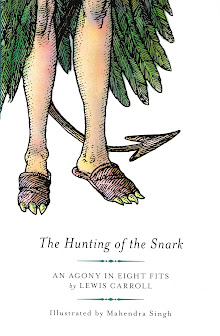
I'm very pleased to announce that Melville House is publishing my comixed version of Lewis Carroll's The Hunting of the Snark in the Fall of 2010. Alas, it will have to appear without the Commentaries which I've been working up so assiduously over the years but no matter, that will be remedied when the book goes into multiple printings after its appearance on Youtube in a blurry surveillance camera video of some American TV celebrity shoplifting it in a opiated stupor.

Melville House is run by the same discerning folks who put out the excellent blog, MobyLives, all of which is meant as an homage to Herman Melville, a man who knew a thing or two about long, fruitless quests for annihilating animals. Melville chose to clothe his Boojum in the blubbery lineaments of the fat, white whale, Moby Dick, (not the excellent kebab joint in Georgetown) and he also made certain that the whale's pursuers got a snootful of insane, nonsensical, contradictory ravings from their leader, Cap'n Ahab. In these critical matters, it's quite obvious that Melville was plundering Carroll's Snark in a classic example of what literary scholars call Anachronistic Plagiarism.

None the less, I'm in a forgiving mood today, as you might imagine and so we'll put aside these petty insinuations concerning the Second Greatest American Novel and move on to the far more pressing matter of Snarkian Ontology, exemplified here in the unassuming person of the Boots, seen above. Carroll makes little mention of this rather pedestrian character except for some perfunctory business with a spade in Fit the Fourth, and some commentators have even insinuated that the Boots did not really exist or that he might have been the actual murderer of the Baker, sharing as he does a "Boo" with the dreaded Boojum.

To all that I say phooey. However, drawing phooey is a bit trickier and it was only after considerable research by my crack team of crack-head researchers that we came up with a solution to all of the above: the Boots was Charles Darwin!


Carroll was probably present at the infamous 1860 debate on Darwinism between T.H. Huxley and Soapy Sam Wilberforce; we know that he owned and read Darwin's works; we even know that he and Darwin corresponded but we are uncertain as to the Great One's exact opinion on Natural Selection.

Well-oiled Carrollians suspect that he disapproved of this logical undoing of the basic tenets of all revealed religions on mainly philosophical grounds. Carroll's faith was unshakeable and more importantly, the Master of Nonsense certainly would have understood the difference between Faith and Logic as far as religions go, a simple mental operation which still seems beyond the limited cognitive abilities of many noisy commentators upon the subject today (so much for evolution, eh?). What might have perturbed Carroll could have been the spectacle of publicly quarreling over such private things, and hence, our choice of Darwin as the Boots.

Both Darwin and the Boots lurk in the shadows of Victorian England and the Snark alike. The former utterly and categorically demolished the entire logical basis of all organized religions almost apologetically, the latter utterly and categorically demolished the entire logical basis of Carroll's Snark almost apologetically. Both belief systems of religion and Snark are solely premised upon revelations, the verbal revelations of a god or a poet who presents us with a priori facts about the fictional Multiverses they have created. Carroll's colorless, practically blank persona of the Boots is a dead giveaway that there really is nothing going on here, that the Snark is just a sound and fury signifying nothing.

Nature and poetry alike shun vacuums, they make such an ontological mess of things and clever, up-to-date gods and poets alike eschew 'em. There's nothing worse than Nothing in the midst of your Something, it's a dead giveaway that you really are up to something and that's the very last thing you want your acolytes and readers to suspect. Fictional suspension of disbelief and all that, don't you know.

In short, there's something going on here, as usual. I'll leave it to the Carroll boffins to sort out the sticky details of all of the above revelations, for now, just take my word for it.

Thursday, January 21, 2010

The bellman always rings thrice …


In honor of nothing in particular, we'll devote this week's posting to an in-depth look at the Bellman (as shown above), the presiding genius and master of ceremonies of Lewis Carroll's Hunting of the Snark.

Readers who care to do so may remember that the Bellman appears in the very first line of the Snark, crying: Just the place for a Snark! This is of course, a tautology (and a rather clever parody of the traditional Homeric invocation of the Muse) and not the first which this avuncular, cozily insane personage will commit. Other Snarkologists have already pointed out that the Bellman may well have been based on an eponymous officer at Christ Church College, "Le Bellman", whose job it was to ring a bell whenever some particularly inert don had finally popped off for good.

Of such grim details are both great poetry and academic life made! An insane man armed with a large, blunt, heavy metal-and-wooden object with which he roams our poem and Oxford alike, announcing the beginning of the verses and the ending of some other poor college-wallah's life. No wonder this illustrator saw fit to flesh out this lugubrious person's person with the above drawing.

The sharp-eyed reader who eats his carrots will instantly ferret out, in his offhand, weaselly ferret-like manner, the fleur-de-lys motif lurking in the wallpaper. This outbreak of French monarchism has been induced by the Bellman's notorious insistence upon the Rule of Three which occurs immediately afterwards in the same opening stanzas:

Just the place for a Snark! I have said it thrice:
What I tell you three times is true.

Such pronouncements reek of royal diktats to this artist's ear; and furthermore, the trefoil motif nicely complements the trinitarian obsessions of what we now call the Clochetic Rule of Three. Learned Snarkologists have found all manner of historical riffraff lurking inside this Rule: a reference to a Victorian mathematical classroom crib, perhaps a jab at the Mad Monadist, Charles Peirce and his triunary blatherings, or it could even be a clever Protosurrealist, anti-anachronistic reference to cybernetics and human cognition and crypto-Catholicism.

But we here at Chez Snarque are made of sterner stuff! We think that the Bellman is nutters because he just is, and we've dug up some really cool facts to support our Nutter Theory. Firstly, the Bellman's odd physical appearance is based upon that of Sir John Tenniel, the quick-fingered illustrator of both of Carroll's Alice books, and a rascally bon vivant, to boot! This cyclopean ink-wallah looked the part, indeed!


SIR JOHN TENNIEL

Secondly, Sir John's illustrations for Carroll included several drawings of the White Knight, that avuncular, cozily insane personage who assists young Alice in her regal quest (zut! more monarchism!) in Through The Looking Glass. Well-oiled Carrollians will grunt appreciatively at all this, knowing that the White Knight was a stand-in for Carroll himself, who was notoriously shy about being bruited about in public as a avuncular, cozily insane personage.

Which leads us to our third observation, and hence, owing to the Clochetic Rule of Three, our self-evident, truly definitive and tyrannically final royal diktak upon the entire matter: the following drawing by Sir John of the Admirable Carroll in mufti as a White Knight who bears an uncanny resemblance to a certain Bellman trying pass himself off as — gasp! — Sir John Tenniel disguised as a certain Christ Church don named Charles Lutwidge Dodgson who had a penchant for going out in public as none other than — gasp again! — Lewis Carroll!


THE WHITE KNIGHT … OR IS HE?

Well, I think that just about wraps it up for both the Bellman's little scheme of trinitarian cross-dressing and more importantly, for whatever little standing I still possess amongst legitimate Carrollian circles.

No, no applause, please, I have more simple tastes. Just rattle your kippered herrings or something like that, I'm off for a nice lie-down with some hot-gin-and-nautch-girl-compresses. I feel a lynch mob coming on …

Thursday, January 14, 2010

Snarkenstein!


In the cozy world of dreams, Nonsense and Lewis Carroll in general, the common house cat is most usually found curled up in the warmest spot in the dream, well-fed and utterly oblivious of the sundry mice and other oneiric vermin which are scurrying in the shadows.

The cat cares not. She betokens nothing and like King Lear, knows that nothing will come from nothing. There is no cat in the Hunting of the Snark for the simple reason that cats are philosophically opposed to anapestic verse … it has such a dog-like trot to it, don't you know.

There are cats in both of Carroll's Alice books but don't get your hopes up, they were attracted there solely by the books' popularity. They enjoy the attention, nothing more.

If you dream of a cat, refer to your dog-eared copy of the Dreambook of Mister Pyridine and then make your preparations quickly, lest the cat wake too soon and leave off dreaming of you!

Thursday, January 7, 2010

hunting snark in the land of nod


To those of you who are wondering what this perturbing image from the Dreambook of Mister Pyridine might have to do with Lewis Carroll's Hunting of the Snark, I can only say: 42, man, 42!

It is a popular fact that dreams are suspected to embody some sort of hidden wisdom, a curious belief when one also considers the general thickieness of vast swathes of the good ol' human race. From whence comes this universal desire to believe that the semiconscious reveries of cerebral organs that are also collectively responsible for war, state-sponsored famines, racial pogroms, organized religion and French grammar might also somehow possess a hidden meaning and wisdom?

This risible desire to find meaning where there is none is responsible for a lot of unhappiness and at the same time, happiness! The Expulsion from Eden is proof positive of the former and the Admirable Carroll's Hunting of the Snark will do nicely for the latter. In both cases, a pattern of facts and events is stitched together into a logical pattern of meaning through sheer will power.

Those who search for the hidden meaning of the Snark are playing at Adam and Eve sitting underneath that infamous Boojum-Tree of Knowledge. Rather than just enjoy the shade it casts (and each other) they have to spoil everything by figuring it all out. When will the human race understand that the meaning of a pattern can sometimes be nothing more than the pattern?

Deep thoughts indeed, you're probably better off just looking at the pretty picture I've provided for your entertainment this week. Believe me, there's no hidden meaning there.

Thursday, December 31, 2009

A snark in the dollhouse …


The above page from the Dream Book of Mister Pyridine perfectly illustrates the fallacy of assuming that there nothing going on here, nothing at all, Officer …

The semi-bifurcated, oblate vivoid shown here, which the alert reader will remember as having first appeared disporting itself in the Bellman's Speech of Fit the Second, is itself a degenerated, inky memoroid distilled from certain examples (NSFW) of Hans Bellmer's infamous Poupées.

Dolls are homunculi of a passive sort (steady on there, Mr. Bellmer) and might be best described as the first attempts of children to create their own personal slavish Golems over which they might then exercise their burgeoning penchant for tyranny and absolute despotism. Any parent whose child has a penchant for doll-decapitation and delimbing will instantly know what I mean.

There is a deep teutonic juju at work in dolls, the same sort of thing-um-jig which spurs on certain poets to create vastly complex symbolic mindscapes upon which they can then, at their passive-aggressive leisure, wreak their aesthetically pleasing vengeance. Lewis Carroll's Hunting of the Snark springs to mind as a sterling example of all of the above, with the one caveat that the violence seems to have been directed more at himself than others.

All of which goes to show that you just can't trust anyone these days, eh? Gosh darn these modern times in which we live, where everything has to mean something else even more complicated. Why can't we all just get along with ourselves, huh, Mister Carroll?

Thursday, December 24, 2009

Snark Kitabu


Last night I dreamt of Africa, my natal land … upon awaking, I hastily referred to my dog-eared copy of The Dreambook of Mister Pyridine. As that infamous tome's epigraph proclaims — good luck, for there is no other!

Hmmm … deadly continents loom ahead … strong stuff indeed for the haruspices amongst us! Speaking of which, no doubt those of you blessed with second sight have been poking around your breakfast livers and come to the conclusion that any further mention of Lewis Carroll's Hunting of the Snark has become rather scarce on this blog.

Nothing could be further from the postmodern, globalized, deconstructed truth! All this talk of dreams is merely an extended riff upon the dominant theme of Fit the Sixth, the Barrister's Dream. The Barrister dreams of Snark, the Poet dreams of Parnassus, the Reader dreams of the Library of Babel and the Artist dreams of his own private Africa where well-inked beasts roam densely crosshatched jungles, themselves dreaming of Eden before the Fall.

Wednesday, December 16, 2009

Mama, don't take my Kodachrome Snark away!


After last week's completely unprovoked and shameless casting of aspersions upon the English, for which the management apologizes (a freak neurological short-circuit in a rogue flying-monkey-ninja-research-department-intern), we turn instead to casting aspersions at someone who is far better equipped to both take 'em and dish 'em out in return … yes, you know whom I mean …

Still trapped as we are in the stasis field of page 42+1 of Lewis Carroll's Hunting of the Snark, and to be more precise, in the Barrister's Dream of Fit the Sixth, it is only fitting that we also stop and take measure of the author of our entropic dilemma, Mister Carroll himself.

Were you aware that Lewis Carroll was a genuinely talented photographer and a pioneer in the subtle and difficult genre of child portraiture? If you don't believe me, I urge you to explore some of the links on the right, under the General Carrolliana heading.

If you do believe me, then you will also believe me when I inform you that according to The Dream Book of Mister Pyridine, those who dream of photography are dreaming of the one who is dreaming them (if one partakes of the Hindu view of things) and hence they are double illusions, similar in metaphysical nature to a photograph itself, which is itself the positive illusion of the negative illusion of the world-maya illusion itself.

Ordinarily, such I reserve such zenlike insights for the other listless habitues of the various saloons and vans-down-by-the-river which I am wont to frequent in my leisure hours but since this is the holiday season and all that, I thought it best to share and enjoy!
____________

NB. Hans Rickheit has commenced a 600-pg. (yow!) magnum opus, Ectopiary … he is posting pages as he goes and I recommend them to you. His Squirrel Machine, for me at least, was the best and most original thing in American comix in a long while. Ectopiary should be well worth visiting for a long time to come!

Wednesday, December 9, 2009

Only Mad Dogs and Englishmen Compose in Anapests in the Midday Sun

The attentive, perhaps even hyperactively aware reader, might think that we seem to have diverted somewhat from the more orthodox interpretations of Lewis Carroll’s Hunting of the Snark.

Nothing could be further from the truth. By scrolling down to earlier posts, you’ll note that we are still in the very bowels of the Barrister’s Dream of Fit the Sixth, and hence, we shall refer again to that classic work of Oneiric Americana, The Dream Book of Mister Pyridine, to parse out the subtle sophistries of this legalistic nightmare …


I think it’s pretty clear by now that we are dealing with an Englishman in the classic Foucaultian Author-Function sense of the word, and times two, if you please! Primo … we have an English poet, the Admirable Carroll, doing the honors behind the pen and secundo … we have the English Barrister’s dream, within which we wander like lost sheep waiting to be legally fleeced.


Of course, our poet is long dead and safely domiciled for all eternity in the Afterlife. Our Barrister might be said to be dead also (and everyone else appearing in his dream), for are not dreams, in all their obscure, unsettling infinity of meaning and duration, not harbingers of the Afterlife?

Food for thought, eh? And when you’re done chewing on all that, you can employ the lottery numbers we’ve provided above, just like Chinese fortune cookies, and purchase the very best dreams that money can buy! Check, please!

NB. Clients From Hell …
Lewis Carroll is reputed to have been a difficult author for illustrators to deal with (although he seems to have pushed them to do their better-then-best, which might give some of us modern-day ink-slingers pause for thought) … however, for any readers who are in the business of making people's eyeballs happy, I very heartily recommend Clients From Hell … and for those of you who have ever hired an artist or designer, why, you might find yourself commemorated on this digital Wall of Shame!

Thursday, December 3, 2009

Dream books, nonsense and bourbon …

In lieu of a genuinely Snarkish posting this week (have no fear, our Snark is in temporary occlusion only), I would like to present you with several Gradgrindish Facts instead :

It is a Fact that the pursuit of Nonsense is a useful pastime which not only will enable you to parse Kafka, but might even procure you gainful employment of some sort, such as parsing Kafka or getting a government grant to study exactly how one parses Kafka. We know this because we saw it on the web (a tip of the crowquill to the learned Dave Haan for bringing this to our attention) and even better, it is a self-fulfilling prophecy which justifies the absolute Nonsense which this blog has been peddling for quite some time now.


Self-fulfilling prophecies were the stock-in-trade of all great thinkers such as Victor Hugo. We see him above as he appeared in that classic grimoire, The Dream Book of Mr Pyridine. Dream books are a peculiarly American, and more precisely, Southern phenomenon; they were (and are) printed collections of various oneiric images which one might see in one’s sleep. When awakening, one refers to the dream book to discover the occluded meaning of the image or event, and more to the point, the accompanying numerical digits which correspond to the winning combination of that day’s numbers racket or lottery.


Such dream books were the preserve of the lower classes, needless to say. The Southern bourgeoisie (see above) had no truck with ‘em, preferring to take their auguries from the shifting patterns of the ice cubes melting at the bottom of their bourbon glasses.


In any case, the belief that the future can be revealed to us and in essence, that everything must mean something is a common delusion of not just the working classes but homo sapiens in general. Animals are not burdened with such risible mental baggage. Like Lewis Carroll’s Snark Hunters, they accept reality for what it is, moment by moment, and consider the very concept of the Future to be the only genuine Nonsense.

À suivre …

Wednesday, November 25, 2009

Fit the Sixth, Page 42+1, Panel 1 … a snark at the opera


“The fact of Desertion I will not dispute;
But its guilt, as I trust, is removed
(So far as related to the costs of this suit)
By the Alibi which has been proved.

Wipe the smirk from your face, dear reader, stifle the groan in your throat … yes, we are punning today and the punnee is a legal suit and the punnor is a gentleman’s suit, size 42.

Of course, you already know that puns are the bittersweet linguistic memory of that long-ago time when any word meant anything, and some of ‘em meant as much as six different things before breakfast. In those prelapsarian times when language was first evolving from the sonic ooze of grunts and snorts into more upright, ambulatory fricatives and uvular trills, the assignment of one particular sound to one particular object was a slapdash, fritter-my-wig sort of business. In truth, we might say that once upon a time all words were puns and Nonsense reigned upon the land.

All of this came to a sticky end with the invention of reeling and writhing, as I’m sure you’ve heard before. Equipped with such skills, even circus and theater folk could interpret the written marx of contract law and stymie the Pig and his legal Snark, all by invoking the Sanity Clause.

What’s this, the Judge sputters! Sanity Clause? You can’t fool me, there ain’t no Sanity Clause! Exactly, milord, 'tis the perfect Christmas Alibi, the Snark replies!

Wednesday, November 11, 2009

Fit the Sixth, Page 42, Panel 2 … 12 angry snarks


“You must know —” said the Judge: but the Snark exclaimed “Fudge!”
That statute is obsolete quite!
Let me tell you, my friends, the whole question depends
On an ancient manorial right.
“In the matter of Treason the pig would appear
To have aided, but scarcely abetted:
While the charge of Insolvency fails, it is clear,
If you grant the plea ‘never indebted.’

The coin of the realm these postlapsarian days seems to be the last and greatest bastion of that very same unblinking faith in the unseen which characterized the salad days of the Middle Ages. Nowadays, most governments print and mint the stuff by the bushel with nothing more to back it up save a vague promise of an tattered xerox of a smudged fax of a unfocussed photograph of a crude drawing of a shifty rumour of someone, somewhere, actually doing something of value sufficient to prop up the coin in question.

However, in the Nonsense world of Lewis Carroll, and more to the point, in the Barrister’s Dream of the Hunting of the Snark, we find a refreshingly hard-nosed, Victorian mentality vis-a-vis whatever coin of the realm you might be trying to palm off on the locals. Messers Carroll & Dodgson had a healthy respect for money, struggling as they did to support various spinster sisters (AKA spinsisters in certain musical circles) and even the odd charity case on an academic’s meager salary. Hence, it is with heavy heart (and light kidney, groan) that they would have regarded the Snark’s pooh-poohing of the charge of Insolvency on the part of his piggish client.

The Snark’s defense of "never indebted" must come as a vindication of sorts to the Pig, whose depiction here as a piggy bank will no doubt amuse the simpler-minded reader. Giant, auspicious pigs with financial and psychic clout were once all the rage in certain mythical, Celtic quarters and such cheap visual sleights-of-hand are this artist’s inky stock-in-trade.

But the Barrister would also like to draw your attention to the chorus line of Martin Heideggers who are shimmying seductively to the delightful tune of When it Rains, It Rains Pennies From Heaven. It’s a comforting melody composed to allay the Judge’s crypto-Calvinist suspicions of any rumored pay-offs emanating from Upstairs and to also lull the Jury into contemplating the possibility that the Pig isn’t responsible for his actions since Society Made Him Do It Anyway (a legal defense employed, curiously enough, by the real Martin Heidegger).

But what’s this, the Judge sputters in dismay! These are no pennies cascading into the Heidegger-Pig, these are — gasp! — shekels! Even more suspicious, these are Tyrian shekels! These notorious coins, adorned with the likeness of the Phoenician god Melqart or Baal, were the favored form of payment for the most infamous act of Treason ever done, yes, they were the fee earned by Judas when he threw his lot in with you-know-who — Beelzebub & Assoc., Esq.! This same Beelzebub, associated in Jewish legal circles with the afore-mentioned Baal (and both of 'em B-Boyz, eh?), has also been seen in company with that pesky Lord of the Flies so memorably depicted by William Golding as a big, fat pig’s head impaled on a stick for the amusement of a crowd of hooting under-age lager louts on holiday.

To sum up, milord and dear readers, this tragic descent of a benevolent, well-moneyed Celtic pig into a satanic, treasonous Judeo-Christian pig is no mere question of fudge, as my learned Snark colleague would have it. No, it is even worse, it is a prime example of Gresham’s Law — bad pigs drive out good!

The defense rests in a crouched, fetal position, as ever, till next week …

Wednesday, November 4, 2009

Fit the Sixth, Page 42, Panel 1 … snarkayana


The indictment had never been clearly expressed,
And it seemed that the Snark had begun,
And had spoken three hours, before any one guessed
What the pig was supposed to have done.
The Jury had each formed a different view
(Long before the indictment was read),
And they all spoke at once, so that none of them knew
One word that the others had said.

Page 42 of any work of literature will always be redolent of the highest Carrollian vibes imaginable; to wit, the well-known mojo of the Puissant Number 42 is at this very moment shedding its potent tantric vibe over the above drawing, a drawing dedicated to the ubiquitious situation of everybody speaking at once so that nobody knows what’s being said.

The late, great Strother Martin (probably one of the Heiddeger Martins from Heidelberg, back in the old country) once noted, in a similar situation involving some other dunderheads messing about with the law, phenomenology and life’s problems in general, that what we have here is a failure to communicate. But how to illustrate such a situation without in turn failing to communicate one’s own self? How can we avoid the relentless, downward spiral of miscommunication, and distrust which so plagues modern youth?

Such logical intricacies were a sort of busman’s holiday for a certain class of Hindu (and Buddhist) philosophers and sages of yore whose otherwise innocuous turbans concealed brains possessed with a fiendish capacity for splitting hairs. The very antithesis of the plain-talking Strother Martin, these learned gentlemen delighted in concocting the metaphysical equivalent of the blazing hot curries on which they subsisted; arguments possessed of such piquancy that they were often disguised as bland, easy-to-swallow parables lest they frighten the kiddies or scare the livestock, so to speak.

The most famous of such parables describes the misguided attempt by a group of blind brahmins to describe what an elephant is like through touch alone. One brahmin, grasping the trunk, thinks the elephant is rope-like, the other hugs a leg and finds the elephant to be tree-like, and so on until you, the befuddled reader trapped in your occidental web of illusion, get the point and purchase another round of curry for the house.

Needless to say, this illusion business (better known as maya in the finer sort of new — and old — deli) is further compounded by this artist with the addition of a really top-knotch epistomelogical corker: the multivalent confusion generated by having everyone concerned being the same person.

In such a case, when observer and observed are one and the same, one can truly say that anything anyone might have to say about anything will be best classified as everyone speaking at once and hence no one knowing what is said (pauses to wipe forehead with a dampened dosa). Or as a certain neologizing German thinkwallah might have put it, what we have here is a failure to überselbstzeichnungangstgemachen.

Stay tuned, tolerant reader, for next week’s exciting, hijacked episode of Lewis Carroll’s Hunting of the Snark … or something like that …
___________

Late-Breaking Snark News … NYC Snarkistas Take Notice!
Peter Pavlakis' film version of the Snark will be premiered at the Queens International Film Festival, Saturday, November 14th. Further information can be found here, plus a neat trailer. It looks quite interesting, a live action version to boot! Best of luck to Peter and if any readers see it, I would love to read your comments & critiques. To the best of my knowledge, this is the 2nd live-action film version currently in production or being shown in North America right now, the other being Michael McNeff's … could this be the long-awaited Snarkian Renaissance which sweeps Hollywood into a craze for All-Things-Nonsense?

Wednesday, October 28, 2009

Fit the Sixth … snarkus interruptus, squirrel resurgens!

More half-truths, demi-lies and outright double-cross-hatchery, a tapestry of black and white shot through with the glittering threads of Gilbert & Sullivan’s Trial By Jury, Heideggerian sophistry, macaronic etymologies, barnyard humor and other assorted bits of legalistic slapstick.

I believe it was Kafka who once noted that an artist always strives to align his internal world with his external world; the thoughtful reader can make of that what they will (serial killer? psychotic third-world dictator?) and no one will be the wiser. Judging from the above farrago of ink and words, this artist has much self-adjustment to do in the Internal World Department.

However, the appearance this week in bookstores of Hans Rickheit’s comix masterpiece, The Squirrel Machine, is a genuine milestone in the above-mentioned artistic business of reconciling one’s inside to one’s outside, so much so that I must confess that I am truly taken aback by Rickheit’s entire effort, in the best sense of the word.

This carefully constructed tale of two pariah brothers in turn-of-the-century New England, both of them obsessed with oneiric experiments of an unsettling and fascinating nature, strikes me as being one of the few original works of art that I’ve seen published in North America over the last two decades, on a par with the better work of Dan Clowes or Charles Burns. It possesses a nicely syncopated structural rhythm moving betwixt various opposites: dream-matter & quotidian reality, concealment & performance, decay & lust, sentient & sapient, even animate & inanimate.

The two brothers experiment upon themselves and others in their hermetic quest, which begins as musical efforts of a Grand Guignol nature and then metastasizes into the most floridly baroque variations upon the ancient themes of lust, power, love and fear.

This is not a tale for the squeamish nor is it a tale for the literal-minded; it is very much a bravura performance in the tradition of Surrealism, or Fantastic Art, or even Symbolism; a anti-realistic spectrum which ranges on one hand from the Mozartian heights of Carrollian Nonsense to the nihilistic abyss of the Comte de Lautréamont. In particular, Rickheit has drunk deeply at the more obscure Central European and German waters of this undercurrent : the younger Max Ernst, Hans Bellmer, Bruno Schulz, Jan Svankmajer, Jan Lenica, Max Klinger and even deeper in the past, E.T.A. Hoffman, Hieronymus Bosch, Hans Baldung Grien, etc.


Rickheit's methodical draftsmanship in the service of the
Underbrain, a sample spread from the Squirrel Machine


The ultra-logical transformation of the ordinary detritus of everyday life (Biedermayer knick-knacks, farm implements, medical devices) into the supercharged playthings of the Underbrain’s Dreamworld was the special preserve of Bellmer and Schulz, and their exquisitely corpse-like juxtaposition of animal sentience upon the human sex drive was their supreme gift to Surrealism; Rickheit has deeply absorbed this lesson and incorporated it into his work.

I am also relieved to say that except for the nihilistic ending of the tale, Rickheit eschews histrionics; the Squirrel Machine is emotionally controlled in a suitably automated sort of way, its precision of tension between meaning and white noise is so well-calibrated that the observant reader unconsciously ceases to resist Rickheit’s oneiric anti-logic.

To those readers who might be wondering what all this has to do with the Snark, I would caution them that behind the respectable and healthy facade of Carrollian Nonsense lurks an unfathomable abyss upon which the former depends for its very life. This behind-the-scenes darkness is not to everyone's taste but it is essential to the health and maintenance of the larger enterprise, it nourishes Nonsense and much more besides in art and literature.

Rickheit has furnished us with a Baedeker to the darker rooms behind this Anti-Naturalist facade, a few doors past classical Surrealism, further down the hall to an unmarked anteroom frequented by the cognoscenti of the Underbrain, a semifurnished room where something deeply unsettling yet still basically logical waits for us. This thread of elemental logic binds us still to Carrollian Nonsense and Rickheit’s teasing of its strands may be cruel at times, but never destructive towards the larger artistic project of imposing meaning upon the unknown.

In short, strongly recommended! In addition, kudos to Fantagraphics for publishing Rickheit. Despite the current renaissance in North American comix, a lot of comix work is still intellectually provincial and dominated by threadbare pop-culture aesthetics. When it comes to putting out quality comix, Messers Thompson and Groth still get it. Show ‘em that you also get it by buying this work, and others in the same vein!

The Squirrel Machine, by Hans Rickheit; 179 pages with an introduction by E. Stephen Frederick; available for purchase from Fantagraphics here. Not recommended for younger readers.

Wednesday, October 21, 2009

Fit the Sixth, Page 41, Panel 2 … the hills are alive with the sound of snark


The Witnesses proved, without error or flaw,
That the sty was deserted when found:
And the Judge kept explaining the state of the law
In a soft under-current of sound.

If you’ve been assiduously following our nonsensical res publica, The Hunting of the Snark, you might have noticed that there has been a steady accumulation of visual details as the story progresses. Such a gradual amplification of things is what the critics call fritter-my-wig or even what-you-may-call-um and believe me, it’s all the rage in the right sort of literary circles.

However, we ‘umble visual artists, (fixated as always on more alimentary matters) call such an accumulation of visual tchotchkes "chicken fat". The late, great Will Elder coined the term whilst inking a drowned fly into a late night rendering of Harvey Kurtzman’s matzoh-ball soup as a practical joke. After a bit of the usual overheated vaudeville cross-talk-cum-haberule®-brandishing and some soft-shoeing with the Pro-White on Elder’s part, the moniker stuck and generations of artists have been ladling the chicken fat (or even schmalz if it’s germane to the proceedings) into their more soup-like drawings ever since.

All of which is a very convoluted and uselessly byzantine way of saying that you should keep a close eye on the progression of our Snark Hunt for it’s growing ever richer in unsaturated animal lipids such as chicken fat and Martin Heidegger. Naturally, one wonders what Lewis Carroll would have made of all our messing about with his otherwise perfectly normal recipe for a bowl of soup … would he have smacked his lips appreciatively at the our addition of the accurately-besmocked and bestyed pigherder Witnesses demonstrating the swineless vacuity of this comic operetta of a legal farce? Would he have slurped greedily at the tasty bits of the timeless humour of Mister Piggy’s magnum opus hoisted aloft before the proceedings like some sort of philosophical pearls before swine?

Or would Mister Carroll have paused in mid-luncheon, his spoon poised at his lips, and angrily demanded this artist to explain post haste what this other bird, this nonchicken and perhaps even swan-like bird masquerading as a legal bagpipe is doing in our collation of a Snark Hunt?

Alas, for Mr. Carroll and his delicate Victorian sense and sensibilities! This unexpectedly swannish creature is probably the grotesque and unexpected consequence of this artist using second-grade-fresh chicken fat in his cheapster drawings, a fly-by-night chicken fat cunningly adulterated with etymological preservatives of unknown provenance.

Yes, dear reader, this sudden outbreak of swans and bagpipes is no accident, on the contrary, it is a Significant Detail! Curiously, the word "sound", deriving as it does from the Old English word "swan," (properly, the sounding bird) seems to provide a perfect excuse for this artist to wreak further havoc on the entire chicken fat paradigm and perhaps even clear the way for a future swan-fat thing-um-a-jig. Or something along these metaphorically miscegenated lines of reasoning which so bedevil this production of the Snark

Without error or flaw indeed, eh?
______________

NB. The very talented Tatiana Ianovskaia has just made available on-line here her charming and graceful renditions of Alice in Wonderland and Through The Looking Glass, they are really worth the price.

In addition, Oleg Lipchenko’s highly detailed and complex version of AIW is coming out shortly from Tundra Books; it is really superior work and also strongly recommended! The Slavic approach to Carroll is so vigorous and incisive; Tatiana and Oleg have approached the same texts with absolutely opposite strategies, and yet each one is accurate, aesthetically cohesive and emotionally satisfying. Perfect Christmas gifts!

… and the equally talented John Coulthart has just produced his 2010 Artist's Calendar, the theme is AIW! Calloo, callay, it's a '60s psychedelic trip and quite well done … he's intimating at the possibility of more Carrollian work, whether calendars or something more substantial remains to be seen.

Wednesday, October 7, 2009

Fit the Sixth, Page 41, Panel 1 … my object all sublime, to make the snark fit the crime


He dreamed that he stood in a shadowy Court,
Where the Snark, with a glass in its eye,
Dressed in gown, bands, and wig, was defending a pig
On the charge of deserting its sty.

Melodramatic courtroom scenes are the crack cocaine of modern cinema and television; the average viewer must have a regular dose at certain intervals or they will soon lose interest in whatever televisual dog’s-breakfast is being served ‘em by the sweaty-palmed, hysterically gibbering minions of Hollywood or Bollywood or whatever-wood they happen to find themselves lost in quasi-Dantesque peril.

However, our watchword for today is — eschew the obvious! Pester me not for your cheap thrills of courtroom antics leavened by lurid, torn-from-the-headlines social issues! You shall have none of that here and I do not care if you lapse into oddly compelling convulsions. Instead, you shall have a wholesome bit of this week’s episode of Lewis Carroll’s Snark Hunt, in which we find the Barrister heaving onto his hind legs before an English judge and jury, all for the benefit of a porcine defendant of no fixed address. There are no lurid social issues being mooted about in this courtroom, just the sweaty business of Man vs. Swine with a pinch of Desertion to lend it all an air of forensic veracity,

Good lord, I hear you mutter, everyone looks like everyone else, what’s going on here? Fret not, dear reader, you are not hallucinating nor is this artist suffering from idiopathic monofacia, in fact this is a prime example of what legal experts call habeas corpus (or more correctly, habeo corpus, for the benefit of congenitally officious readers).

Yes indeed, we have here the body and the face of the Barrister, AKA Martin Heidegger, multiplied ten-fold so that he can simultaneously play all the necessary roles of this Carrollian nightmare of a courtroom drama. In doing so, not only do we cut down on unnecessary expenditures of our favorite brand of second-grade-fresh, reheated cafeteria-style india ink but we can also avoid the bothersome necessity of accurately drawing the many different faces of a full complement of judge, jury, defendant, spectators and string section.

Good lord, I hear you mutter, string section? Why yes, a string section and I think they are playing something rather jolly, a spritely tune which could even serve as an overture to the impending legal machinations of Messers Heidegger, Heidegger, Heidegger and Heidegger (gesundheit). It sounds rather like a bit of Gilbert and Sullivan and the hypernaturally eagle-eyed reader will have already noted the bit of foolscap in the Barrister’s hand upon which we can observe that hark, the hour of ten is sounding!

Cryptically sound advice indeed, for it might serve as both an indicator of the numerical quantity of Heideggers facially cluttering the landscape and more to the point, perhaps even the opening verses of Gilbert and Sullivan’s forensic benchwarmer, Trial By Jury.

The well-oiled Carrollian will sigh appreciatively at all this, knowing as they do that Carroll once harbored designs of collaborating with Sir Arthur Seymour Sullivan. These designs were crushed by something or the other, such was (and is) the topsy-turvy world of the crushing theater.

It is only now, over 130 years later, that the reader can judge for himself what such a collaboration might have looked like as he peruses our artistic reconstruction of a Carroll and Sullivan collaboration. I suggest that with glass in eye, you observe in a melodiously crosshatched manner that Heideggers with anxious fears are abounding, breathing hope and fear — for to-day in this arena, summoned by a stern subpoena, the Snark shortly will appear.

Wednesday, September 30, 2009

Fit the Sixth, Page 40, Panel 2 … if that there Barrister was to wake, added the Snark, you'd go out — bang! — just like a candle!


But the Barrister, weary of proving in vain
That the Beaver’s lace-making was wrong,
Fell asleep, and in dreams saw the creature quite plain
That his fancy had dwelt on so long.

And on the sixth Fit, the Barrister slept.

Played here by the notorious Continental steamer, Martin Heidegger, (right Zeit up and left Sein down) the Barrister has been overwhelmed by the fumes of cheap plonk and the Beaver’s well-turned ankles and has sunk into a torpid sort of slumber upon the thickly inked lawn.

Our dear reader, who eschews cheap drink and chorus girls in favor of the headier vintages of Carrollian verse, will note that the Barrister has been furnished here with dreams in the plural. He or she will nod knowingly, perhaps even smugly, for every Carrollian worth their mustard and cress is cognizant of the Master’s mysterious penchant for dreams.

In fact, Lewis Carroll never met a novel or poem in which he didn’t feel obliged to stuff in the odd bit of dreamwork to move the plot along, and by providing the luckless Barrister with an multiplicity of dreams our poet may be betraying his own crypto-Hindu sympathies! Classical Hindu epistemology, bursting at the seams as it does with a nightmarish superfluity of dreams and illusions, all of ‘em nested one within the other, would have been pure catnip for the likes of Carroll.

This artist is aware that there are those amongst us who will object to the above theory, they might mutter darkly about a certain virulent strain of Neo-Platonism run amuck on the playing fields of Eton from which Carroll may have been infected, rather than some curry-inflected metaphysics hailing from god knows where. Well, they can toss their Neo-Platonic influences into the dust bin as far as we’re concerned, for it’s Hinduism which has the real pukka goods on Runaway Idealism and this Floating Metadream We Call Life. Like the Red King in Through the Looking Glass, we are all of us, readers, artist, poet and Barrister, dreaming of one another and if we ever do wake up to find out what’s Real, well, what is Reality anyway, huh?

After mentally digesting all of this, the less tolerant DR will start things off by giving this over-heated illustrator a gentle boxing about the ears and a light touching up with a lead featherduster. They will then will reach for their Bradshaw of the Future (our preferred etymological opium den) and look pensive whilst they peruse the pedigree of the word "dream", a word which in Old English meant "joy" or even curiouser and curiouser, "music".

Tossing aside their Bradshaw with an insouciant pshaw, the less tolerant DR will then gird their loins and push their way past the more tolerant DR (still asleep and reeking of cheap plonk and ankles, no doubt) and towards the well-inked anthropomorphic forks afflicted with the Amorous Gigantism of Inanimate Objects, the Beaver’s size 9 chukka boots, the winged goblets and obligatory bar of soap, the Man-Ray-smiles and the cloth-headed judge-and-jury — all of ‘em merely a smokescreen for the 9-piece band ensconced in their band-shell in the background of this etymological-cum-epistemological mis-en-scene!

And what is this joyful music that our dream orchestra* is producing for the benefit of our dream Barrister? Is it the melodious warblings of some Hindustani songstress afflicted with a keening adenoidal distress? Is it the rock ‘n roll oompah-oompah of some hipster, Platonic cave-dwellers? To find out, dear readers, stay tuned for next week’s episode of The Hunting of the Snark!
____________________

*Our readers might even be more bewildered than usual to learn that this illustrator is personally afflicted with the rather enjoyable syndrome of musical dreaming; that for many years his dreams have been provided with a sort of involuntary cinematic soundtrack, not of his choosing although usually of a classical nature with full symphonic scoring and occasional instrumental soloists. On occasion a bit of pop rubbish gets by, the theme to Star Wars or suchlike, but this artist is the sort of high-minded fellow who thinks nothing of walking out of a bad film or dream.